Iwaki Y, Starzl T E, Yagihashi A, Taniwaki S, Abu-Elmagd K, Tzakis A, Fung J, Todo S
Department of Surgery, University of Pittsburgh School of Medicine, Pennsylvania.
Lancet. 1991 Apr 6;337(8745):818-9. doi: 10.1016/0140-6736(91)92517-6.
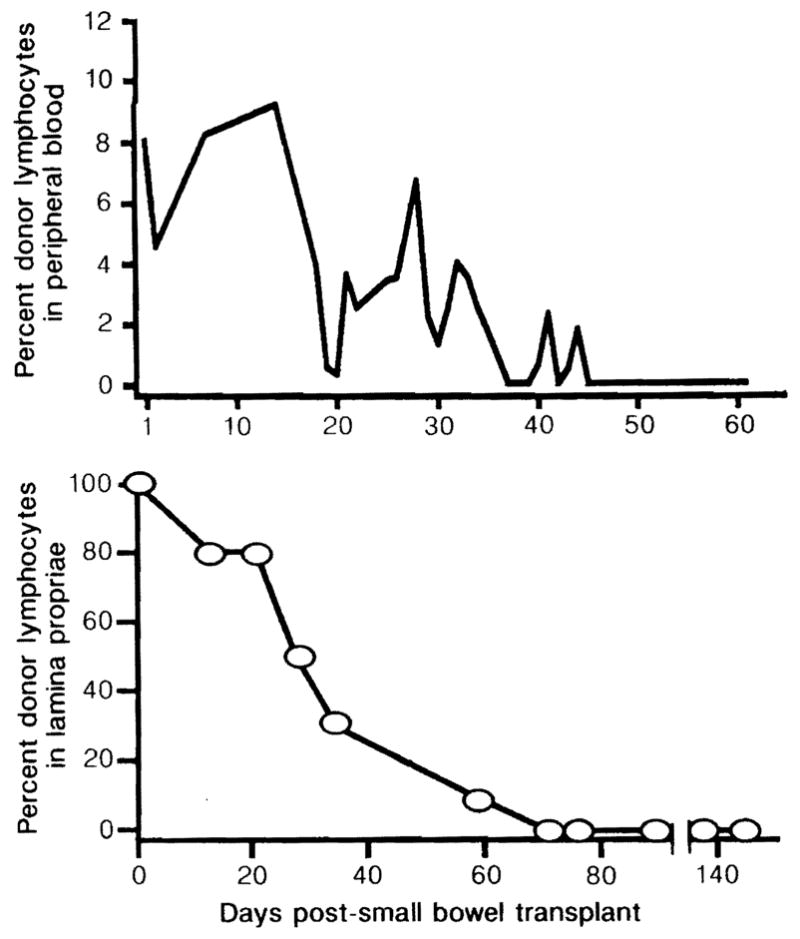
The presence of recipient lymphocytes in grafts is thought to equate with rejection. Thus, we wished to follow the fate of lymphocytes after transplant of the small bowel. Three complete small-bowel transplants, two with the liver from the same donor also transplanted, were done successfully. Patients were immunosuppressed with FK 506. 5 to 11% of lymphocytes in the recipients' peripheral blood were of donor origin during the early postoperative period when there were no clinical signs of graft-versus-host disease. However, donor cells were no longer detectable after 12 to 54 days. Serial biopsy specimens of the grafted small bowel showed progressive replacement of lymphocytes in the lamina propria by those of the recipient's HLA phenotype. Lymphoid repopulation was complete after 10 to 12 weeks but the epithelial cells of the intestine remained those of the donor. The patients are on enteral alimentation after 5, 6, and 8 months with histopathologically normal or nearly normal intestines. Re-examination of assumptions about the rejection of intestinal grafts and strategies for its prevention are required following these observations.
移植物中存在受者淋巴细胞被认为等同于排斥反应。因此,我们希望追踪小肠移植后淋巴细胞的命运。成功进行了3例全小肠移植,其中2例还同时移植了来自同一供者的肝脏。患者接受FK 506免疫抑制治疗。术后早期,当没有移植物抗宿主病的临床症状时,受者外周血中5%至11%的淋巴细胞来自供者。然而,12至54天后就不再能检测到供者细胞。移植小肠的系列活检标本显示,固有层中的淋巴细胞逐渐被具有受者HLA表型的淋巴细胞所取代。10至12周后淋巴细胞再填充完成,但肠上皮细胞仍为供者的细胞。5、6和8个月后,患者接受肠内营养,肠道组织病理学检查正常或接近正常。基于这些观察结果,需要重新审视关于肠道移植物排斥反应的假设及其预防策略。