Kertész Sándor, Kerényi Zoltán, Mérai Zsuzsanna, Bartos Imre, Pálfy Tamás, Barta Endre, Silhavy Dániel
Agricultural Biotechnology Center, Gödöllo, Hungary.
Nucleic Acids Res. 2006;34(21):6147-57. doi: 10.1093/nar/gkl737. Epub 2006 Nov 6.
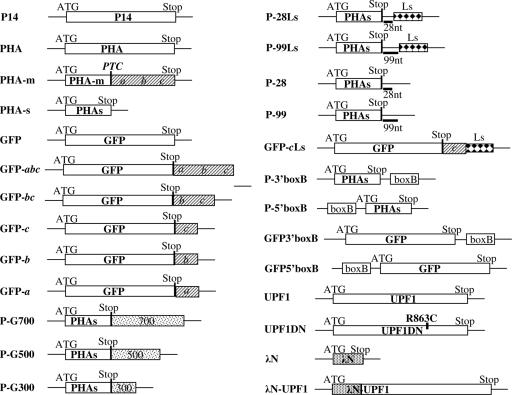
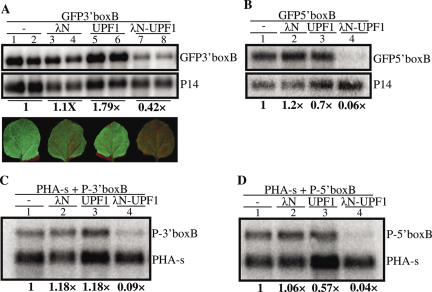
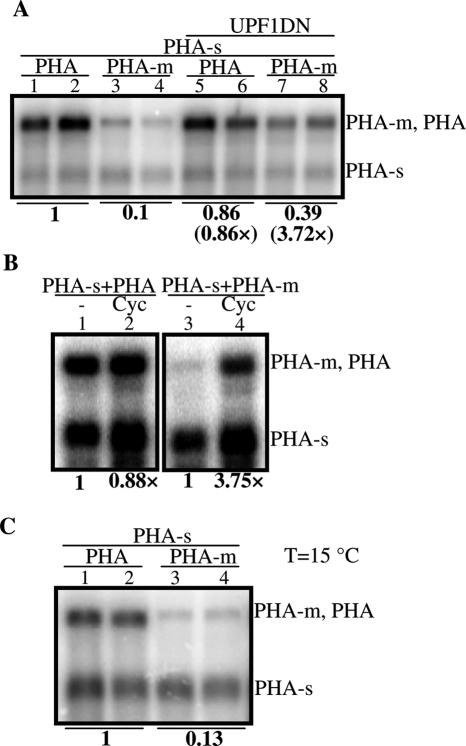
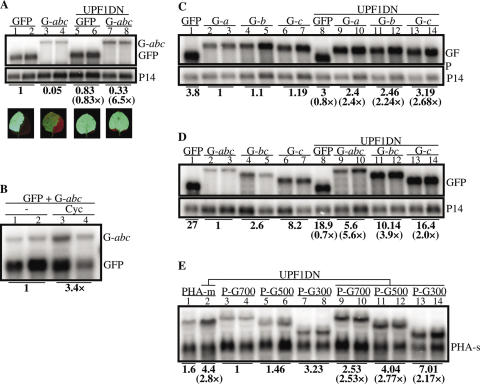
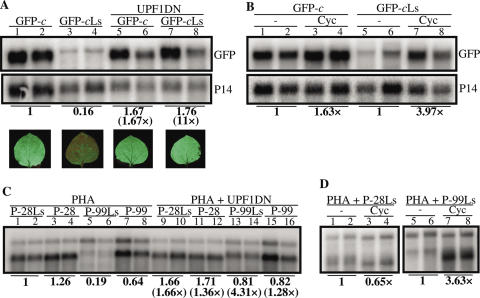
Nonsense-mediated mRNA decay (NMD) is a eukaryotic quality control mechanism that identifies and eliminates aberrant mRNAs containing a premature termination codon (PTC). Although, key trans-acting NMD factors, UPF1, UPF2 and UPF3 are conserved in yeast and mammals, the cis-acting NMD elements are different. In yeast, short specific sequences or long 3'-untranslated regions (3'-UTRs) render an mRNA subject to NMD, while in mammals' 3'-UTR located introns trigger NMD. Plants also possess an NMD system, although little is known about how it functions. We have elaborated an agroinfiltration-based transient NMD assay system and defined the cis-acting elements that mediate plant NMD. We show that unusually long 3'-UTRs or the presence of introns in the 3'-UTR can subject mRNAs to NMD. These data suggest that both long 3'-UTR-based and intron-based PTC definition operated in the common ancestors of extant eukaryotes (stem eukaryotes) and support the theory that intron-based NMD facilitated the spreading of introns in stem eukaryotes. We have also identified plant UPF1 and showed that tethering of UPF1 to either the 5'- or 3'-UTR of an mRNA results in reduced transcript accumulation. Thus, plant UPF1 might bind to mRNA in a late, irreversible phase of NMD.
无义介导的mRNA降解(NMD)是一种真核生物质量控制机制,可识别并消除含有提前终止密码子(PTC)的异常mRNA。尽管关键的反式作用NMD因子UPF1、UPF2和UPF3在酵母和哺乳动物中是保守的,但顺式作用NMD元件却有所不同。在酵母中,短的特定序列或长的3'非翻译区(3'-UTR)会使mRNA受到NMD作用,而在哺乳动物中,位于3'-UTR的内含子会触发NMD。植物也拥有一个NMD系统,尽管对其功能了解甚少。我们构建了一种基于农杆菌浸润的瞬时NMD检测系统,并确定了介导植物NMD的顺式作用元件。我们发现,异常长的3'-UTR或3'-UTR中内含子的存在会使mRNA受到NMD作用。这些数据表明,基于长3'-UTR和顺式作用元件的PTC定义在现存真核生物(主干真核生物)的共同祖先中起作用,并支持基于内含子的NMD促进了内含子在主干真核生物中传播的理论。我们还鉴定了植物UPF1,并表明将UPF1与mRNA的5'-或3'-UTR连接会导致转录本积累减少。因此,植物UPF1可能在NMD的后期不可逆阶段与mRNA结合。