Mharakurwa Sungano, Simoloka Christopher, Thuma Philip E, Shiff Clive J, Sullivan David J
The Malaria Institute at Macha, P.O. Box 630166, Choma, Zambia.
Malar J. 2006 Nov 8;5:103. doi: 10.1186/1475-2875-5-103.
Current detection or screening for malaria infection necessitates drawing blood by fingerprick or venipuncture, which poses risks and limitations for repeated measurement. This study presents PCR detection of Plasmodium falciparum in human urine and saliva samples, and illustrates this potential application in genotyping malaria infections.
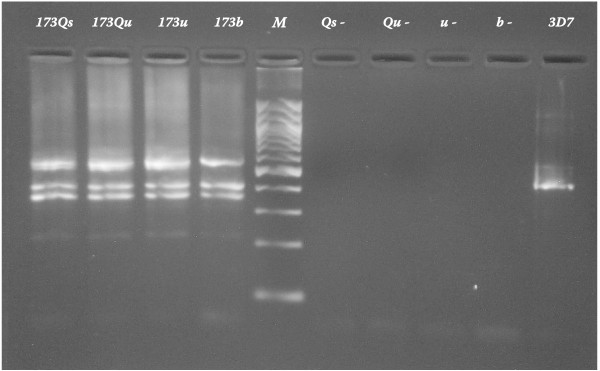
Urine and saliva were obtained from 47 thick film positive and 4 negative individuals one day after collection of blood slides and filter paper blood spots. P. falciparum DNA was extracted from blood, urine and saliva, in separate groups, using the Chelex method or Qiagen DNEasy kit (urine and saliva only). Blood, urine and saliva extracts were subjected to PCR in separate batches. Amplicons from the various sample types were examined for MSP2 polymorphisms and restriction fragment patterns on DHFR amino acid codon 59.
Malaria infections exhibited primarily low-grade parasite densities, with a geometric mean of 775 asexual parasites/mul. Regularly matching polymorphic MSP2 genotypes were found between the corresponding urine, saliva and peripheral blood amplicons of each individual, with different inter-individual polymorphic genotypes. Amplicon yields were significantly dependent on DNA extraction method, parasite density and primer set (p < 0.001). A Qiagen kit extraction had more than 2x higher amplicon yield than the Chelex method, for both urine and saliva. Amplicon yields were 1.6 fold higher from saliva than urine. For each unit increase in log parasite density, the probability of amplicon enhanced 1.8 fold. Highest amplicon yields were obtained from the primer set with the shortest PCR product.
P. falciparum infection is detectable by PCR on human urine and saliva samples. Subject to further refinement of extraction technique and amplicon yields, large-scale malaria parasite screening and epidemiological surveys could be possible without the need to collect blood and use of needles or sharps.
目前检测或筛查疟疾感染需要通过手指采血或静脉穿刺采血,这对重复检测存在风险和局限性。本研究展示了在人类尿液和唾液样本中进行恶性疟原虫的PCR检测,并阐述了这种潜在应用在疟疾感染基因分型中的作用。
在采集血涂片和滤纸血斑一天后,从47名厚血膜阳性个体和4名阴性个体中获取尿液和唾液。使用Chelex法或Qiagen DNEasy试剂盒(仅用于尿液和唾液),分别从血液、尿液和唾液中提取恶性疟原虫DNA。血液、尿液和唾液提取物分别进行PCR检测。对来自不同样本类型的扩增子进行MSP2多态性和二氢叶酸还原酶(DHFR)氨基酸密码子59的限制性片段模式检测。
疟疾感染主要表现为低水平的寄生虫密度,无性寄生虫的几何平均数为775个/μl。在每个个体相应的尿液、唾液和外周血扩增子之间发现了经常匹配的多态性MSP2基因型,个体间的多态性基因型不同。扩增子产量显著依赖于DNA提取方法、寄生虫密度和引物组(p < 0.001)。对于尿液和唾液,使用Qiagen试剂盒提取的扩增子产量比Chelex法高出2倍以上。唾液中的扩增子产量比尿液高1.6倍。寄生虫密度对数每增加一个单位,扩增子产生的概率增加1.8倍。使用PCR产物最短的引物组获得的扩增子产量最高。
通过对人类尿液和唾液样本进行PCR检测可检测到恶性疟原虫感染。在提取技术和扩增子产量进一步优化的情况下,无需采血和使用针头或锐器就有可能进行大规模疟疾寄生虫筛查和流行病学调查。