Heo Won Do, Inoue Takanari, Park Wei Sun, Kim Man Lyang, Park Byung Ouk, Wandless Thomas J, Meyer Tobias
Department of Molecular Pharmacology, 318 Campus Drive, Clark Building, Stanford University Medical School, Stanford, CA 94305, USA.
Science. 2006 Dec 1;314(5804):1458-61. doi: 10.1126/science.1134389. Epub 2006 Nov 9.
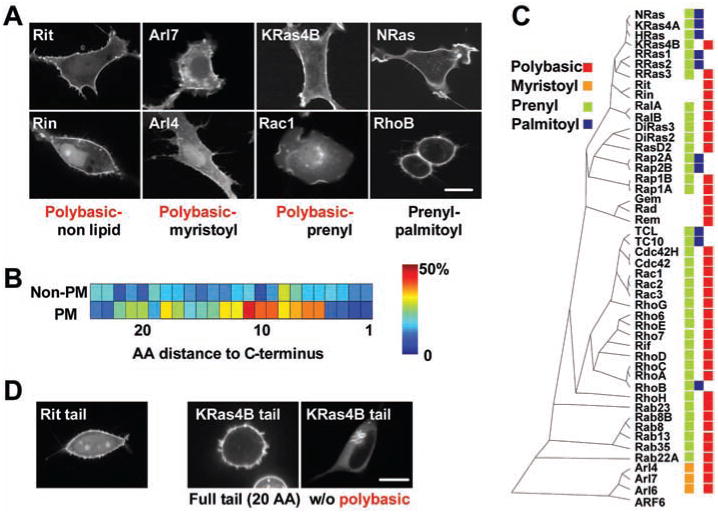
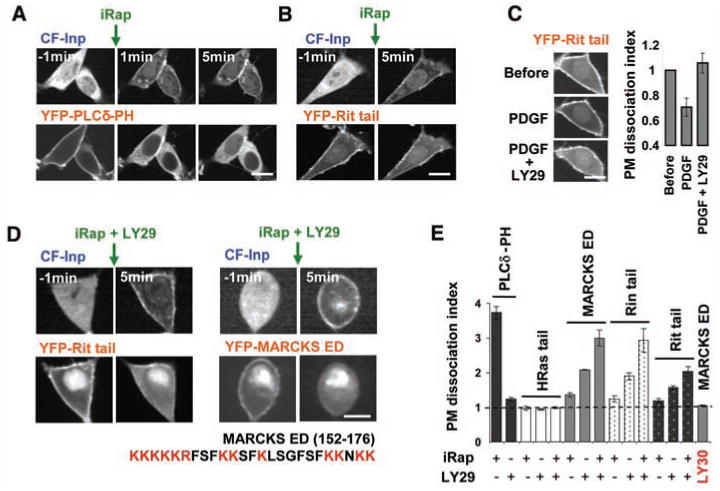
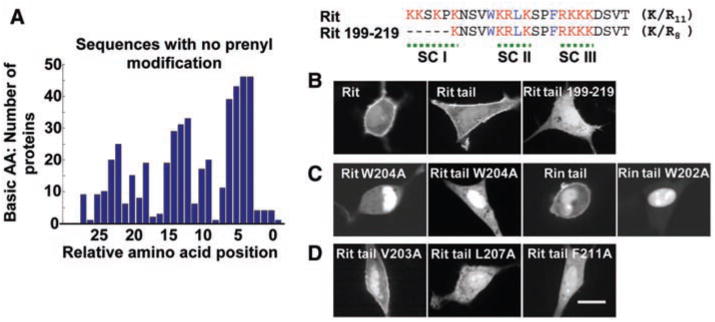
Many signaling, cytoskeletal, and transport proteins have to be localized to the plasma membrane (PM) in order to carry out their function. We surveyed PM-targeting mechanisms by imaging the subcellular localization of 125 fluorescent protein-conjugated Ras, Rab, Arf, and Rho proteins. Out of 48 proteins that were PM-localized, 37 contained clusters of positively charged amino acids. To test whether these polybasic clusters bind negatively charged phosphatidylinositol 4,5-bisphosphate [PI(4,5)P2] lipids, we developed a chemical phosphatase activation method to deplete PM PI(4,5)P2. Unexpectedly, proteins with polybasic clusters dissociated from the PM only when both PI(4,5)P2 and phosphatidylinositol 3,4,5-trisphosphate [PI(3,4,5)P3] were depleted, arguing that both lipid second messengers jointly regulate PM targeting.
许多信号转导、细胞骨架和转运蛋白必须定位于质膜(PM)才能发挥其功能。我们通过对125种荧光蛋白偶联的Ras、Rab、Arf和Rho蛋白的亚细胞定位进行成像,研究了质膜靶向机制。在48种定位于质膜的蛋白中,有37种含有带正电荷的氨基酸簇。为了测试这些多碱性簇是否结合带负电荷的磷脂酰肌醇4,5-二磷酸[PI(4,5)P2]脂质,我们开发了一种化学磷酸酶激活方法来耗尽质膜PI(4,5)P2。出乎意料的是,只有当PI(4,5)P2和磷脂酰肌醇3,4,5-三磷酸[PI(3,4,5)P3]都被耗尽时,带有多碱性簇的蛋白才会从质膜上解离,这表明这两种脂质第二信使共同调节质膜靶向。