Waller J, Marlow L A V, Wardle J
Cancer Research UK Health Behaviour Unit, Department of Epidemiology and Public Health, University College London, 2-16 Torrington Place, London WC1E 6BT, UK.
Sex Transm Infect. 2007 Apr;83(2):155-9. doi: 10.1136/sti.2006.023333. Epub 2006 Nov 10.
To test the hypotheses that (1) women who know that human papillomavirus (HPV) is sexually transmitted will expect to experience higher levels of stigma, shame and anxiety if they test positive for the virus than women who are not aware of the mode of transmission and (2) women who are aware of the high prevalence of HPV infection will expect to experience lower levels of stigma, shame and anxiety than women who underestimate its prevalence.
A web-based survey in which information about HPV was manipulated to generate a 2 x 2 design (awareness that HPV is sexually transmitted v no awareness; awareness of the high prevalence of HPV v no awareness). Participants (n = 811) were female students. They were asked to imagine that they had tested positive for HPV. Outcome measures were expected stigma, shame and anxiety.
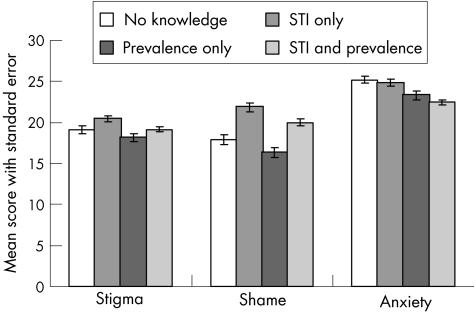
Great differences were observed in emotional reactions to imagining testing HPV positive between the four groups based on knowledge of HPV. Knowledge of the prevalence was associated with lower levels of stigma, shame and anxiety. Knowledge that HPV is sexually transmitted was associated with higher levels of stigma and shame, but not anxiety. Women who knew that HPV is sexually transmitted but not that it is highly prevalent had the highest scores for stigma and shame.
Raising public awareness of the sexually transmitted nature of HPV has the potential to increase women's feelings of stigma and shame if they test positive for the virus. However, our findings suggest that ensuring women's awareness of HPV being common may reduce these feelings and also reduce anxiety, perhaps by "normalising" the infection.
检验以下假设:(1)知晓人乳头瘤病毒(HPV)通过性传播的女性,若检测出病毒呈阳性,相较于不知传播方式的女性,预期会经历更高水平的污名化、羞耻感和焦虑;(2)知晓HPV感染高流行率的女性,相较于低估其流行率的女性,预期会经历更低水平的污名化、羞耻感和焦虑。
一项基于网络的调查,其中关于HPV的信息被操控以产生2×2设计(知晓HPV通过性传播与否;知晓HPV高流行率与否)。参与者(n = 811)为女学生。她们被要求想象自己HPV检测呈阳性。结果测量指标为预期的污名化、羞耻感和焦虑。
基于对HPV的了解,四组在想象HPV检测呈阳性时的情绪反应上观察到巨大差异。对流行率的了解与较低水平的污名化、羞耻感和焦虑相关。知晓HPV通过性传播与较高水平的污名化和羞耻感相关,但与焦虑无关。知晓HPV通过性传播但不知其高流行率的女性在污名化和羞耻感方面得分最高。
提高公众对HPV性传播性质的认识,如果女性检测出病毒呈阳性,有可能增加她们的污名化和羞耻感。然而,我们的研究结果表明,确保女性知晓HPV常见可能会减少这些感受,也可能会减少焦虑,或许是通过使感染“正常化”。