Ochaion Avivit, Bar-Yehuda Sara, Cohn Shira, Del Valle Luis, Perez-Liz Georginia, Madi Lea, Barer Faina, Farbstein Motti, Fishman-Furman Sari, Reitblat Tatiana, Reitblat Alexander, Amital Howard, Levi Yair, Molad Yair, Mader Reuven, Tishler Moshe, Langevitz Pnina, Zabutti Alexander, Fishman Pnina
Can-Fite Biopharma Ltd, 10 Bareket Street, Kiryat-Matalon, Petah-Tikva, 49170, Israel.
Arthritis Res Ther. 2006;8(6):R169. doi: 10.1186/ar2078.
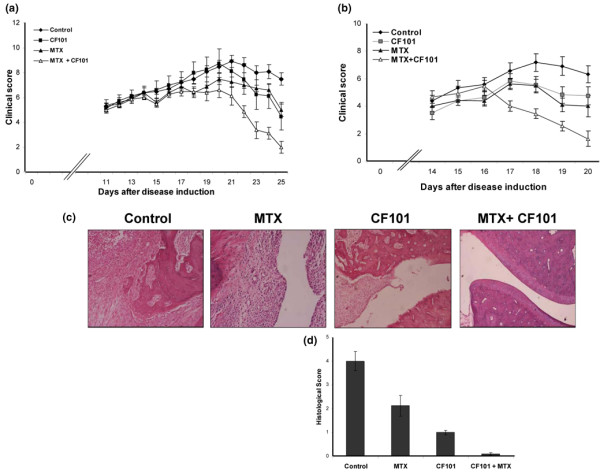
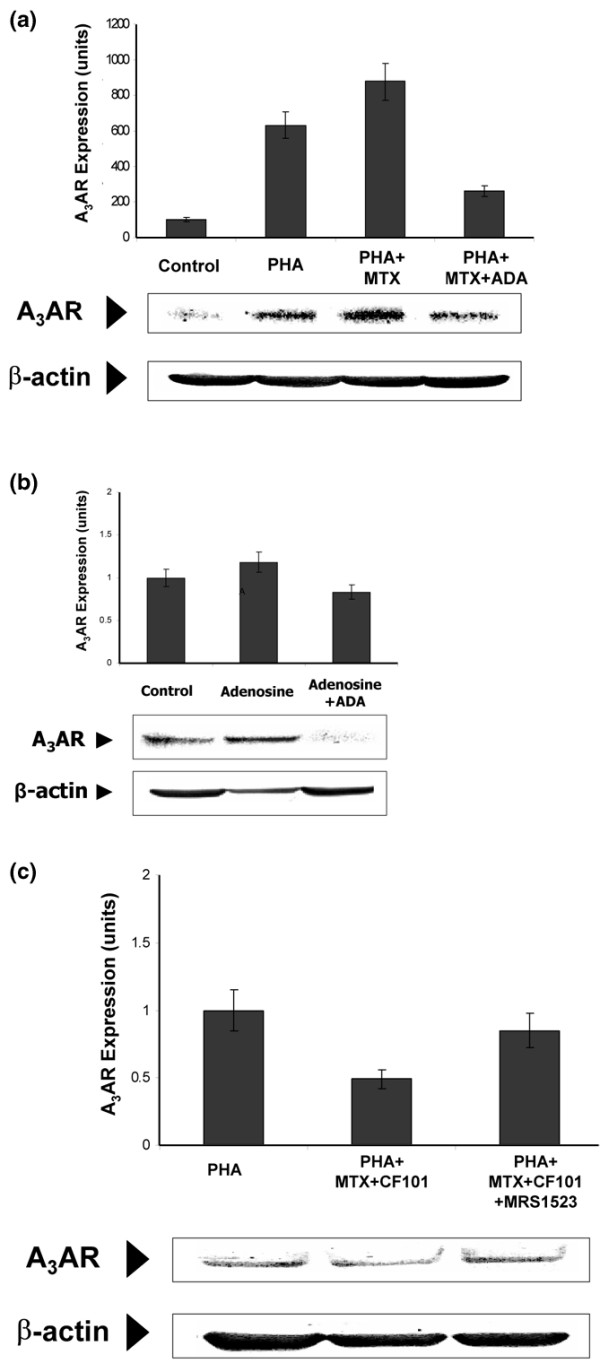
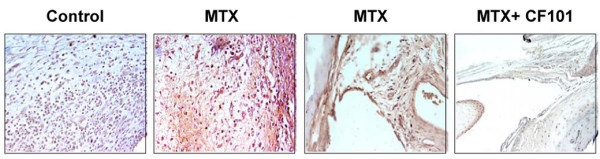
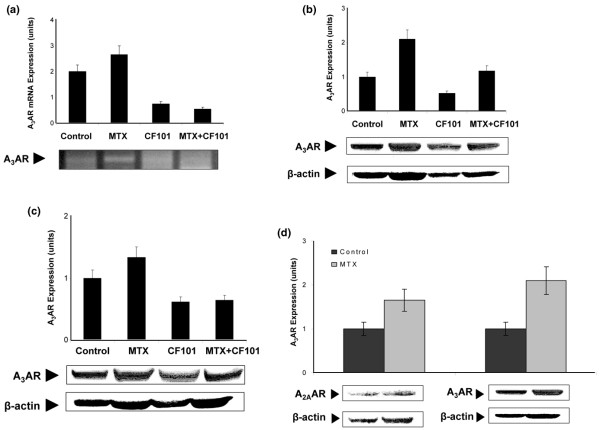
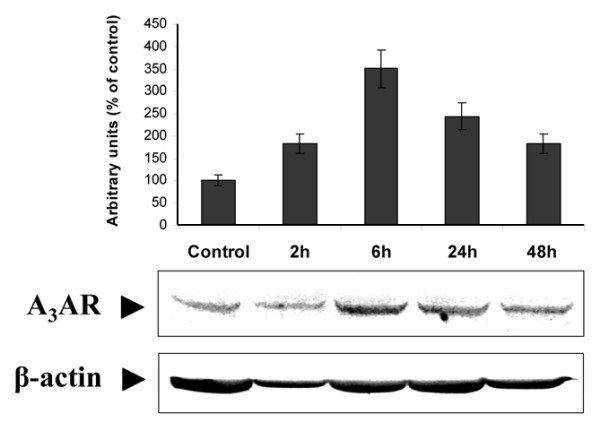
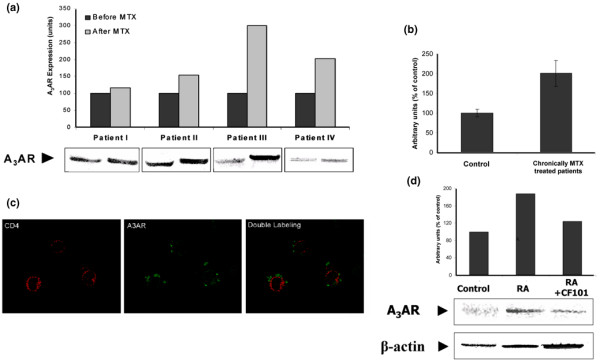
Methotrexate (MTX) exerts an anti-inflammatory effect via its metabolite adenosine, which activates adenosine receptors. The A3 adenosine receptor (A3AR) was found to be highly expressed in inflammatory tissues and peripheral blood mononuclear cells (PBMCs) of rats with adjuvant-induced arthritis (AIA). CF101 (IB-MECA), an A3AR agonist, was previously found to inhibit the clinical and pathological manifestations of AIA. The aim of the present study was to examine the effect of MTX on A3AR expression level and the efficacy of combined treatment with CF101 and MTX in AIA rats. AIA rats were treated with MTX, CF101, or both agents combined. A3AR mRNA, protein expression and exhibition were tested in paw and PBMC extracts from AIA rats utilizing immunohistochemistry staining, RT-PCR and Western blot analysis. A3AR level was tested in PBMC extracts from patients chronically treated with MTX and healthy individuals. The effect of CF101, MTX and combined treatment on A3AR expression level was also tested in PHA-stimulated PBMCs from healthy individuals and from MTX-treated patients with rheumatoid arthritis (RA). Combined treatment with CF101 and MTX resulted in an additive anti-inflammatory effect in AIA rats. MTX induced A2AAR and A3AR over-expression in paw cells from treated animals. Moreover, increased A3AR expression level was detected in PBMCs from MTX-treated RA patients compared with cells from healthy individuals. MTX also increased the protein expression level of PHA-stimulated PBMCs from healthy individuals. The increase in A3AR level was counteracted in vitro by adenosine deaminase and mimicked in vivo by dipyridamole, demonstrating that receptor over-expression was mediated by adenosine. In conclusion, the data presented here indicate that MTX induces increased A3AR expression and exhibition, thereby potentiating the inhibitory effect of CF101 and supporting combined use of these drugs to treat RA.
甲氨蝶呤(MTX)通过其代谢产物腺苷发挥抗炎作用,腺苷可激活腺苷受体。研究发现,在佐剂性关节炎(AIA)大鼠的炎症组织和外周血单核细胞(PBMC)中,A3腺苷受体(A3AR)高度表达。A3AR激动剂CF101(IB - MECA)此前被发现可抑制AIA的临床和病理表现。本研究旨在探讨MTX对A3AR表达水平的影响,以及CF101与MTX联合治疗对AIA大鼠的疗效。对AIA大鼠分别给予MTX、CF101或两者联合治疗。利用免疫组化染色、RT - PCR和蛋白质印迹分析,检测AIA大鼠爪组织和PBMC提取物中的A3AR mRNA、蛋白质表达及展示情况。检测长期接受MTX治疗的患者和健康个体的PBMC提取物中的A3AR水平。还在健康个体和接受MTX治疗的类风湿关节炎(RA)患者经PHA刺激的PBMC中,检测CF101、MTX及联合治疗对A3AR表达水平的影响。CF101与MTX联合治疗在AIA大鼠中产生了相加的抗炎作用。MTX诱导治疗动物爪细胞中A2AAR和A3AR过表达。此外,与健康个体的细胞相比,在接受MTX治疗的RA患者的PBMC中检测到A3AR表达水平升高。MTX还增加了健康个体经PHA刺激的PBMC的蛋白质表达水平。腺苷脱氨酶在体外可抵消A3AR水平的升高,双嘧达莫在体内可模拟这种升高,表明受体过表达由腺苷介导。总之,此处呈现的数据表明,MTX诱导A3AR表达和展示增加,从而增强CF101的抑制作用,并支持联合使用这些药物治疗RA。