Weinstein James N, Lurie Jon D, Tosteson Tor D, Skinner Jonathan S, Hanscom Brett, Tosteson Anna N A, Herkowitz Harry, Fischgrund Jeffrey, Cammisa Frank P, Albert Todd, Deyo Richard A
Dartmouth Medical School, Hanover, NH, USA.
JAMA. 2006 Nov 22;296(20):2451-9. doi: 10.1001/jama.296.20.2451.
For patients with lumbar disk herniation, the Spine Patient Outcomes Research Trial (SPORT) randomized trial intent-to-treat analysis showed small but not statistically significant differences in favor of diskectomy compared with usual care. However, the large numbers of patients who crossed over between assigned groups precluded any conclusions about the comparative effectiveness of operative therapy vs usual care.
To compare the treatment effects of diskectomy and usual care.
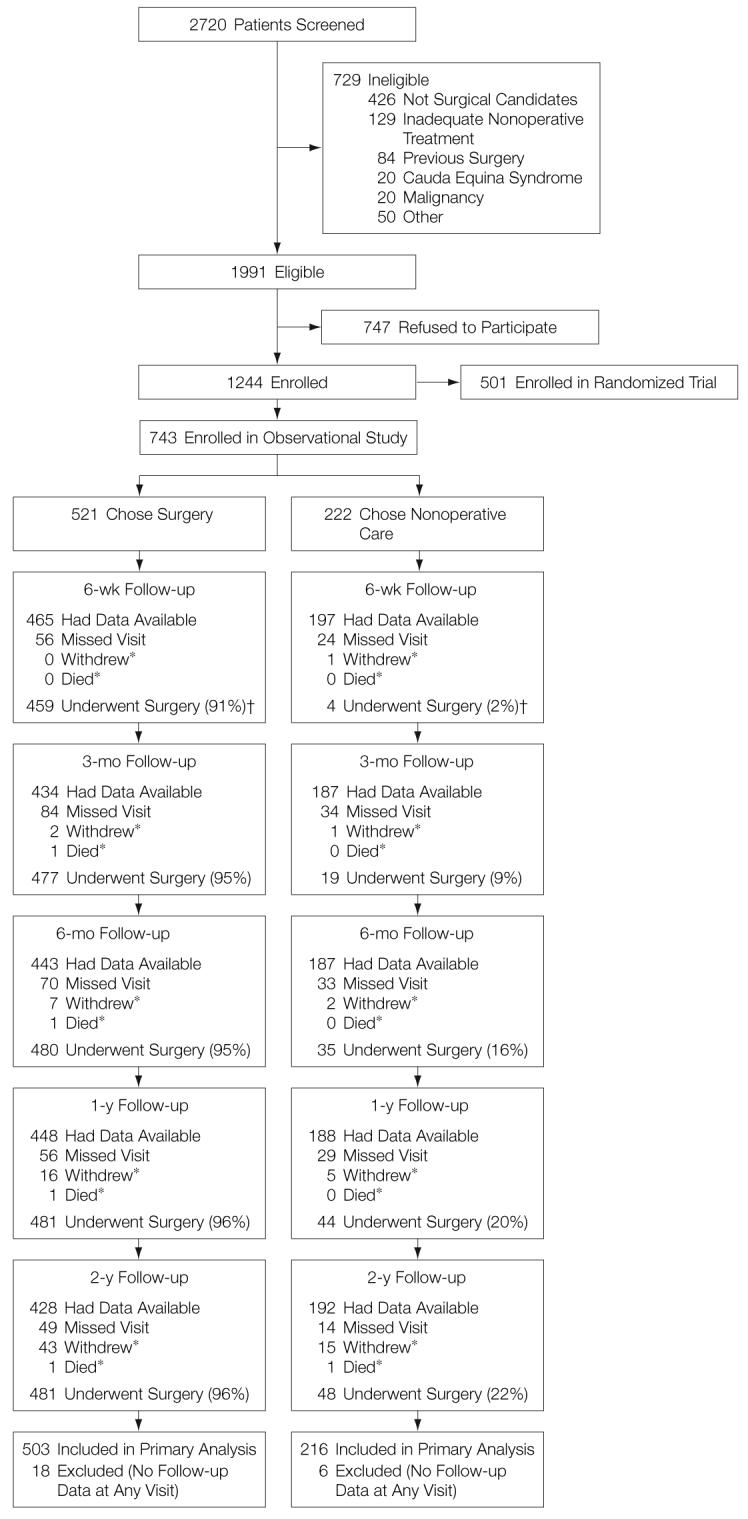
DESIGN, SETTING, AND PATIENTS: Prospective observational cohort of surgical candidates with imaging-confirmed lumbar intervertebral disk herniation who were treated at 13 spine clinics in 11 US states and who met the SPORT eligibility criteria but declined randomization between March 2000 and March 2003.
Standard open diskectomy vs usual nonoperative care.
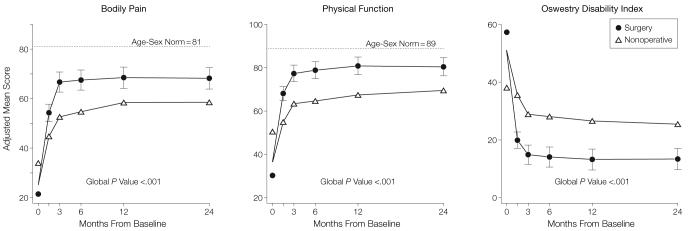
Changes from baseline in the Medical Outcomes Study Short-Form Health Survey (SF-36) bodily pain and physical function scales and the modified Oswestry Disability Index (American Academy of Orthopaedic Surgeons/MODEMS version).
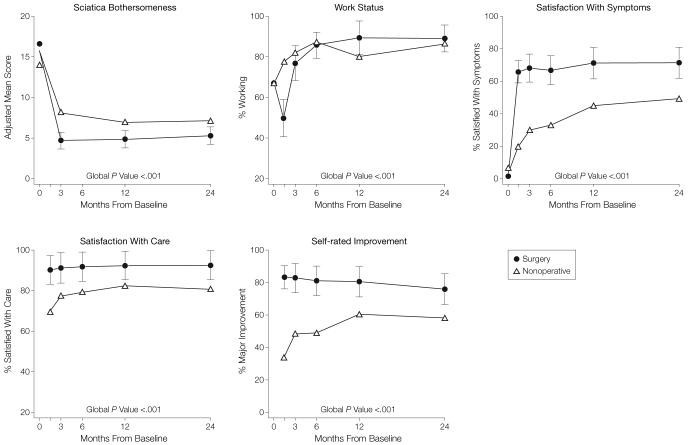
Of the 743 patients enrolled in the observational cohort, 528 patients received surgery and 191 received usual nonoperative care. At 3 months, patients who chose surgery had greater improvement in the primary outcome measures of bodily pain (mean change: surgery, 40.9 vs nonoperative care, 26.0; treatment effect, 14.8; 95% confidence interval, 10.8-18.9), physical function (mean change: surgery, 40.7 vs nonoperative care, 25.3; treatment effect, 15.4; 95% CI, 11.6-19.2), and Oswestry Disability Index (mean change: surgery, -36.1 vs nonoperative care, -20.9; treatment effect, -15.2; 95% CI, -18.5. to -11.8). These differences narrowed somewhat at 2 years: bodily pain (mean change: surgery, 42.6 vs nonoperative care, 32.4; treatment effect, 10.2; 95% CI, 5.9-14.5), physical function (mean change: surgery, 43.9 vs nonoperavtive care 31.9; treatment effect, 12.0; 95% CI; 7.9-16.1), and Oswestry Disability Index (mean change: surgery -37.6 vs nonoperative care -24.2; treatment effect, -13.4; 95% CI, -17.0 to -9.7).
Patients with persistent sciatica from lumbar disk herniation improved in both operated and usual care groups. Those who chose operative intervention reported greater improvements than patients who elected nonoperative care. However, nonrandomized comparisons of self-reported outcomes are subject to potential confounding and must be interpreted cautiously.
clinicaltrials.gov Identifier: NCT00000410.
对于腰椎间盘突出症患者,脊柱患者预后研究试验(SPORT)的随机试验意向性分析显示,与常规治疗相比,椎间盘切除术有微小但无统计学意义的优势。然而,大量在指定组间交叉的患者使得无法得出手术治疗与常规治疗比较有效性的任何结论。
比较椎间盘切除术和常规治疗的治疗效果。
设计、设置和患者:对影像学确诊为腰椎间盘突出症的手术候选者进行前瞻性观察队列研究,这些患者在美国11个州的13家脊柱诊所接受治疗,且符合SPORT纳入标准,但在2000年3月至2003年3月期间拒绝随机分组。
标准开放性椎间盘切除术与常规非手术治疗。
医学结局研究简明健康调查(SF - 36)身体疼痛和身体功能量表以及改良的奥斯维斯特残疾指数(美国矫形外科医师学会/MODEMS版本)相对于基线的变化。
在观察队列纳入的743例患者中,528例接受了手术,191例接受了常规非手术治疗。在3个月时,选择手术的患者在身体疼痛(平均变化:手术组40.9,非手术治疗组26.0;治疗效果14.8;95%置信区间,10.8 - 18.9)、身体功能(平均变化:手术组40.7,非手术治疗组25.3;治疗效果15.4;95%CI,11.6 - 19.2)和奥斯维斯特残疾指数(平均变化:手术组 - 36.1,非手术治疗组 - 20.9;治疗效果, - 15.2;95%CI, - 18.5至 - 11.8)等主要结局指标上有更大改善。这些差异在2年时有所缩小:身体疼痛(平均变化:手术组42.6,非手术治疗组32.4;治疗效果10.2;95%CI,5.9 - 14.5)、身体功能(平均变化:手术组