Gupta Rigu, Sharma Sudha, Doherty Kevin M, Sommers Joshua A, Cantor Sharon B, Brosh Robert M
Laboratory of Molecular Gerontology, National Institute on Aging, NIH, 5600 Nathan Shock Drive, Baltimore, MD 21224, USA.
Nucleic Acids Res. 2006;34(22):6673-83. doi: 10.1093/nar/gkl964. Epub 2006 Dec 1.
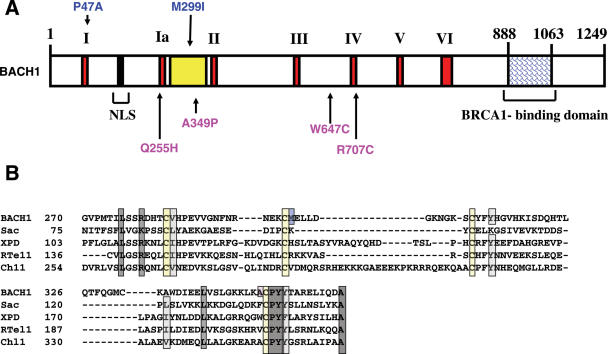
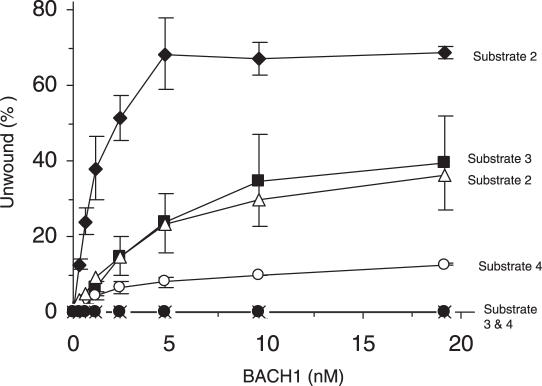
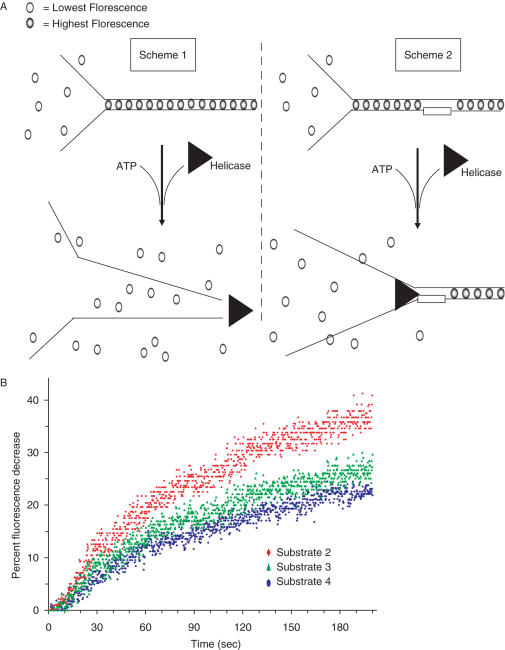
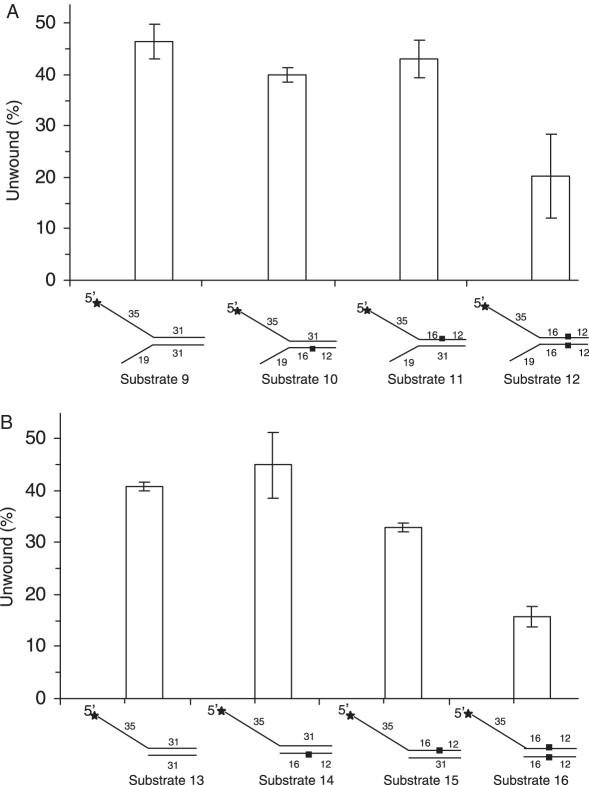
The BRCA1 associated C-terminal helicase (BACH1) associated with breast cancer has been implicated in double strand break (DSB) repair. More recently, BACH1 (FANCJ) has been genetically linked to the chromosomal instability disorder Fanconi Anemia (FA). Understanding the roles of BACH1 in cellular DNA metabolism and how BACH1 dysfunction leads to tumorigenesis requires a comprehensive investigation of its catalytic mechanism and molecular functions in DNA repair. In this study, we have determined that BACH1 helicase contacts with both the translocating and the non-translocating strands of the duplex are critical for its ability to track along the sugar phosphate backbone and unwind dsDNA. An increased motor ATPase of a BACH1 helicase domain variant (M299I) enabled the helicase to unwind the backbone-modified DNA substrate in a more proficient manner. Alternatively, increasing the length of the 5' tail of the DNA substrate allowed BACH1 to overcome the backbone discontinuity, suggesting that BACH1 loading mechanism is critical for its ability to unwind damaged DNA molecules.
与乳腺癌相关的BRCA1关联C端解旋酶(BACH1)参与双链断裂(DSB)修复。最近,BACH1(FANCJ)在基因上与染色体不稳定疾病范可尼贫血(FA)相关联。了解BACH1在细胞DNA代谢中的作用以及BACH1功能障碍如何导致肿瘤发生,需要对其在DNA修复中的催化机制和分子功能进行全面研究。在本研究中,我们确定BACH1解旋酶与双链的易位链和非易位链的接触对于其沿着糖磷酸骨架追踪并解开双链DNA的能力至关重要。BACH1解旋酶结构域变体(M299I)的运动ATP酶增加,使解旋酶能够更有效地解开骨架修饰的DNA底物。或者,增加DNA底物5'尾的长度使BACH1能够克服骨架的不连续性,这表明BACH1加载机制对其解开受损DNA分子的能力至关重要。