Weller P F, Rand T H, Goelz S E, Chi-Rosso G, Lobb R R
Department of Medicine, Charles A. Dana Research Institute, Beth Israel Hospital, Harvard Medical School, Boston, MA 02215.
Proc Natl Acad Sci U S A. 1991 Aug 15;88(16):7430-3. doi: 10.1073/pnas.88.16.7430.
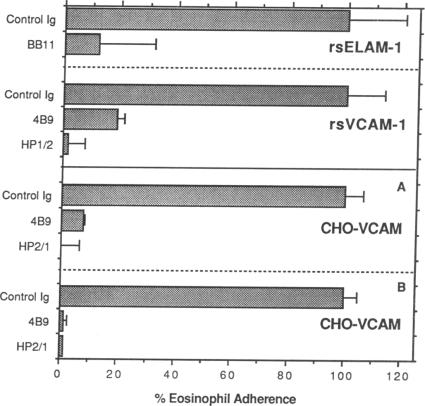
Adherence of human eosinophils to cytokine-stimulated endothelial cells, which was only partially due to CD18-dependent pathways, was also mediated by binding to endothelial leukocyte adhesion molecule 1 (ELAM-1) and vascular cell adhesion molecule 1 (VCAM-1). Eosinophils bound specifically to both recombinant soluble ELAM-1 and recombinant soluble VCAM-1. Eosinophil binding to recombinant soluble VCAM-1 and to transfected CHO cells expressing VCAM-1 was inhibited with anti-VCAM-1 (4B9) and anti-very late activation antigen 4 (anti-VLA-4; HP1/2 or HP2/1) monoclonal antibodies. Eosinophils, but not neutrophils, expressed VLA-4 detected by cytofluorography. Eosinophil adherence to tumor necrosis factor alpha-stimulated human umbilical vein endothelial cells was partially blocked by monoclonal antibodies against ELAM-1 (BB11) and VCAM-1 (4B9) and against VLA-4 (HP2/1). Thus, while both eosinophils and neutrophils can bind to activated endothelial cells by adherence to ICAM-1 and ELAM-1, only eosinophils expressed VLA-4 and adhered to VCAM-1 on activated endothelial cells. Eosinophil adherence to VCAM-1 might provide a mechanism contributing to the selective recruitment of eosinophils into tissue sites of inflammation.
人类嗜酸性粒细胞与细胞因子刺激的内皮细胞的黏附,部分归因于CD18依赖性途径,同时也通过与内皮白细胞黏附分子1(ELAM-1)和血管细胞黏附分子1(VCAM-1)的结合介导。嗜酸性粒细胞与重组可溶性ELAM-1和重组可溶性VCAM-1均特异性结合。抗VCAM-1(4B9)和抗极晚期活化抗原4(抗VLA-4;HP1/2或HP2/1)单克隆抗体可抑制嗜酸性粒细胞与重组可溶性VCAM-1以及与表达VCAM-1的转染CHO细胞的结合。通过细胞荧光术检测发现,嗜酸性粒细胞而非中性粒细胞表达VLA-4。抗ELAM-1(BB11)、抗VCAM-1(4B9)和抗VLA-4(HP2/1)单克隆抗体可部分阻断嗜酸性粒细胞对肿瘤坏死因子α刺激的人脐静脉内皮细胞的黏附。因此,虽然嗜酸性粒细胞和中性粒细胞都可通过黏附ICAM-1和ELAM-1与活化的内皮细胞结合,但只有嗜酸性粒细胞表达VLA-4并黏附于活化内皮细胞上的VCAM-1。嗜酸性粒细胞对VCAM-1的黏附可能为嗜酸性粒细胞选择性募集到炎症组织部位提供一种机制。