Terai Yohey, Seehausen Ole, Sasaki Takeshi, Takahashi Kazuhiko, Mizoiri Shinji, Sugawara Tohru, Sato Tetsu, Watanabe Masakatsu, Konijnendijk Nellie, Mrosso Hillary D J, Tachida Hidenori, Imai Hiroo, Shichida Yoshinori, Okada Norihiro
Graduate School of Bioscience and Biotechnology, Tokyo Institute of Technology, Yokohama, Japan.
PLoS Biol. 2006 Dec;4(12):e433. doi: 10.1371/journal.pbio.0040433.
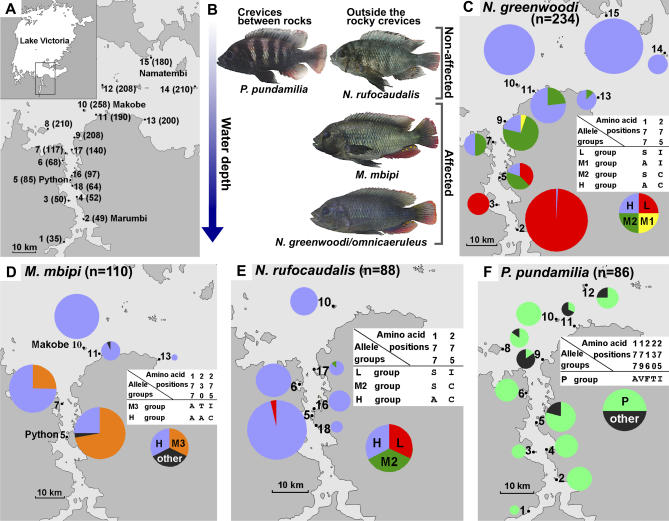
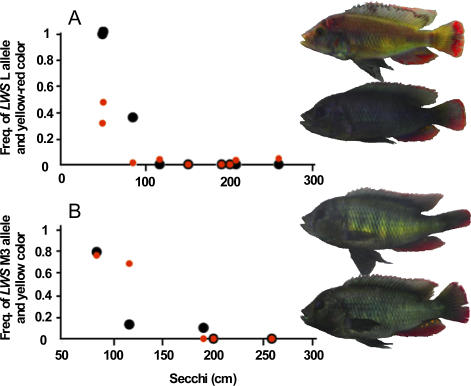
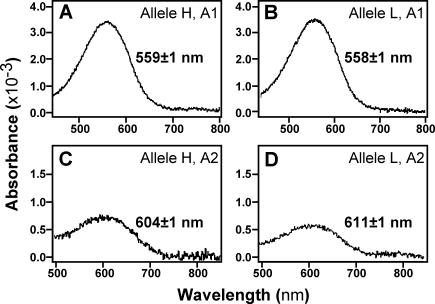
Divergent natural selection acting on ecological traits, which also affect mate choice, is a key element of ecological speciation theory, but has not previously been demonstrated at the molecular gene level to our knowledge. Here we demonstrate parallel evolution in two cichlid genera under strong divergent selection in a gene that affects both. Strong divergent natural selection fixed opsin proteins with different predicted light absorbance properties at opposite ends of an environmental gradient. By expressing them and measuring absorbance, we show that the reciprocal fixation adapts populations to divergent light environments. The divergent evolution of the visual system coincides with divergence in male breeding coloration, consistent with incipient ecological by-product speciation.
作用于生态性状(其也影响配偶选择)的趋异自然选择是生态物种形成理论的关键要素,但据我们所知,此前尚未在分子基因水平得到证实。在此,我们展示了在强烈趋异选择下,两个丽鱼属在一个影响两者的基因中发生了平行进化。强烈的趋异自然选择在环境梯度的两端固定了具有不同预测吸光特性的视蛋白。通过对它们进行表达并测量吸光度,我们表明这种相互固定使种群适应了不同的光照环境。视觉系统的趋异进化与雄性繁殖体色的差异相吻合,这与初始生态副产品物种形成一致。