Spearman M, Curtin H, Dusenbery D, Janecka I P, Reyna E L
Skull Base Surg. 1995;5(4):199-205. doi: 10.1055/s-2008-1058916.
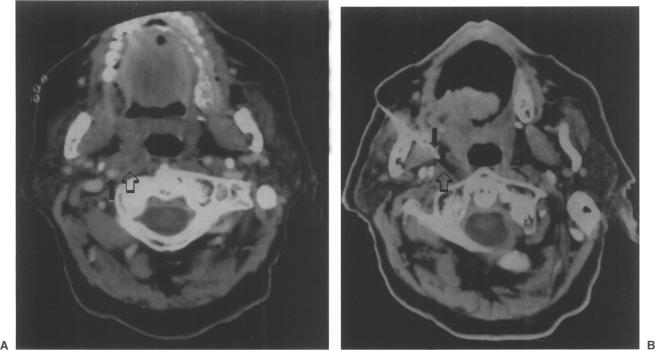
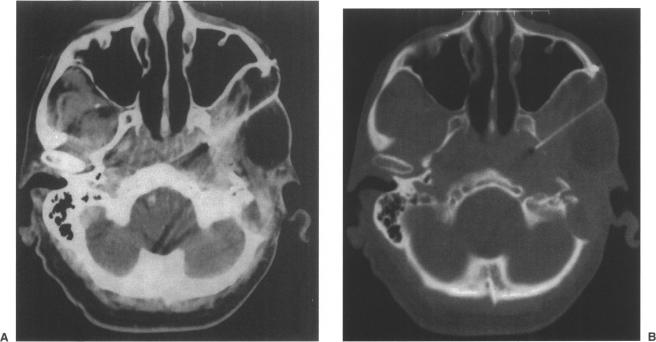
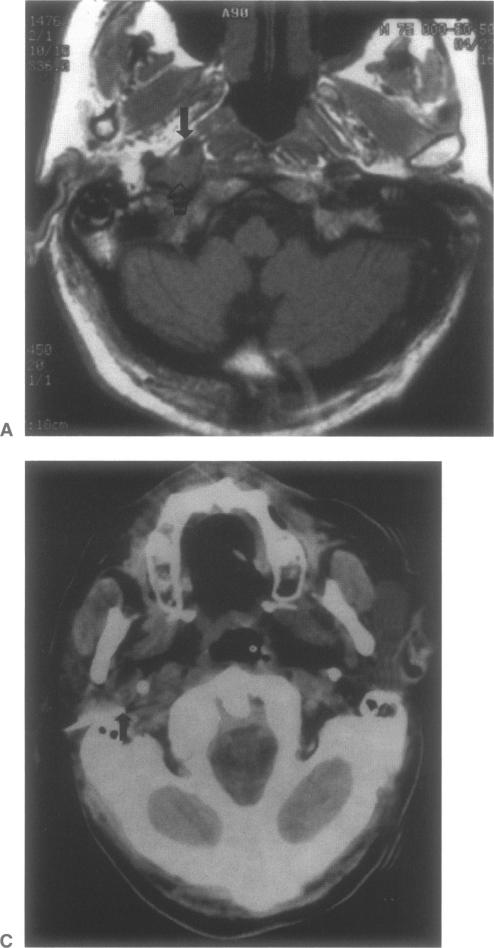
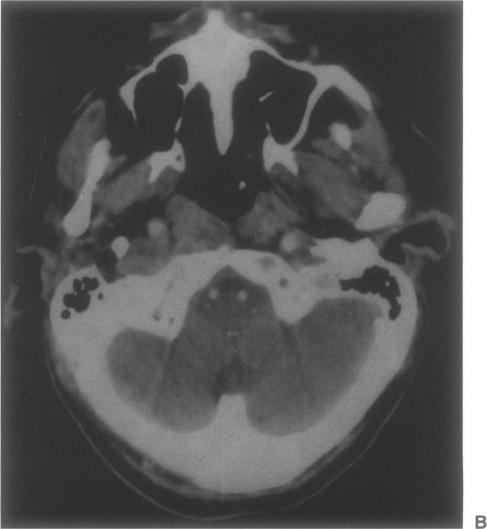
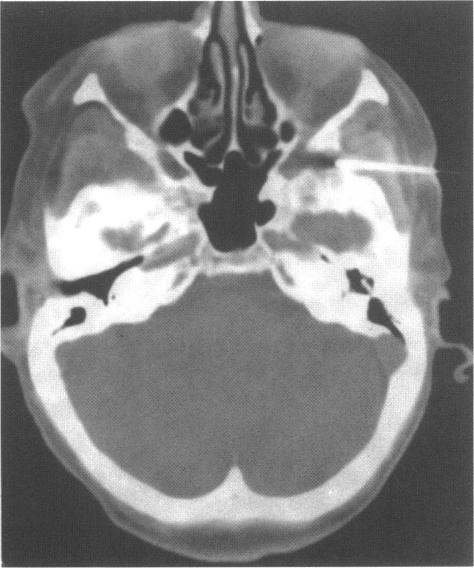
Suspicious findings in the parapharyngeal region on computed tomographic (CT) or magnetic resonance imaging studies can be a diagnostic problem. Blind biopsy through the mucosa can be inadequate, since the abnormality is not directly visible. With CT guidance, fine needle aspiration (FNA) of parapharyngeal masses can be performed with a needle confidently placed within the lesion. Vital structures such as the carotid artery are avoided. We present a series of 33 CT-guided FNA on 30 patients to evaluate the safety and the degree of accuracy of the procedure. Most of the patients had been treated previously for local malignancy. All patients had surgical pathologic study, autopsy, or clinical and imaging follow-up to confirm the FNA cytology results. Twenty of the 33 biopsies were positive for malignant cells, confirming recurrence of the primary head and neck malignancy. Of the 33 CT-directed FNA, 13 were negative for malignant cells. Three of these 13 were found to be false-negative FNA. None of the patients had complications from the procedure. CT directed FNA of masses at the skull base or in the parapharyngeal area can be performed safely. A high degree of accuracy is achieved, with 30 (90.9%) accurate in identifying the presence or absence of malignancy in our series.
计算机断层扫描(CT)或磁共振成像研究中发现的咽旁区域可疑结果可能是一个诊断难题。由于无法直接看到异常情况,通过黏膜进行盲目活检可能并不充分。在CT引导下,可以用针将其准确置于病变内,对咽旁肿块进行细针穿刺抽吸(FNA)。可避免诸如颈动脉等重要结构。我们对30例患者进行了一系列33次CT引导下的FNA,以评估该操作的安全性和准确性。大多数患者此前曾接受过局部恶性肿瘤治疗。所有患者均接受了手术病理研究、尸检或临床及影像学随访,以确认FNA细胞学结果。33次活检中有20次恶性细胞呈阳性,证实了原发性头颈恶性肿瘤的复发。在33次CT引导下的FNA中,有13次恶性细胞呈阴性。这13次中有3次被发现为FNA假阴性。所有患者均未出现该操作的并发症。可以安全地对颅底或咽旁区域的肿块进行CT引导下的FNA。在我们的系列研究中,其准确性很高,在识别有无恶性肿瘤方面有30次(90.9%)准确。