Yoshioka T, Feigenbaum L, Jay G
Laboratory of Virology, Jerome H. Holland Laboratory, American Red Cross, Rockville, Maryland 20855.
Mol Cell Biol. 1991 Nov;11(11):5479-86. doi: 10.1128/mcb.11.11.5479-5486.1991.
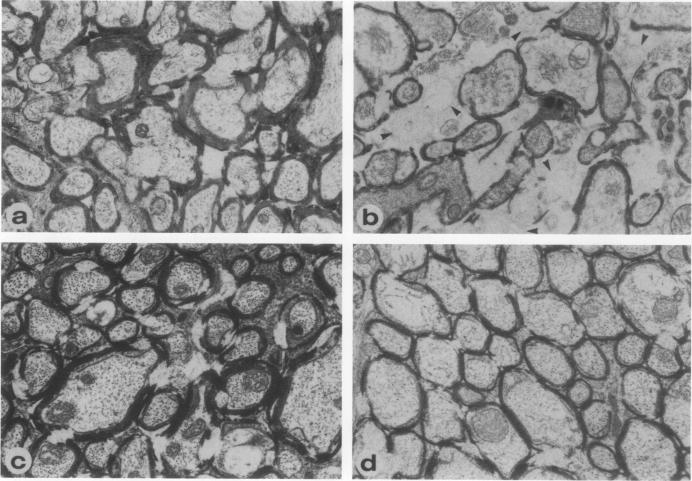
A common feature of demyelinating diseases such as multiple sclerosis in humans and experimental autoimmune encephalomyelitis in rodents is the marked elevation in the expression of the major histocompatibility complex (MHC) antigens in the involved sites. By specific targeting of a syngeneic MHC class I gene to oligodendrocytes, we have generated transgenic mice which not only exhibit severe involuntary tremors and develop tonic seizures but also show extensive demyelination in both the brain and the spinal cord. The fact that demyelination in these mice occurs in the absence of immune infiltration dismisses an autoimmune involvement but suggests that the MHC class I antigens play a direct role in inducing disease. Our findings lend support to the possibility that demyelinating diseases are induced by infectious agents such as viruses which can either directly activate MHC gene expression in oligodendroglia or indirectly activate expression through the release by reactive T cells of gamma interferon in the brain.
人类的脱髓鞘疾病(如多发性硬化症)和啮齿动物的实验性自身免疫性脑脊髓炎的一个共同特征是,受累部位主要组织相容性复合体(MHC)抗原的表达显著升高。通过将同基因MHC I类基因特异性靶向少突胶质细胞,我们培育出了转基因小鼠,这些小鼠不仅表现出严重的不自主震颤并出现强直性癫痫发作,而且在大脑和脊髓中都出现了广泛的脱髓鞘。这些小鼠在没有免疫浸润的情况下发生脱髓鞘,这排除了自身免疫的参与,但表明MHC I类抗原在诱发疾病中起直接作用。我们的研究结果支持了这样一种可能性,即脱髓鞘疾病是由病毒等感染因子诱发的,这些病毒要么直接激活少突胶质细胞中的MHC基因表达,要么通过反应性T细胞在大脑中释放γ干扰素间接激活表达。