Ali Ibne Karim M, Ehrenkaufer Gretchen M, Hackney Jason A, Singh Upinder
Department of Microbiology and Immunology, Stanford University School of Medicine, Stanford, California 94305-5107, USA.
BMC Genomics. 2007 Jan 5;8:7. doi: 10.1186/1471-2164-8-7.
In higher eukaryotes DNA methylation regulates important biological functions including silencing of gene expression and protection from adverse effects of retrotransposons. In the protozoan parasite Entamoeba histolytica, a DNA methyltransferase has been identified and treatment with 5-azacytidine (5-AzaC), a potent inhibitor of DNA methyltransferase, has been reported to attenuate parasite virulence. However, the overall extent of DNA methylation and its subsequent effects on global gene expression in this parasite are currently unknown.
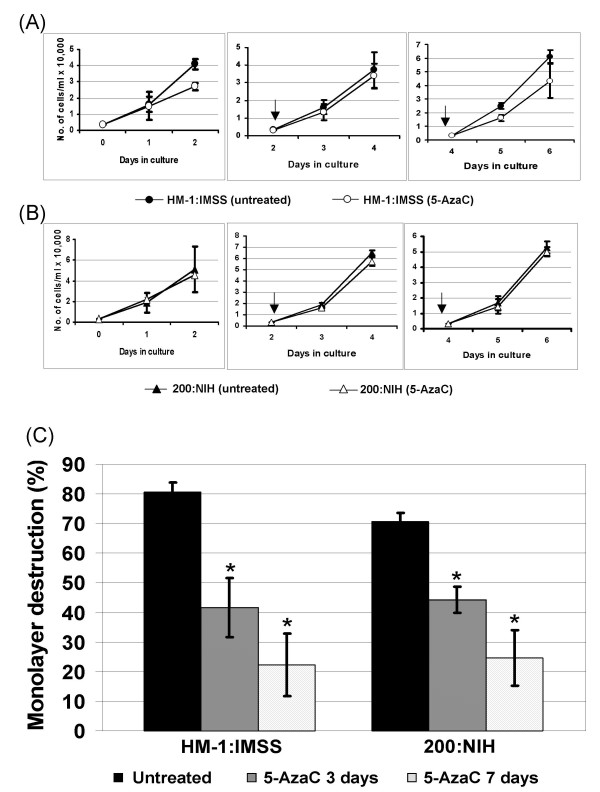
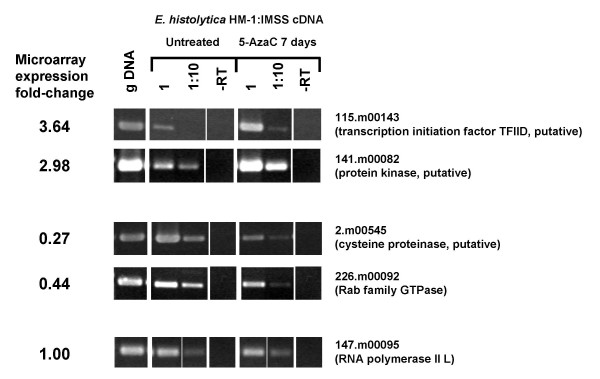
In order to identify the genome-wide effects of DNA methylation in E. histolytica, we used a short oligonucleotide microarray representing 9,435 genes (approximately 95% of all annotated amebic genes) and compared the expression profile of E. histolytica HM-1:IMSS parasites with those treated with 23 microM 5-AzaC for up to one week. Overall, 2.1% of genes tested were transcriptionally modulated under these conditions. 68 genes were upregulated and 131 genes down regulated (2-fold change; p-value < 0.05). Sodium-bisulfite treatment and sequencing of genes indicated that there were at least two subsets of genes with genomic DNA methylation in E. histolytica: (i) genes that were endogenously silenced by genomic DNA methylation and for which 5-AzaC treatment induced transcriptional de-repression, and (ii) genes that have genomic DNA methylation, but which were not endogenously silenced by the methylation. We identified among the genes down regulated by 5-AzaC treatment a cysteine proteinase (2.m00545) and lysozyme (52.m00148) both of which have known roles in amebic pathogenesis. Decreased expression of these genes in the 5-AzaC treated E. histolytica may account in part for the parasites reduced cytolytic abilities.
This work represents the first genome-wide analysis of DNA-methylation in Entamoeba histolytica and indicates that DNA methylation has relatively limited effects on gene expression in this parasite.
在高等真核生物中,DNA甲基化调节重要的生物学功能,包括基因表达沉默和抵御逆转录转座子的不利影响。在原生动物寄生虫溶组织内阿米巴中,已鉴定出一种DNA甲基转移酶,据报道,用强效DNA甲基转移酶抑制剂5-氮杂胞苷(5-AzaC)处理可减弱寄生虫的毒力。然而,目前尚不清楚该寄生虫中DNA甲基化的总体程度及其对全局基因表达的后续影响。
为了确定溶组织内阿米巴中DNA甲基化的全基因组效应,我们使用了一个代表9435个基因(约占所有注释的阿米巴基因的95%)的短寡核苷酸微阵列,并比较了溶组织内阿米巴HM-1:IMSS寄生虫与用23μM 5-AzaC处理长达一周的寄生虫的表达谱。总体而言,在这些条件下,2.1%的测试基因发生了转录调控。68个基因上调,131个基因下调(2倍变化;p值<0.05)。亚硫酸氢钠处理和基因测序表明,溶组织内阿米巴中至少有两个基因组DNA甲基化的基因子集:(i)因基因组DNA甲基化而内源性沉默且5-AzaC处理诱导转录去抑制的基因,以及(ii)具有基因组DNA甲基化但未被甲基化内源性沉默的基因。我们在5-AzaC处理下调的基因中鉴定出一种半胱氨酸蛋白酶(2.m00545)和溶菌酶(52.m00148),它们在阿米巴病发病机制中都具有已知作用。在5-AzaC处理的溶组织内阿米巴中这些基因表达的降低可能部分解释了寄生虫细胞溶解能力的降低。
这项工作代表了对溶组织内阿米巴DNA甲基化的首次全基因组分析,并表明DNA甲基化对该寄生虫的基因表达影响相对有限。