Lin Meng-Lay, Park Jae-Hyun, Nishidate Toshihiko, Nakamura Yusuke, Katagiri Toyomasa
Laboratory of Molecular Medicine, Human Genome Center, Institute of Medical Science, The University of Tokyo, Tokyo, Japan.
Breast Cancer Res. 2007;9(1):R17. doi: 10.1186/bcr1650.
Cancer therapies directed at specific molecular targets in signaling pathways of cancer cells, such as tamoxifen, aromatase inhibitors and trastuzumab, have proven useful for treatment of advanced breast cancers. However, increased risk of endometrial cancer with long-term tamoxifen administration and of bone fracture due to osteoporosis in postmenopausal women undergoing aromatase inhibitor therapy are recognized side effects. These side effects as well as drug resistance make it necessary to search for novel molecular targets for drugs on the basis of well-characterized mechanisms of action.
Using accurate genome-wide expression profiles of breast cancers, we found maternal embryonic leucine-zipper kinase (MELK) to be significantly overexpressed in the great majority of breast cancer cells. To assess whether MELK has a role in mammary carcinogenesis, we knocked down the expression of endogenous MELK in breast cancer cell lines using mammalian vector-based RNA interference. Furthermore, we identified a long isoform of Bcl-G (Bcl-GL), a pro-apoptotic member of the Bcl-2 family, as a possible substrate for MELK by pull-down assay with recombinant wild-type and kinase-dead MELK. Finally, we performed TUNEL assays and FACS analysis, measuring proportions of apoptotic cells, to investigate whether MELK is involved in the apoptosis cascade through the Bcl-GL-related pathway.
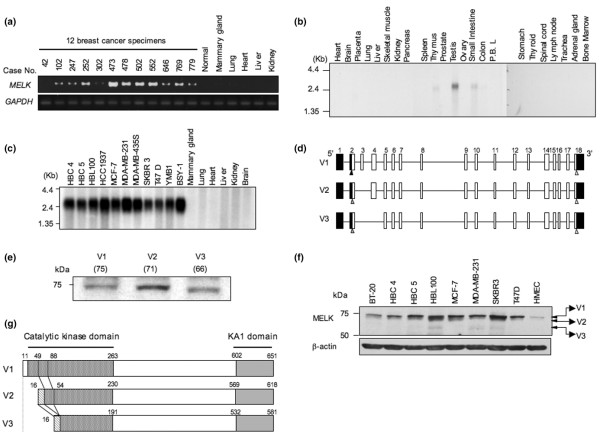
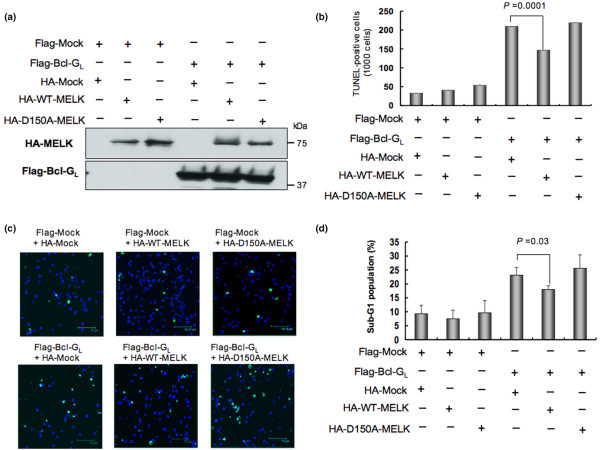
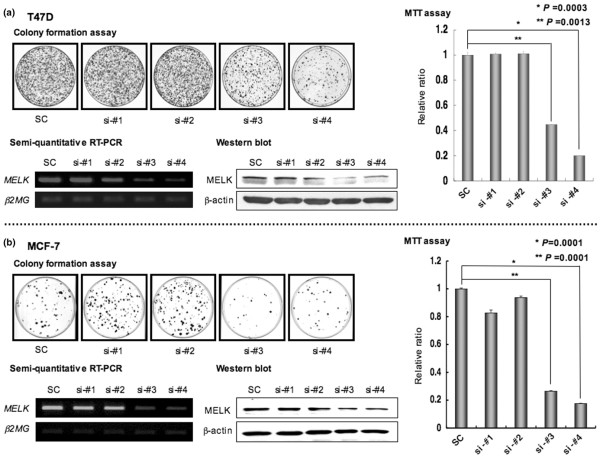
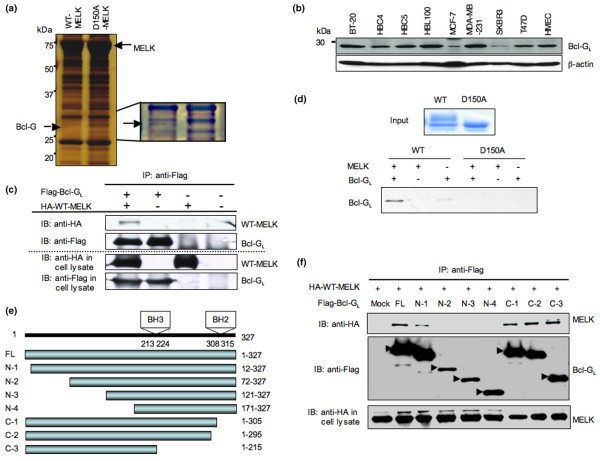
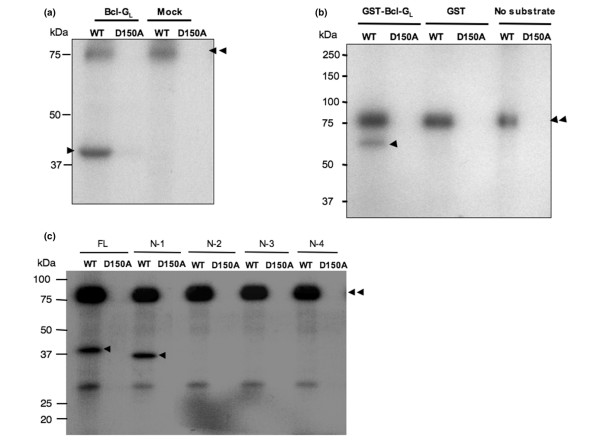
Northern blot analyses on multiple human tissues and cancer cell lines demonstrated that MELK was overexpressed at a significantly high level in a great majority of breast cancers and cell lines, but was not expressed in normal vital organs (heart, liver, lung and kidney). Suppression of MELK expression by small interfering RNA significantly inhibited growth of human breast cancer cells. We also found that MELK physically interacted with Bcl-GL through its amino-terminal region. Immunocomplex kinase assay showed that Bcl-GL was specifically phosphorylated by MELK in vitro. TUNEL assays and FACS analysis revealed that overexpression of wild-type MELK suppressed Bcl-GL-induced apoptosis, while that of D150A-MELK did not.
Our findings suggest that the kinase activity of MELK is likely to affect mammary carcinogenesis through inhibition of the pro-apoptotic function of Bcl-GL. The kinase activity of MELK could be a promising molecular target for development of therapy for patients with breast cancers.
针对癌细胞信号通路中特定分子靶点的癌症治疗方法,如他莫昔芬、芳香化酶抑制剂和曲妥珠单抗,已被证明对晚期乳腺癌的治疗有效。然而,长期服用他莫昔芬会增加子宫内膜癌的风险,而接受芳香化酶抑制剂治疗的绝经后女性会因骨质疏松而增加骨折风险,这些都是公认的副作用。这些副作用以及耐药性使得有必要基于充分了解的作用机制来寻找新的药物分子靶点。
利用准确的乳腺癌全基因组表达谱,我们发现母源胚胎亮氨酸拉链激酶(MELK)在绝大多数乳腺癌细胞中显著过表达。为了评估MELK在乳腺癌发生过程中是否起作用,我们使用基于哺乳动物载体的RNA干扰技术在乳腺癌细胞系中敲低内源性MELK的表达。此外,通过用重组野生型和激酶失活型MELK进行下拉实验,我们鉴定出Bcl-2家族的促凋亡成员Bcl-G的一种长异构体(Bcl-GL)可能是MELK的底物。最后,我们进行了TUNEL检测和FACS分析,测量凋亡细胞的比例,以研究MELK是否通过Bcl-GL相关途径参与凋亡级联反应。
对多种人类组织和癌细胞系的Northern印迹分析表明,MELK在绝大多数乳腺癌和细胞系中显著高水平过表达,但在正常重要器官(心脏、肝脏、肺和肾脏)中不表达。小干扰RNA抑制MELK表达可显著抑制人乳腺癌细胞的生长。我们还发现MELK通过其氨基末端区域与Bcl-GL发生物理相互作用。免疫复合物激酶检测表明,Bcl-GL在体外被MELK特异性磷酸化。TUNEL检测和FACS分析显示,野生型MELK的过表达抑制了Bcl-GL诱导的凋亡,而D150A-MELK的过表达则没有。
我们的研究结果表明,MELK的激酶活性可能通过抑制Bcl-GL的促凋亡功能影响乳腺癌的发生。MELK的激酶活性可能是开发乳腺癌患者治疗方法的一个有前景的分子靶点。