Weadick Cameron J, Chang Belinda S W
Department of Ecology & Evolutionary Biology, University of Toronto, Ontario, Canada.
BMC Evol Biol. 2007 Feb 8;7 Suppl 1(Suppl 1):S11. doi: 10.1186/1471-2148-7-S1-S11.
The diversity of visual systems in fish has long been of interest for evolutionary biologists and neurophysiologists, and has recently begun to attract the attention of molecular evolutionary geneticists. Several recent studies on the copy number and genomic organization of visual pigment proteins, the opsins, have revealed an increased opsin diversity in fish relative to most vertebrates, brought about through recent instances of opsin duplication and divergence. However, for the subfamily of opsin genes that mediate vision at the long-wavelength end of the spectrum, the LWS opsins, it appears that most fishes possess only one or two loci, a value comparable to most other vertebrates. Here, we characterize the LWS opsins from cDNA of an individual guppy, Poecilia reticulata, a fish that is known exhibit variation in its long-wavelength sensitive visual system, mate preferences and colour patterns.
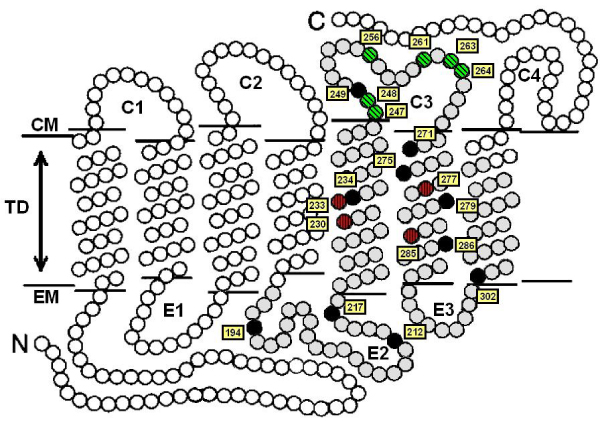
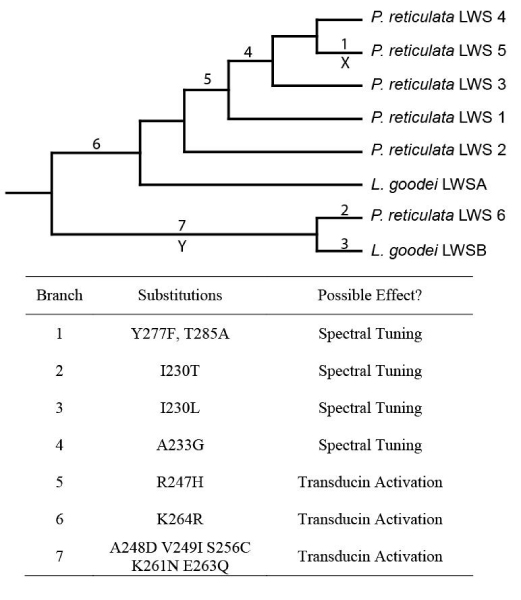
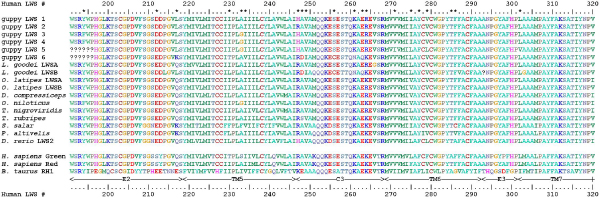
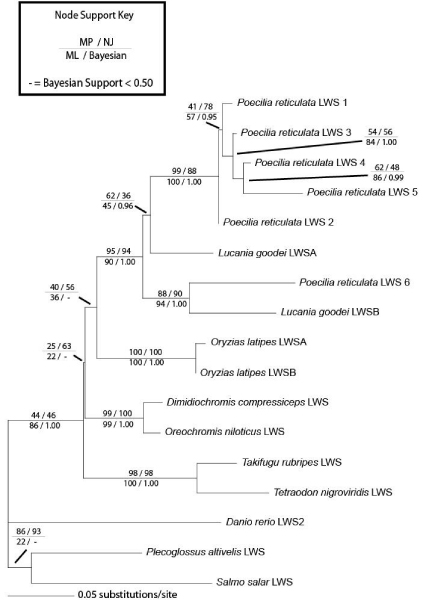
We identified six LWS opsins expressed within a single individual. Phylogenetic analysis revealed that these opsins descend from duplication events both pre-dating and following the divergence of the guppy lineage from that of the bluefin killifish, Lucania goodei, the closest species for which comparable data exists. Numerous amino acid substitutions exist among these different LWS opsins, many at sites known to be important for visual pigment function, including spectral sensitivity and G-protein activation. Likelihood analyses using codon-based models of evolution reveal significant changes in selective constraint along two of the guppy LWS opsin lineages.
The guppy displays an unusually high number of LWS opsins compared to other fish, and to vertebrates in general. Observing both substitutions at functionally important sites and the persistence of lineages across species boundaries suggests that these opsins might have functionally different roles, especially with regard to G-protein activation. The reasons why are currently unknown, but may relate to aspects of the guppy's behavioural ecology, in which both male colour patterns and the female mate preferences for these colour patterns experience strong, highly variable selection pressures.
鱼类视觉系统的多样性长期以来一直吸引着进化生物学家和神经生理学家,最近也开始引起分子进化遗传学家的关注。最近几项关于视觉色素蛋白(视蛋白)的拷贝数和基因组组织的研究表明,与大多数脊椎动物相比,鱼类的视蛋白多样性有所增加,这是由近期视蛋白的复制和分化导致的。然而,对于介导光谱长波端视觉的视蛋白基因亚家族,即LWS视蛋白,大多数鱼类似乎只拥有一两个基因座,这一数值与大多数其他脊椎动物相当。在此,我们从孔雀鱼(Poecilia reticulata)个体的cDNA中鉴定LWS视蛋白,孔雀鱼是一种已知在其长波敏感视觉系统、配偶偏好和颜色模式方面存在变异的鱼类。
我们在一个个体中鉴定出六个表达的LWS视蛋白。系统发育分析表明,这些视蛋白起源于孔雀鱼谱系与蓝鳍鳉(Lucania goodei,有可比数据的最接近物种)谱系分化之前和之后的复制事件。这些不同的LWS视蛋白之间存在许多氨基酸替换,其中许多位于已知对视觉色素功能重要的位点,包括光谱敏感性和G蛋白激活。使用基于密码子的进化模型进行的似然分析表明,沿着孔雀鱼的两个LWS视蛋白谱系,选择约束发生了显著变化。
与其他鱼类以及一般脊椎动物相比,孔雀鱼显示出异常高数量的LWS视蛋白。在功能重要位点观察到替换以及跨物种边界谱系的持续存在表明,这些视蛋白可能具有功能上不同的作用,特别是在G蛋白激活方面。其原因目前尚不清楚,但可能与孔雀鱼的行为生态学方面有关,在孔雀鱼的行为生态学中,雄性颜色模式和雌性对这些颜色模式的配偶偏好都经历强烈且高度可变