Servais Stéphane, Letexier Dominique, Favier Roland, Duchamp Claude, Desplanches Dominique
Laboratoire de Physiologie Intégrative, Cellulaire et Moléculaire, UMR 5123 CNRS, Université Claude Bernard Lyon 1, Bât Raphael Dubois 43 Boulevard du 11 Novembre 1918, 69622 Villeurbanne Cedex 09, France.
Free Radic Biol Med. 2007 Mar 1;42(5):627-35. doi: 10.1016/j.freeradbiomed.2006.12.001. Epub 2006 Dec 15.
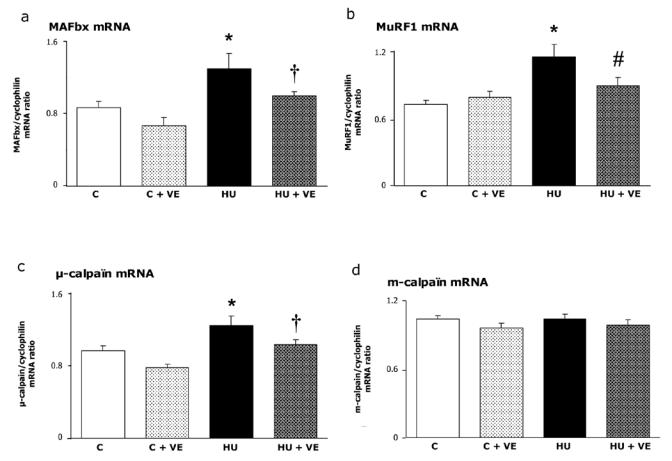
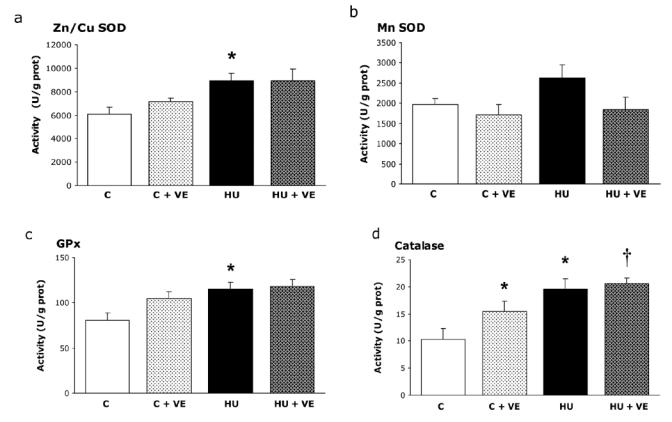
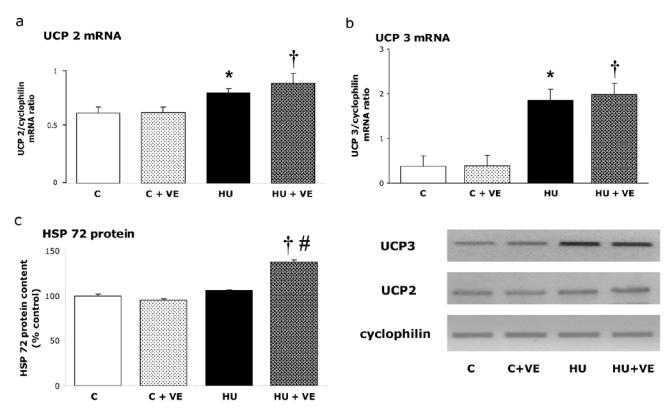
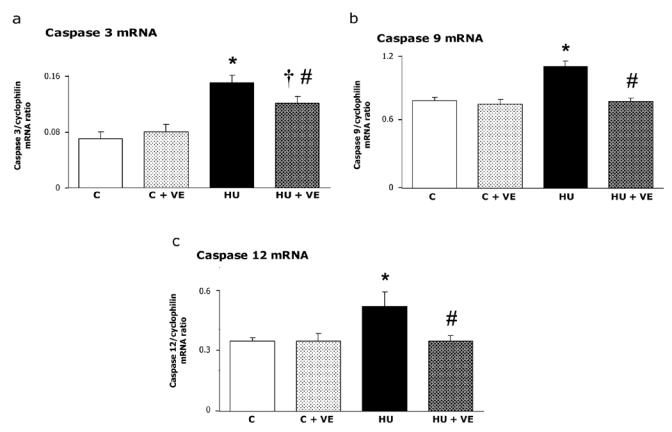
Exposure to reduced activity induces skeletal muscle atrophy. Oxidative stress might contribute to muscle wasting via proteolysis activation. This study aimed to test two hypotheses in rats. First, supplementation of the antioxidant vitamin E, prior and during the phase of unloading, would partly counteract unloading-induced soleus muscle atrophy. Secondly, vitamin E supplementation would decrease the rate of muscle proteolysis by reducing expression of calpains, caspases-3, -9, and -12, and E3 ubiquitin ligases (MuRF1 and MAFbx). Soleus muscle atrophy (-49%) induced by 14 days of hindlimb unloading was reduced to only 32% under vitamin E. Vitamin E partly prevented the decrease in type I and IIa fiber size. Supplementation increased HSP72 content and suppressed the rise in muscle level of thiobarbituric acid-reactive substance caused by unloading but failed to modify the lower ratio of reduced vs oxidized glutathione, the higher uncoupling proteins mRNA, and the antioxidant enzyme activities (superoxide dismutase, catalase, and glutathione peroxidase) observed after unloading. Vitamin E treatment abolished the large upregulation of caspases-9 and -12 and MuRF1 transcripts in unloaded muscle and greatly decreased the upregulation of mu-calpain, caspase-3, and MAFbx mRNA. In conclusion, the protective effect of vitamin E might be due to modulation of muscle proteolysis-related genes rather than to its antioxidant function.
活动减少会导致骨骼肌萎缩。氧化应激可能通过激活蛋白水解作用导致肌肉消瘦。本研究旨在验证大鼠的两个假设。第一,在卸载阶段之前及期间补充抗氧化剂维生素E,将部分抵消卸载引起的比目鱼肌萎缩。第二,补充维生素E将通过降低钙蛋白酶、半胱天冬酶-3、-9和-12以及E3泛素连接酶(MuRF1和MAFbx)的表达来降低肌肉蛋白水解速率。后肢卸载14天引起的比目鱼肌萎缩(-49%)在维生素E作用下仅降至32%。维生素E部分防止了I型和IIa型纤维大小的减小。补充维生素E增加了热休克蛋白72的含量,并抑制了卸载引起的肌肉中硫代巴比妥酸反应性物质水平的升高,但未能改变卸载后观察到的还原型谷胱甘肽与氧化型谷胱甘肽较低的比例、较高的解偶联蛋白mRNA以及抗氧化酶活性(超氧化物歧化酶、过氧化氢酶和谷胱甘肽过氧化物酶)。维生素E处理消除了卸载肌肉中半胱天冬酶-9和-12以及MuRF1转录物的大幅上调,并大大降低了微钙蛋白酶、半胱天冬酶-3和MAFbx mRNA的上调。总之,维生素E的保护作用可能归因于对肌肉蛋白水解相关基因的调节,而非其抗氧化功能。