Mackillop James, Menges David P, McGeary John E, Lisman Stephen A
Department of Psychology, State University of New York at Binghamton, PO Box 6000, Binghamton, NY 13902-6000, USA.
Behav Brain Funct. 2007 Feb 19;3:11. doi: 10.1186/1744-9081-3-11.
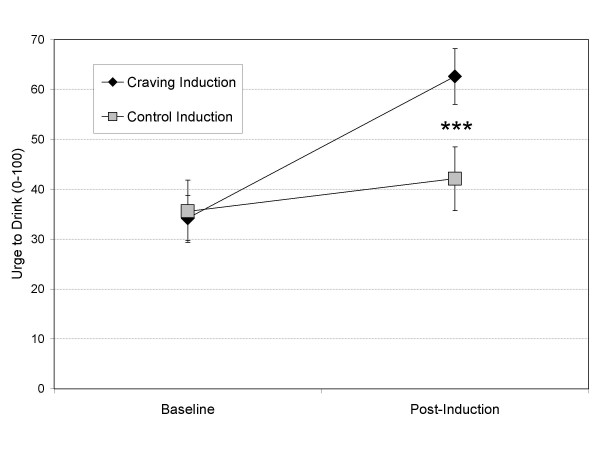
Craving for alcohol is a highly controversial subjective construct and may be clarified by Loewenstein's visceral theory, which emphasizes craving's behavioral effects on the relative value of alcohol. Based on the visceral theory, this study examined the effects of a craving induction on the relative value of alcohol as measured by a behavioral choice task. In addition, based on previous evidence of its role in the expression of craving, the influence of DRD4 VNTR genotype (DRD4-L vs. DRD4-S) was also examined.
Thirty-five heavy drinkers (54% male; 31% DRD4-L) were randomly assigned to receive either a craving induction (exposure to personally relevant alcohol cues) or a control induction (exposure to neutral cues), which was followed by an alcohol-money choice task. Participants were assessed for craving and positive/negative affect throughout the procedure, and relative value of alcohol was derived from participant choices for alcohol versus money. DRD4 VNTR status was assessed retrospectively via buccal samples using previously established protocols.
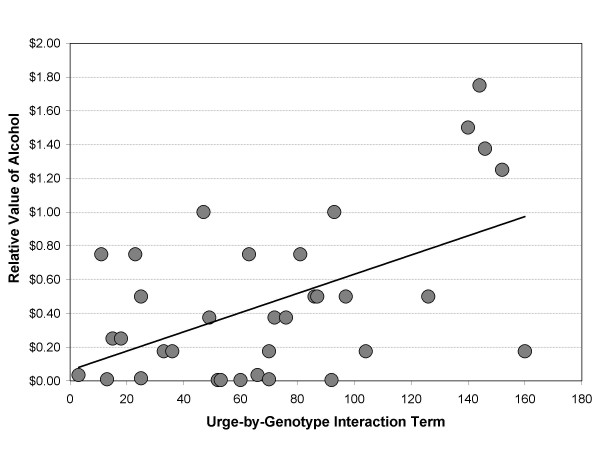
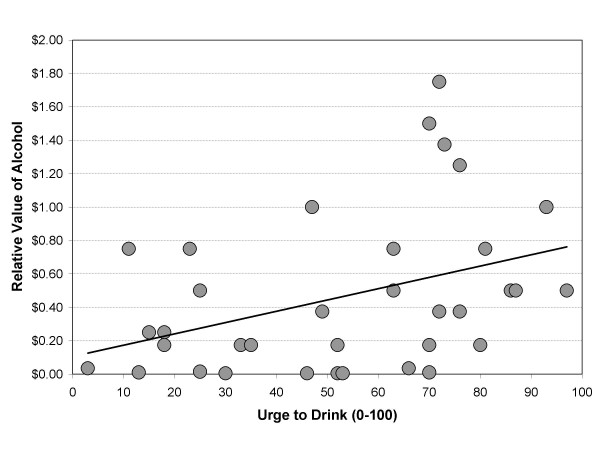
Factorial analysis of the craving induction revealed that it was associated with significant increase in craving (p < .001), but not greater relative value of alcohol. Factorial analyses including DRD4 VNTR genotype of did not suggest an influence on reactivity to the craving induction, although this analysis was substantially compromised by small cell sample sizes. Continuous analyses revealed that craving was significantly associated with the relative value of alcohol (p < .05) and possession of the DRD4-L allele further amplified this relationship (p < .001).
These results are interpreted as generally supporting Loewenstein's visceral theory of craving and evidence of a functional role of DRD4 VNTR genotype in the expression of craving for alcohol. Methodological limitations, mechanisms underlying these findings, and future directions are discussed.
对酒精的渴望是一个极具争议的主观概念,Loewenstein的内脏理论或许能对其做出解释,该理论强调渴望对酒精相对价值的行为影响。基于内脏理论,本研究通过一项行为选择任务,考察了渴望诱导对酒精相对价值的影响。此外,基于先前关于其在渴望表达中作用的证据,还考察了DRD4 VNTR基因型(DRD4-L与DRD4-S)的影响。
35名重度饮酒者(54%为男性;31%为DRD4-L)被随机分配接受渴望诱导(暴露于与个人相关的酒精线索)或对照诱导(暴露于中性线索),随后进行酒精-金钱选择任务。在整个过程中评估参与者的渴望程度以及积极/消极情绪,酒精的相对价值由参与者对酒精与金钱的选择得出。通过颊部样本,采用先前制定的方案对DRD4 VNTR状态进行回顾性评估。
对渴望诱导的因子分析表明,它与渴望程度的显著增加相关(p < .001),但与酒精的相对价值增加无关。包含DRD4 VNTR基因型的因子分析未显示对渴望诱导反应性的影响,尽管该分析因细胞样本量小而受到很大影响。连续分析表明,渴望与酒精的相对价值显著相关(p < .05),并且拥有DRD4-L等位基因进一步增强了这种关系(p < .001)。
这些结果总体上被解释为支持Loewenstein的渴望内脏理论,并证明了DRD4 VNTR基因型在酒精渴望表达中的功能作用。讨论了方法学局限性、这些发现的潜在机制以及未来的研究方向。