Dorrestijn Oscar, Stevens Martin, Diercks Ron L, van der Meer Klaas, Winters Jan C
Department of Orthopedic Surgery, University Medical Center Groningen, University of Groningen, Hanzeplein 1, Groningen, The Netherlands.
BMC Musculoskelet Disord. 2007 Feb 22;8:15. doi: 10.1186/1471-2474-8-15.
Subacromial impingement syndrome (SIS) is the most frequently recorded shoulder disorder. When conservative treatment of SIS fails, a subacromial decompression is warranted. However, the best moment of referral for surgery is not well defined. Both early and late referrals have disadvantages - unnecessary operations and smaller improvements in shoulder function, respectively. This paper describes the design of a new interdisciplinary treatment strategy for SIS (TRANSIT), which comprises rules to treat SIS in primary care and a well-defined moment of referral for surgery.
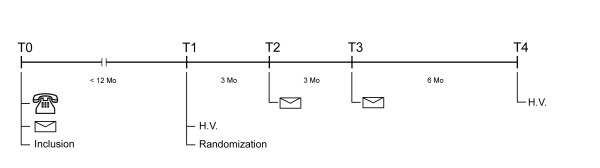
METHODS/DESIGN: The effectiveness of an arthroscopic subacromial decompression versus usual medical care will be evaluated in a randomized controlled trial (RCT). Patients are eligible for inclusion when experiencing a recurrence of SIS within one year after a first episode of SIS which was successfully treated with a subacromial corticosteroid injection. After inclusion they will receive injection treatment again by their general practitioner. When, after this treatment, there is a second recurrence within a year post-injection, the participants will be randomized to either an arthroscopic subacromial decompression (intervention group) or continuation of usual medical care (control group). The latter will be performed by a general practitioner according to the Dutch National Guidelines for Shoulder Problems. At inclusion, at randomization and three, six and 12 months post-randomization an outcome assessment will take place. The primary outcome measure is the patient-reported Shoulder Disability Questionnaire. The secondary outcome measures include both disease-specific and generic measures, and an economic evaluation. Treatment effects will be compared for all measurement points by using a GLM repeated measures analyses.
The rationale and design of an RCT comparing arthroscopic subacromial decompression with usual medical care for subacromial impingement syndrome are presented. The results of this study will improve insight into the best moment of referral for surgery for SIS.
肩峰下撞击综合征(SIS)是最常记录的肩部疾病。当SIS的保守治疗失败时,有必要进行肩峰下减压术。然而,手术转诊的最佳时机尚未明确界定。早期和晚期转诊都有缺点,分别是不必要的手术和肩部功能改善较小。本文描述了一种针对SIS的新的跨学科治疗策略(TRANSIT)的设计,该策略包括在初级保健中治疗SIS的规则以及明确的手术转诊时机。
方法/设计:在一项随机对照试验(RCT)中评估关节镜下肩峰下减压术与常规医疗护理的有效性。患者在首次发作SIS并通过肩峰下皮质类固醇注射成功治疗后一年内再次出现SIS复发时符合纳入条件。纳入后,他们将由全科医生再次进行注射治疗。在此次治疗后,如果注射后一年内再次复发,参与者将被随机分为关节镜下肩峰下减压术组(干预组)或继续接受常规医疗护理组(对照组)。后者将由全科医生根据荷兰国家肩部问题指南进行。在纳入时、随机分组时以及随机分组后3个月、6个月和12个月进行结果评估。主要结局指标是患者报告的肩部残疾问卷。次要结局指标包括疾病特异性和通用指标以及经济评估。将通过使用广义线性模型重复测量分析比较所有测量点的治疗效果。
介绍了一项比较关节镜下肩峰下减压术与常规医疗护理治疗肩峰下撞击综合征的RCT的基本原理和设计。本研究的结果将有助于深入了解SIS手术转诊的最佳时机。