Akbari Najibeh, Ozen Selin, Şenlikçi Huma Bölük, Haberal Murat, Çetin Nuri
Department of Physical and Rehabilitation Medicine, Başkent University Faculty of Medicine, Ankara, Turkey.
Jt Dis Relat Surg. 2020;31(1):115-22. doi: 10.5606/ehc.2020.71056.
This study aims to compare the effects of ultrasound (US)-guided and blind subacromial corticosteroid and local anesthetic (LA) injection in the treatment of subacromial impingement syndrome (SIS) on shoulder pain, range of motion (ROM), and functionality.
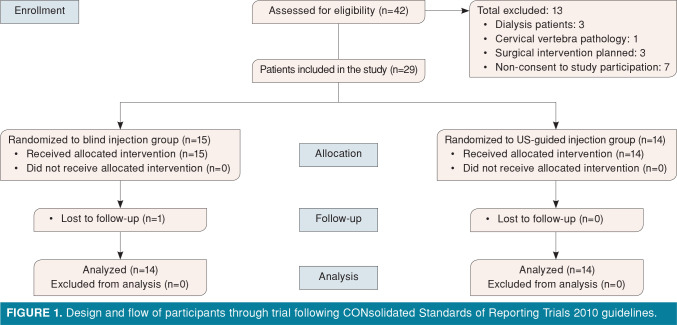
The prospective study was conducted between 01 February 2017 and 31 May 2017. A total of 29 patients with clinical findings and magnetic resonance imaging (MRI) consistent with SIS were randomized into two groups: 14 patients received US-guided subacromial corticosteroid and LA injection and 15 patients received a blind subacromial corticosteroid and LA injection. Patients were evaluated before and one month after treatment. One patient was lost to follow up. The primary outcome measure was a visual analog scale (VAS) for shoulder pain. Secondary outcomes were active shoulder ROM in flexion and abduction, the Disabilities of the Arm, Shoulder, and Hand (DASH) questionnaire and the modified Constant-Murley Score (CMS).
Twenty-eight patients (11 males, 17 females; mean age 39.5 in the US guided group and 42.5 in the blind group; range 20 to 64 years in both groups) completed the study. There was a significant improvement in VAS for shoulder pain, active ROM, DASH questionnaire score and modified CMS in both groups four weeks after treatment (p<0.05). There was no between-group difference in VAS, ROM or DASH questionnaire scores. Following treatment, the modified CMS in the US-guided injection group was higher than in the blind injection group (p=0.02). However, when the mean change in modified CMS in the US-guided injection group was compared to that of the blind injection group, the difference was insignificant (p=0.23).
Both US-guided and blind subacromial steroid injection improve shoulder pain, ROM, and functionality in SIS; one treatment option was not found to be superior to the other. Therefore, blind injection can be performed in clinical settings where US is not available. Equally, blind injection can also be performed in patients who have a definite diagnosis of SIS based on clinical and MRI findings.
本研究旨在比较超声(US)引导下和盲法肩峰下皮质类固醇与局部麻醉剂(LA)注射治疗肩峰下撞击综合征(SIS)对肩部疼痛、活动范围(ROM)和功能的影响。
前瞻性研究于2017年2月1日至2017年5月31日进行。共有29例临床表现及磁共振成像(MRI)符合SIS的患者被随机分为两组:14例患者接受US引导下肩峰下皮质类固醇与LA注射,15例患者接受盲法肩峰下皮质类固醇与LA注射。在治疗前及治疗后1个月对患者进行评估。有1例患者失访。主要结局指标是肩部疼痛视觉模拟量表(VAS)。次要结局指标包括主动肩部前屈和外展ROM、手臂、肩部和手部功能障碍(DASH)问卷以及改良的Constant-Murley评分(CMS)。
28例患者(11例男性,17例女性;US引导组平均年龄39.5岁,盲法组平均年龄42.5岁;两组年龄范围均为20至64岁)完成了研究。治疗4周后,两组的肩部疼痛VAS、主动ROM、DASH问卷评分和改良CMS均有显著改善(p<0.05)。VAS、ROM或DASH问卷评分在组间无差异。治疗后,US引导注射组的改良CMS高于盲法注射组(p=0.02)。然而,当比较US引导注射组改良CMS的平均变化与盲法注射组时,差异无统计学意义(p=0.23)。
US引导下和盲法肩峰下类固醇注射均可改善SIS患者的肩部疼痛、ROM和功能;未发现一种治疗方法优于另一种。因此,在没有US的临床环境中可进行盲法注射。同样,对于根据临床和MRI表现确诊为SIS的患者也可进行盲法注射。