Boer Kimberly R, Mahler Cecilia W, Unlu Cagdas, Lamme Bas, Vroom Margreeth B, Sprangers Mirjam A, Gouma Dirk J, Reitsma Johannes B, De Borgie Corianne A, Boermeester Marja A
Department of Clinical Epidemiology & Biostatistics, Academic Medical Center, Amsterdam, The Netherlands.
Crit Care. 2007;11(1):R30. doi: 10.1186/cc5710.
The aim of this study was to determine the long-term prevalence of post-traumatic stress disorder (PTSD) symptomology in patients following secondary peritonitis and to determine whether the prevalence of PTSD-related symptoms differed between patients admitted to the intensive care unit (ICU) and patients admitted only to the surgical ward.
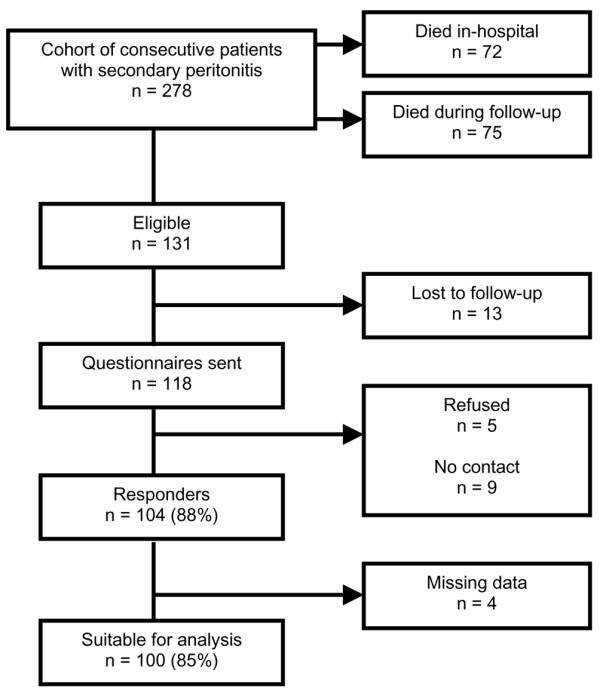
A retrospective cohort of consecutive patients treated for secondary peritonitis was sent a postal survey containing a self-report questionnaire, namely the Post-traumatic Stress Syndrome 10-question inventory (PTSS-10). From a database of 278 patients undergoing surgery for secondary peritonitis between 1994 and 2000, 131 patients were long-term survivors (follow-up period at least four years) and were eligible for inclusion in our study, conducted at a tertiary referral hospital in Amsterdam, The Netherlands.
The response rate was 86%, yielding a cohort of 100 patients; 61% of these patients had been admitted to the ICU. PTSD-related symptoms were found in 24% (95% confidence interval 17% to 33%) of patients when a PTSS-10 score of 35 was chosen as the cutoff, whereas the prevalence of PTSD symptomology when borderline patients scoring 27 points or more were included was 38% (95% confidence interval 29% to 48%). In a multivariate analyses controlling for age, sex, Acute Physiology and Chronic Health Evaluation II (APACHE II) score, number of relaparotomies and length of hospital stay, the likelihood of ICU-admitted patients having PTSD symptomology was 4.3 times higher (95% confidence interval 1.11 to 16.5) than patients not admitted to the ICU, using a PTSS-10 score cutoff of 35 or greater. Older patients and males were less likely to report PTSD symptoms.
Nearly a quarter of patients receiving surgical treatment for secondary peritonitis developed PTSD symptoms. Patients admitted to the ICU were at significantly greater risk for having PTSD symptoms after adjusting for baseline differences, in particular age.
本研究的目的是确定继发性腹膜炎患者创伤后应激障碍(PTSD)症状的长期患病率,并确定入住重症监护病房(ICU)的患者与仅入住外科病房的患者在PTSD相关症状的患病率上是否存在差异。
对一组因继发性腹膜炎接受治疗的连续患者进行回顾性队列研究,向他们发送一份包含自我报告问卷的邮政调查问卷,即创伤后应激综合征10项问卷(PTSS-10)。在1994年至2000年间接受继发性腹膜炎手术的278例患者的数据库中,131例为长期存活者(随访期至少四年),有资格纳入我们在荷兰阿姆斯特丹一家三级转诊医院进行的研究。
应答率为86%,产生了一个由100例患者组成的队列;其中61%的患者曾入住ICU。当以PTSS-10评分为35作为临界值时,24%(95%置信区间17%至33%)的患者存在PTSD相关症状,而将得分27分及以上的临界患者纳入后,PTSD症状的患病率为38%(95%置信区间29%至48%)。在一项控制年龄、性别、急性生理与慢性健康状况评估II(APACHE II)评分、再次剖腹手术次数和住院时间的多变量分析中,使用PTSS-10评分临界值35及以上时,入住ICU的患者出现PTSD症状的可能性比未入住ICU的患者高4.3倍(95%置信区间1.11至16.5)。老年患者和男性报告PTSD症状的可能性较小。
近四分之一接受继发性腹膜炎手术治疗的患者出现了PTSD症状。在调整基线差异(尤其是年龄)后,入住ICU的患者出现PTSD症状的风险显著更高。