Fritzen Scott A
LKY School of Public Policy, National University of Singapore, 469C Bukit Timah Road, 259772, Singapore.
Hum Resour Health. 2007 Feb 26;5:4. doi: 10.1186/1478-4491-5-4.
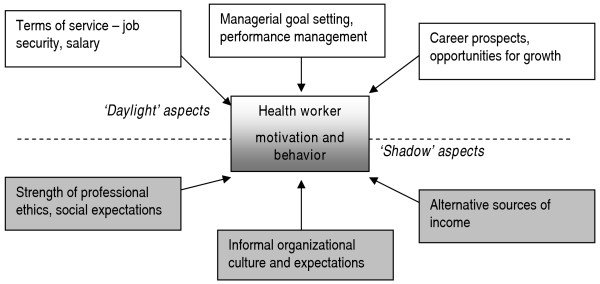
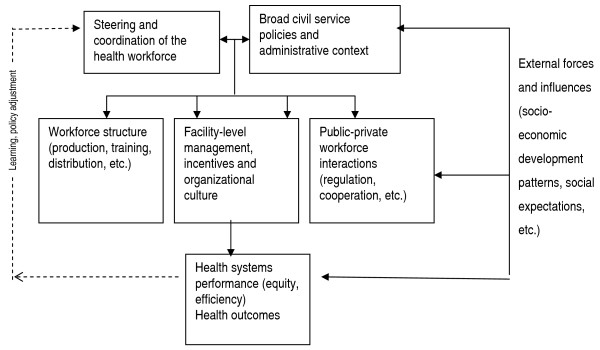
The study of the health workforce has gained in prominence in recent years, as the dynamic interconnections between human resource issues and health system effectiveness have come into sharper focus. This paper reviews lessons relating to strategic management challenges emerging from the growing literature in this area. Workforce issues are strategic: they affect overall system performance as well as the feasibility and sustainability of health reforms. Viewing workforce issues strategically forces health authorities to confront the yawning gaps between policy and implementation in many developing countries. Lessons emerge in four areas. One concerns imbalances in workforce structure, whether from a functional specialization, geographical or facility lens. These imbalances pose a strategic challenge in that authorities must attempt to steer workforce distribution over time using a limited range of policy tools. A second group of lessons concerns the difficulties of central-level steering of the health workforce, often critically weak due to the lack of proper information systems and the complexities of public sector decentralization and service commercialization trends affecting the grassroots.A third cluster examines worker capacity and motivation, often shaped in developing countries as much by the informal norms and incentives as by formal attempts to support workers or to hold them accountable. Finally, a range of reforms centering on service contracting and improvements to human resource management are emerging. Since these have as a necessary (but not sufficient) condition some flexibility in personnel practices, recent trends towards the sharing of such functions with local authorities are promising. The paper identifies a number of current lines of productive research, focusing on the relationship between health policy reforms and the local institutional environments in which the workforce, both public and private, is deployed.
近年来,随着人力资源问题与卫生系统有效性之间的动态相互联系日益受到关注,卫生人力研究变得越发重要。本文回顾了这一领域不断增多的文献中有关战略管理挑战的经验教训。人力问题具有战略意义:它们影响着整个系统的绩效以及卫生改革的可行性和可持续性。从战略角度看待人力问题迫使卫生当局正视许多发展中国家在政策与实施之间存在的巨大差距。经验教训体现在四个方面。一是人力结构失衡问题,无论是从职能专业化、地理分布还是机构层面来看。这些失衡构成了战略挑战,因为当局必须尝试在一段时间内利用有限的政策工具来引导人力分配。第二类经验教训涉及中央层面指导卫生人力的困难,由于缺乏适当的信息系统以及影响基层的公共部门权力下放和服务商业化趋势的复杂性,中央层面往往极为薄弱。第三类问题审视了工作人员的能力和积极性,在发展中国家,其形成往往既受非正式规范和激励措施的影响,也受支持工作人员或要求其承担责任的正式举措的影响。最后,一系列以服务合同和人力资源管理改进为核心的改革正在出现。由于这些改革在人员管理方面有一定灵活性(但并非充分条件),近期与地方当局共享此类职能的趋势很有前景。本文确定了一些当前富有成效的研究方向,重点关注卫生政策改革与部署公共和私营卫生人力的地方机构环境之间的关系。