Diretto Gianfranco, Welsch Ralf, Tavazza Raffaela, Mourgues Fabienne, Pizzichini Daniele, Beyer Peter, Giuliano Giovanni
ENEA, Casaccia Research Center, Rome, Italy.
BMC Plant Biol. 2007 Mar 2;7:11. doi: 10.1186/1471-2229-7-11.
Beta-carotene is the main dietary precursor of vitamin A. Potato tubers contain low levels of carotenoids, composed mainly of the xanthophylls lutein (in the beta-epsilon branch) and violaxanthin (in the beta-beta branch). None of these carotenoids have provitamin A activity. We have previously shown that tuber-specific silencing of the first step in the epsilon-beta branch, LCY-e, redirects metabolic flux towards beta-beta carotenoids, increases total carotenoids up to 2.5-fold and beta-carotene up to 14-fold.
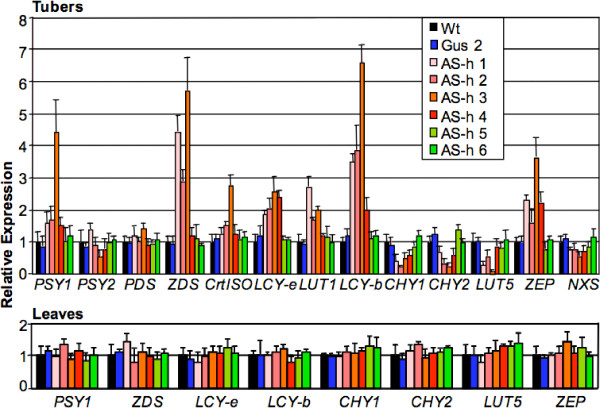
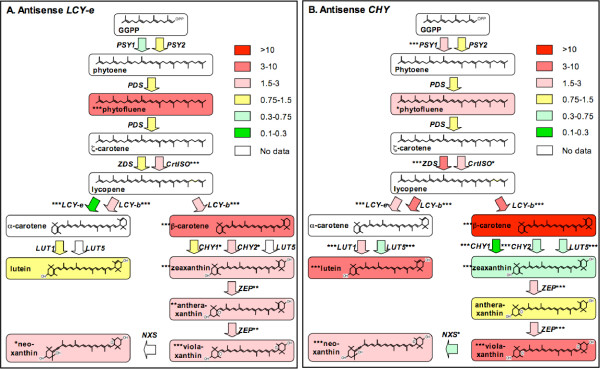
In this work, we silenced the non-heme beta-carotene hydroxylases CHY1 and CHY2 in the tuber. Real Time RT-PCR measurements confirmed the tuber-specific silencing of both genes . CHY silenced tubers showed more dramatic changes in carotenoid content than LCY-e silenced tubers, with beta-carotene increasing up to 38-fold and total carotenoids up to 4.5-fold. These changes were accompanied by a decrease in the immediate product of beta-carotene hydroxylation, zeaxanthin, but not of the downstream xanthophylls, viola- and neoxanthin. Changes in endogenous gene expression were extensive and partially overlapping with those of LCY-e silenced tubers: CrtISO, LCY-b and ZEP were induced in both cases, indicating that they may respond to the balance between individual carotenoid species.
Together with epsilon-cyclization of lycopene, beta-carotene hydroxylation is another regulatory step in potato tuber carotenogenesis. The data are consistent with a prevalent role of CHY2, which is highly expressed in tubers, in the control of this step. Combination of different engineering strategies holds good promise for the manipulation of tuber carotenoid content.
β-胡萝卜素是维生素A的主要膳食前体。马铃薯块茎中类胡萝卜素含量较低,主要由叶黄素(β-ε分支)和紫黄质(β-β分支)组成。这些类胡萝卜素均无维生素A原活性。我们之前已经表明,在块茎中特异性沉默ε-β分支第一步的LCY-e,可使代谢通量转向β-β类胡萝卜素,使总类胡萝卜素增加至2.5倍,β-胡萝卜素增加至14倍。
在这项研究中,我们在块茎中沉默了非血红素β-胡萝卜素羟化酶CHY1和CHY2。实时RT-PCR测量证实了这两个基因在块茎中的特异性沉默。与LCY-e沉默的块茎相比,CHY沉默的块茎类胡萝卜素含量变化更为显著,β-胡萝卜素增加至38倍,总类胡萝卜素增加至4.5倍。这些变化伴随着β-胡萝卜素羟基化的直接产物玉米黄质的减少,但下游叶黄素、堇菜黄质和新黄质并未减少。内源基因表达的变化广泛,且部分与LCY-e沉默的块茎重叠:在两种情况下,CrtISO、LCY-b和ZEP均被诱导,表明它们可能对单个类胡萝卜素物种之间的平衡做出反应。
与番茄红素的ε-环化一起,β-胡萝卜素羟基化是马铃薯块茎类胡萝卜素生物合成中的另一个调控步骤。数据表明在块茎中高表达的CHY2在这一步骤的控制中起主要作用。不同工程策略的组合有望用于调控块茎类胡萝卜素含量。