Wang Wei, Bradley Allan
Department of Cell Biology and Genetics, College of Life Sciences, Peking University, Beijing, PR China.
Genome Biol. 2007;8(4):R48. doi: 10.1186/gb-2007-8-4-r48.
Host factors required for retroviral infection are potential targets for the modulation of diseases caused by retroviruses. During the retroviral life cycle, numerous cellular factors interact with the virus and play an essential role in infection. Cultured embryonic stem (ES) cells are susceptible to retroviral infection, therefore providing access to all of the genes required for this process to take place. In order to identify the host factors involved in retroviral infection, we designed and implemented a scheme for identifying ES cells that are resistant to retroviral infection and subsequent cloning of the mutated gene.
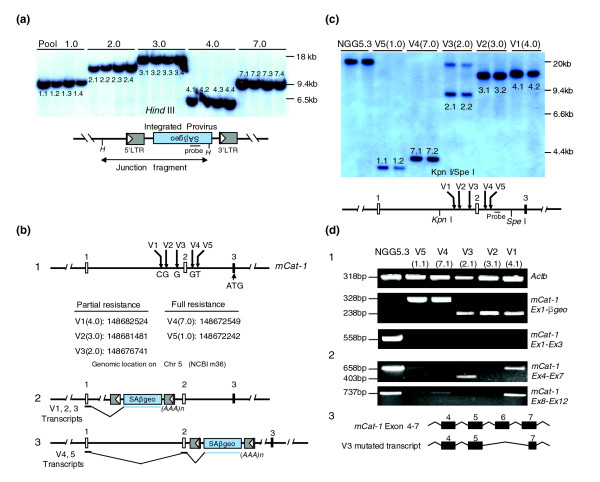
A library of mutant ES cells was established by genome-wide insertional mutagenesis in Blm-deficient ES cells, and a screen was performed by superinfection of the library at high multiplicity with a recombinant retrovirus carrying a positive and negative selection cassette. Stringent negative selection was then used to exclude the infected ES cells. We successfully recovered five independent clones of ES cells that are resistant to retroviral infection. Analysis of the mutations in these clones revealed four different homozygous and one compound heterozygous mutation in the mCat-1 locus, which confirms that mCat-1 is the ecotropic murine leukemia virus receptor in ES cells.
We have demonstrated the feasibility and reliability of this recessive genetic approach to identifying critical genes required for retroviral infection in ES cells; the approach provides a unique opportunity to recover other cellular factors required for retroviral infection. The resulting insertionally mutated Blm-deficient ES cell library might also provide access to essential host cell components that are required for infection and replication for other types of virus.
逆转录病毒感染所需的宿主因子是调控逆转录病毒所致疾病的潜在靶点。在逆转录病毒生命周期中,众多细胞因子与病毒相互作用并在感染过程中发挥关键作用。培养的胚胎干细胞(ES细胞)易受逆转录病毒感染,因此可用于研究该过程所需的所有基因。为了鉴定参与逆转录病毒感染的宿主因子,我们设计并实施了一个方案,以鉴定对逆转录病毒感染具有抗性的ES细胞,并随后克隆突变基因。
通过在缺乏Blm的ES细胞中进行全基因组插入诱变建立了突变ES细胞文库,并通过用携带正负选择盒的重组逆转录病毒以高复数对该文库进行超感染来进行筛选。然后使用严格的负选择来排除被感染的ES细胞。我们成功获得了五个对逆转录病毒感染具有抗性的ES细胞独立克隆。对这些克隆中的突变分析揭示了mCat-1基因座中的四种不同纯合突变和一种复合杂合突变,这证实了mCat-1是ES细胞中的嗜亲性小鼠白血病病毒受体。
我们已经证明了这种隐性遗传方法在鉴定ES细胞中逆转录病毒感染所需关键基因方面的可行性和可靠性;该方法为鉴定逆转录病毒感染所需的其他细胞因子提供了独特的机会。由此产生的插入诱变的缺乏Blm的ES细胞文库也可能提供对其他类型病毒感染和复制所需的重要宿主细胞成分的研究途径。