Huang Zhi, Ha Grace K, Petitto John M
McKnight Brain Institute, University of Florida, Gainesville, FL 32608, USA.
Neurosci Lett. 2007 May 1;417(2):160-4. doi: 10.1016/j.neulet.2007.01.086. Epub 2007 Mar 25.
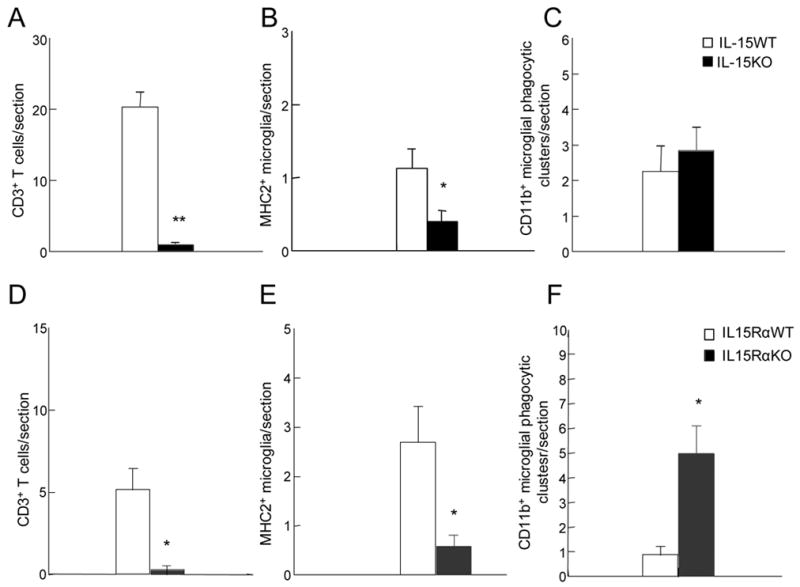
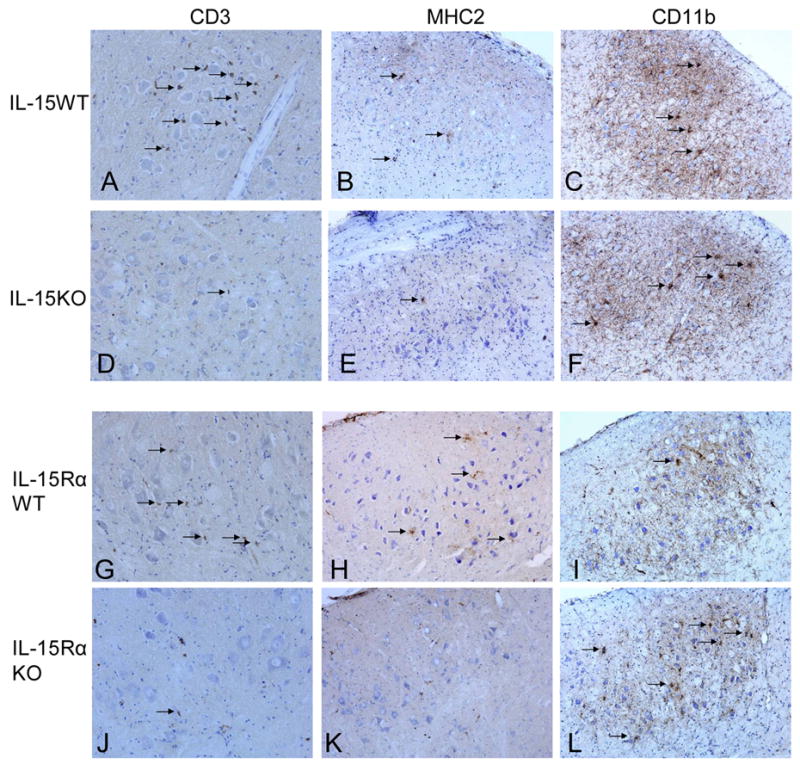
IL-15 is a potent T cell chemoattractant, and this cytokine and its unique alpha subunits, IL-15R alpha, can modify immune cell expression of several T cell chemokines and their receptors. Facial nerve axotomy in mice leads to T cell migration across an intact blood-brain-barrier (BBB), and under certain conditions T cells can provide neuroprotection to injured neurons in the facial motor nucleus (FMN). Although chemokines and chemoattractant cytokines are thought to be responsible for T cell migration to the injured cell bodies, data addressing this question are lacking. This study tested the hypothesis that T cell homing to the axotomized FMN would be impaired in knockout (KO) mice with the IL-15 and IL-15R alpha genes deleted, and sought to determine if microglial responsiveness and motoneuron death are affected. Both IL-15KO and IL-15R alpha KO mice exhibited a marked reduction in CD3(+) T cells and had fewer MHC2(+) activated microglia in the injured FMN than their respective WT controls at day 14 post-axotomy. Although there was a relative absence of T cell recruitment into the axotomized FMN in both knockout strains, IL-15R alpha KO mice had five times more motoneuron death (characterized by perineuronal microglial clusters engulfing dead motoneurons) than their WT controls, whereas dead neurons in IL-15KO did not differ from their WT controls. Further studies are needed to dissect the mechanisms that underlie these observations (e.g., central vs. peripheral immune contributions).
白细胞介素-15(IL-15)是一种强效的T细胞趋化因子,这种细胞因子及其独特的α亚基,即IL-15Rα,能够改变几种T细胞趋化因子及其受体在免疫细胞中的表达。小鼠面神经切断术会导致T细胞穿过完整的血脑屏障(BBB)迁移,并且在某些条件下,T细胞能够为面神经运动核(FMN)中受损的神经元提供神经保护。尽管趋化因子和趋化性细胞因子被认为是T细胞向受损细胞体迁移的原因,但缺乏针对这一问题的数据。本研究检验了以下假设:在缺失IL-15和IL-15Rα基因的基因敲除(KO)小鼠中,T细胞归巢至切断轴突的FMN会受到损害,并试图确定小胶质细胞反应性和运动神经元死亡是否受到影响。在轴突切断术后第14天,与各自的野生型(WT)对照相比,IL-15基因敲除小鼠和IL-15Rα基因敲除小鼠的CD3(+) T细胞均显著减少,且在受损的FMN中,MHC2(+) 活化小胶质细胞也更少。尽管在两种基因敲除品系中,T细胞向切断轴突的FMN的募集相对较少,但IL-15Rα基因敲除小鼠的运动神经元死亡数量(以吞噬死亡运动神经元的神经元周围小胶质细胞簇为特征)是其野生型对照的五倍,而IL-15基因敲除小鼠中的死亡神经元与野生型对照并无差异。需要进一步研究以剖析这些观察结果背后的机制(例如,中枢与外周免疫的作用)。