Barghini Paolo, Di Gioia Diana, Fava Fabio, Ruzzi Maurizio
Department of Agrobiology and Agrochemistry, University of Tuscia, via Camillo de Lellis-snc, 01100 Viterbo, Italy.
Microb Cell Fact. 2007 Apr 16;6:13. doi: 10.1186/1475-2859-6-13.
Vanillin is one of the most important aromatic flavour compounds used in the food and cosmetic industries. Natural vanillin is extracted from vanilla beans and is relatively expensive. Moreover, the consumer demand for natural vanillin highly exceeds the amount of vanillin extracted by plant sources. This has led to the investigation of other routes to obtain this flavour such as the biotechnological production from ferulic acid. Studies concerning the use of engineered recombinant Escherichia coli cells as biocatalysts for vanillin production are described in the literature, but yield optimization and biotransformation conditions have not been investigated in details.
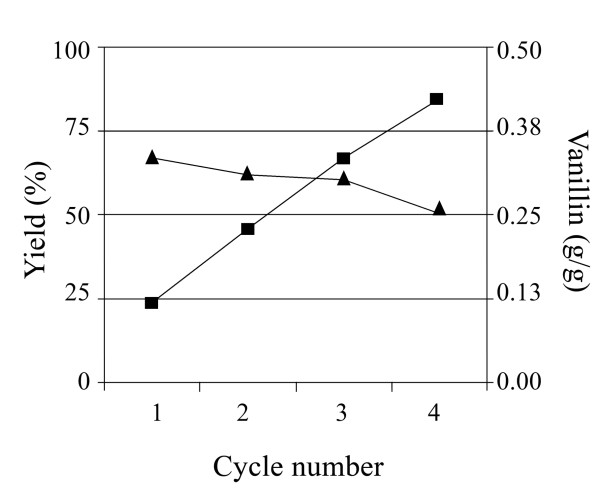
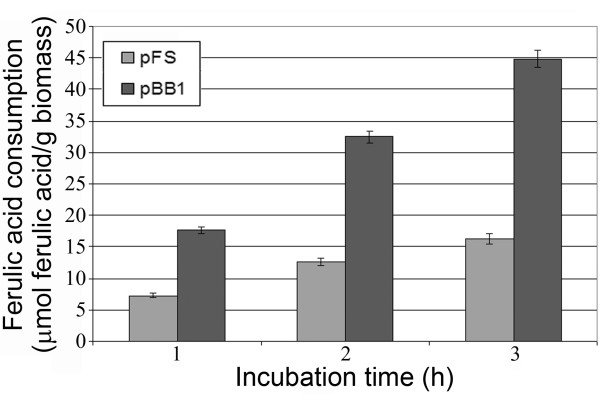
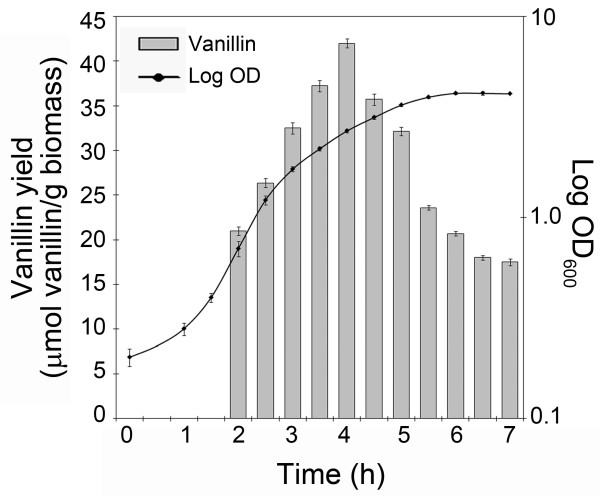
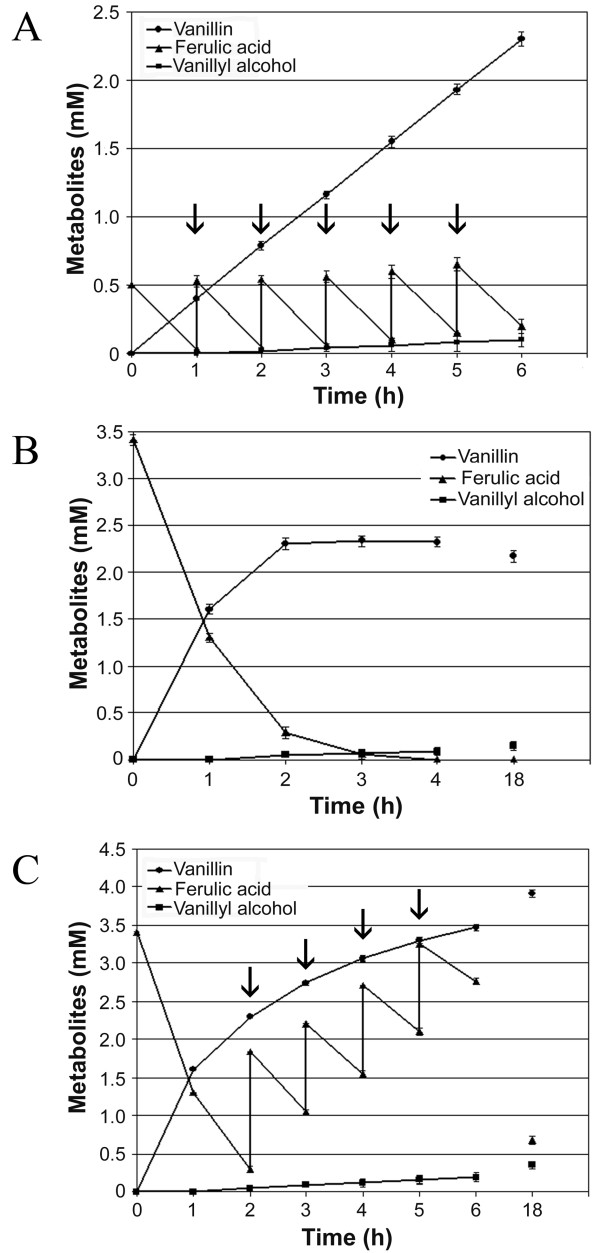
Effect of plasmid copy number in metabolic engineering of E. coli for the synthesis of vanillin has been evaluated by the use of genes encoding feruloyl-CoA synthetase and feruloyl hydratase/aldolase from Pseudomonas fluorescens BF13. The higher vanillin production yield was obtained using resting cells of E. coli strain JM109 harbouring a low-copy number vector and a promoter exhibiting a low activity to drive the expression of the catabolic genes. Optimization of the bioconversion of ferulic acid to vanillin was accomplished by a response surface methodology. The experimental conditions that allowed us to obtain high values for response functions were 3.3 mM ferulic acid and 4.5 g/L of biomass, with a yield of 70.6% and specific productivity of 5.9 micromoles/g x min after 3 hours of incubation. The final concentration of vanillin in the medium was increased up to 3.5 mM after a 6-hour incubation by sequential spiking of 1.1 mM ferulic acid. The resting cells could be reused up to four times maintaining the production yield levels over 50%, thus increasing three times the vanillin obtained per gram of biomass.
Ferulic acid can be efficiently converted to vanillin, without accumulation of undesirable vanillin reduction/oxidation products, using E. coli JM109 cells expressing genes from the ferulic acid-degrader Pseudomonas fluorescens BF13. Optimization of culture conditions and bioconversion parameters, together with the reuse of the biomass, leaded to a final production of 2.52 g of vanillin per liter of culture, which is the highest found in the literature for recombinant strains and the highest achieved so far applying such strains under resting cells conditions.
香草醛是食品和化妆品行业中使用的最重要的芳香风味化合物之一。天然香草醛是从香草豆中提取的,相对昂贵。此外,消费者对天然香草醛的需求远远超过植物来源提取的香草醛量。这导致人们研究其他获取这种风味物质的途径,例如从阿魏酸进行生物技术生产。文献中描述了有关使用工程重组大肠杆菌细胞作为香草醛生产生物催化剂的研究,但产量优化和生物转化条件尚未进行详细研究。
通过使用编码来自荧光假单胞菌BF13的阿魏酰辅酶A合成酶和阿魏酰水合酶/醛缩酶的基因,评估了质粒拷贝数在大肠杆菌代谢工程中合成香草醛的作用。使用携带低拷贝数载体和具有低活性启动子以驱动分解代谢基因表达的大肠杆菌JM109菌株的静息细胞,可获得更高的香草醛产量。通过响应面法实现了阿魏酸向香草醛生物转化的优化。使我们能够获得响应函数高值的实验条件为3.3 mM阿魏酸和4.5 g/L生物量,孵育3小时后产率为70.6%,比生产率为5.9微摩尔/克×分钟。通过依次添加1.1 mM阿魏酸,孵育6小时后培养基中香草醛的最终浓度提高到3.5 mM。静息细胞可重复使用多达四次,产率水平保持在50%以上,从而使每克生物量获得的香草醛增加了三倍。
使用表达来自阿魏酸降解菌荧光假单胞菌BF13基因的大肠杆菌JM109细胞,阿魏酸可以有效地转化为香草醛,而不会积累不需要的香草醛还原/氧化产物。培养条件和生物转化参数的优化,以及生物量的重复使用,最终每升培养物产生2.52 g香草醛,这是文献中重组菌株的最高产量,也是迄今为止在静息细胞条件下应用此类菌株所达到的最高产量。