Huxley-Jones Julie, Clarke Toni-Kim, Beck Christine, Toubaris George, Robertson David L, Boot-Handford Raymond P
Wellcome Trust Centre for Cell-Matrix Research, Faculty of Life Sciences, University of Manchester, Manchester, UK.
BMC Evol Biol. 2007 Apr 17;7:63. doi: 10.1186/1471-2148-7-63.
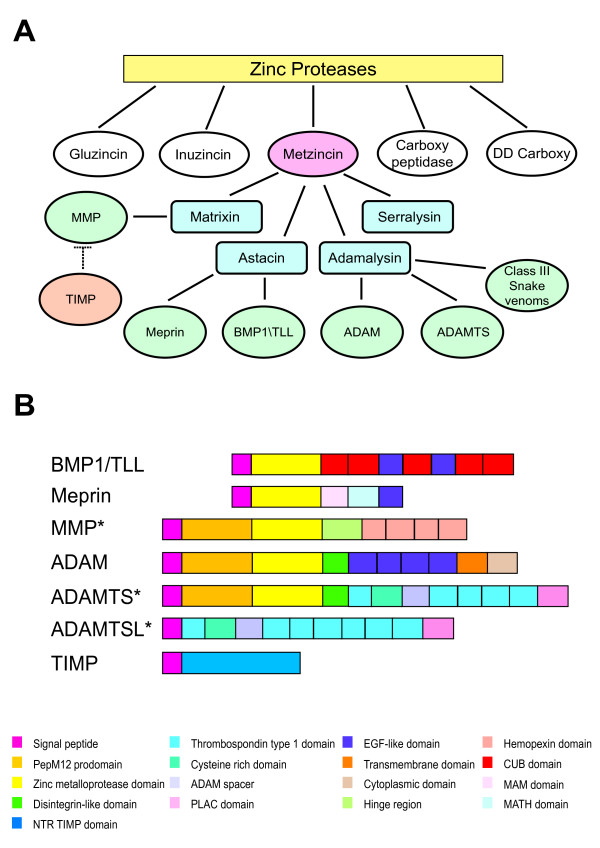
The metzincins are a large gene superfamily of proteases characterized by the presence of a zinc protease domain, and include the ADAM, ADAMTS, BMP1/TLL, meprin and MMP genes. Metzincins are involved in the proteolysis of a wide variety of proteins, including those of the extracellular matrix. The metzincin gene superfamily comprises eighty proteins in the human genome and ninety-three in the mouse. When and how the level of complexity apparent in the vertebrate metzincin gene superfamily arose has not been determined in detail. Here we present a comprehensive analysis of vertebrate metzincins using genes from both Ciona intestinalis and Danio rerio to provide new insights into the complex evolution of this gene superfamily.
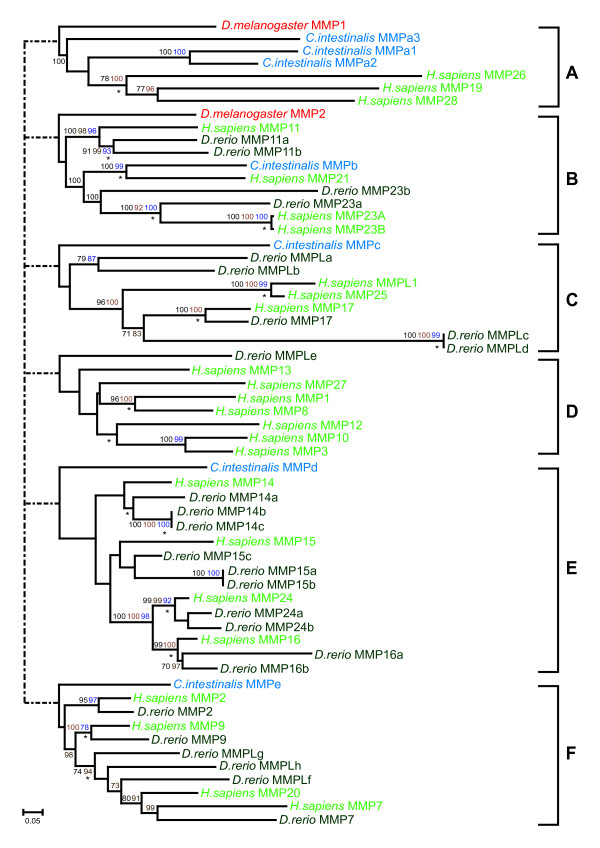
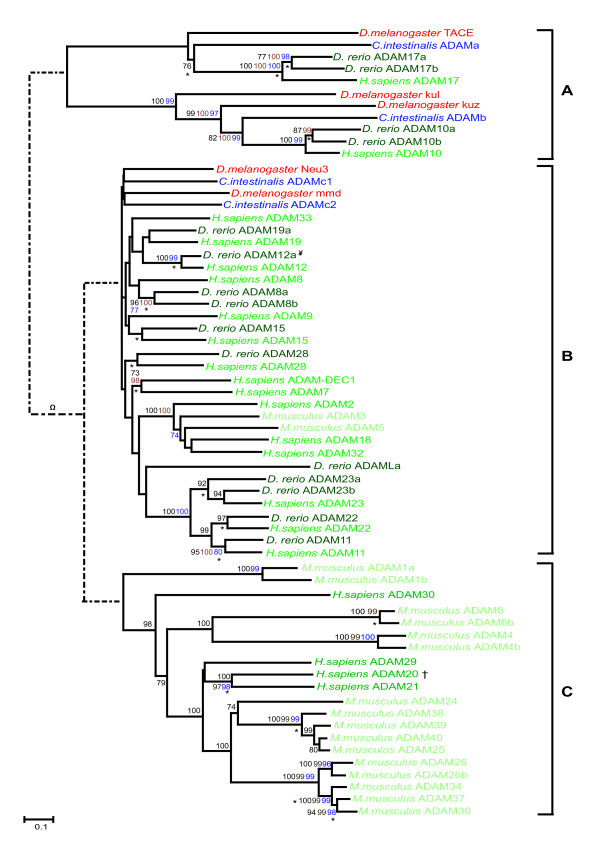
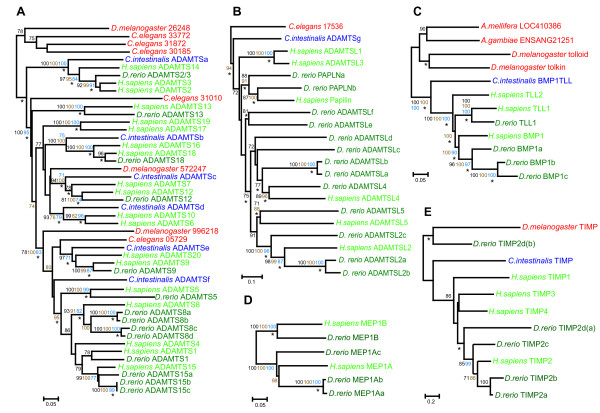
We have identified 19 metzincin genes in the ciona genome and 83 in the zebrafish genome. Phylogenetic analyses reveal that the expansion of the metzincin gene superfamily in vertebrates has occurred predominantly by the simple duplication of pre-existing genes rather than by the appearance and subsequent expansion of new metzincin subtypes (the only example of which is the meprin gene family). Despite the number of zebrafish metzincin genes being relatively similar to that of tetrapods (e.g. man and mouse), the pattern of gene retention and loss within these lineages is markedly different. In addition, we have studied the evolution of the related TIMP gene family and identify a single ciona and four zebrafish TIMP genes.
The complexity seen in the vertebrate metzincin gene families was mainly acquired during vertebrate evolution. The metzincin gene repertoire in protostomes and invertebrate deuterostomes has remained relatively stable. The expanded metzincin gene repertoire of extant tetrapods, such as man, has resulted largely from duplication events associated with early vertebrate evolution, prior to the sarcopterygian-actinopterygian split. The teleost repertoire of metzincin genes in part parallels that of tetrapods but has been significantly modified, perhaps as a consequence of a teleost-specific duplication event.
金属锌蛋白酶是一个大型的蛋白酶基因超家族,其特征是存在一个锌蛋白酶结构域,包括ADAM、ADAMTS、BMP1/TLL、膜联蛋白和基质金属蛋白酶(MMP)基因。金属锌蛋白酶参与多种蛋白质的蛋白水解过程,包括细胞外基质中的蛋白质。在人类基因组中,金属锌蛋白酶基因超家族包含80种蛋白质,在小鼠中则有93种。脊椎动物金属锌蛋白酶基因超家族中明显的复杂程度是何时以及如何产生的,目前尚未详细确定。在此,我们利用来自玻璃海鞘和斑马鱼的基因对脊椎动物金属锌蛋白酶进行了全面分析,以提供对这个基因超家族复杂进化的新见解。
我们在玻璃海鞘基因组中鉴定出19个金属锌蛋白酶基因,在斑马鱼基因组中鉴定出83个。系统发育分析表明,脊椎动物中金属锌蛋白酶基因超家族的扩张主要是通过现有基因的简单复制,而非新的金属锌蛋白酶亚型的出现及随后的扩张(膜联蛋白基因家族是唯一的例外)。尽管斑马鱼金属锌蛋白酶基因的数量与四足动物(如人类和小鼠)相对相似,但这些谱系中基因保留和丢失的模式却明显不同。此外,我们研究了相关的金属蛋白酶组织抑制剂(TIMP)基因家族的进化,并鉴定出一个玻璃海鞘TIMP基因和四个斑马鱼TIMP基因。
脊椎动物金属锌蛋白酶基因家族中所见的复杂性主要是在脊椎动物进化过程中获得的。原口动物和无脊椎动物后口动物中的金属锌蛋白酶基因库相对保持稳定。现存四足动物(如人类)中扩展的金属锌蛋白酶基因库很大程度上源于与早期脊椎动物进化相关的复制事件,该事件发生在肉鳍鱼-辐鳍鱼分化之前。硬骨鱼的金属锌蛋白酶基因库部分与四足动物相似,但已发生显著改变,这可能是硬骨鱼特有的复制事件的结果。