Montanini Barbara, Blaudez Damien, Jeandroz Sylvain, Sanders Dale, Chalot Michel
UMR INRA/UHP 1136 Interactions Arbres/Micro-organismes, Nancy-Université, Vandoeuvre, France.
BMC Genomics. 2007 Apr 23;8:107. doi: 10.1186/1471-2164-8-107.
The Cation Diffusion Facilitator (CDF) family is a ubiquitous family of heavy metal transporters. Much interest in this family has focused on implications for human health and bioremediation. In this work a broad phylogenetic study has been undertaken which, considered in the context of the functional characteristics of some fully characterised CDF transporters, has aimed at identifying molecular determinants of substrate selectivity and at suggesting metal specificity for newly identified CDF transporters.
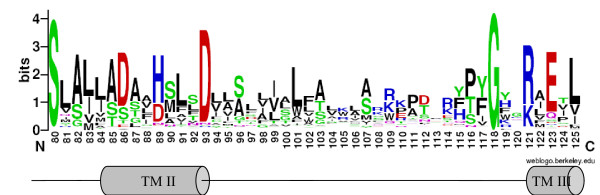
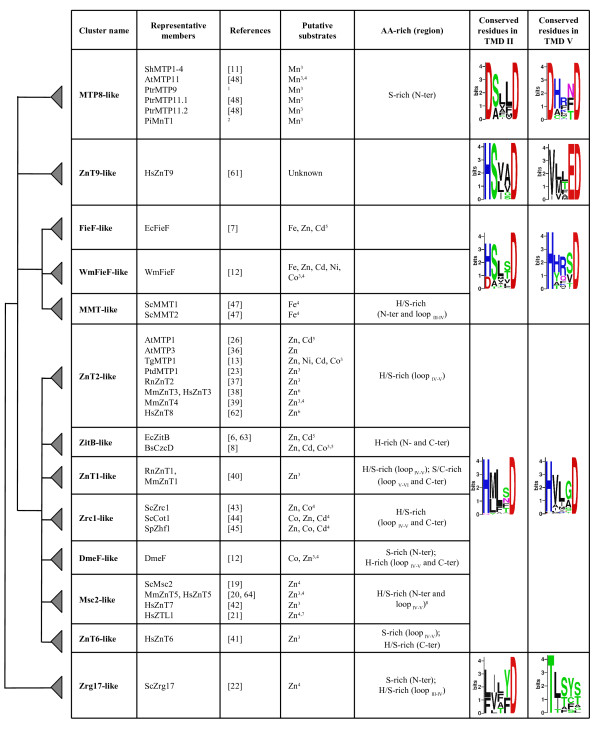
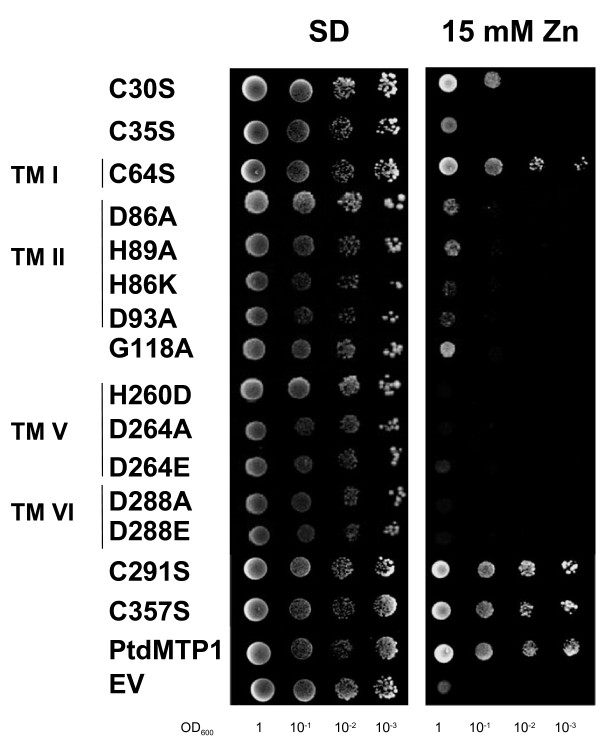
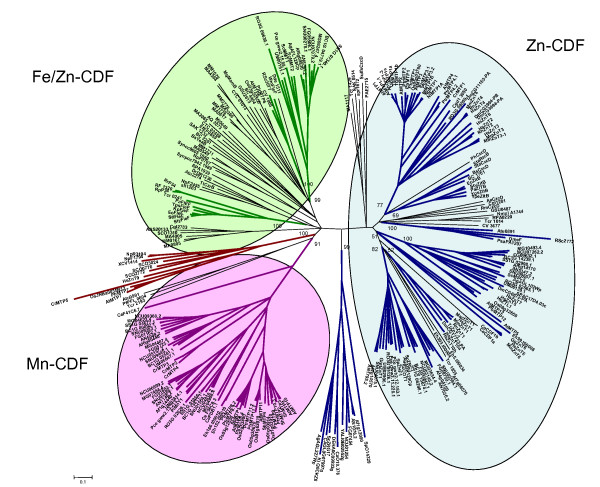
Representative CDF members from all three kingdoms of life (Archaea, Eubacteria, Eukaryotes) were retrieved from genomic databases. Protein sequence alignment has allowed detection of a modified signature that can be used to identify new hypothetical CDF members. Phylogenetic reconstruction has classified the majority of CDF family members into three groups, each containing characterised members that share the same specificity towards the principally-transported metal, i.e. Zn, Fe/Zn or Mn. The metal selectivity of newly identified CDF transporters can be inferred by their position in one of these groups. The function of some conserved amino acids was assessed by site-directed mutagenesis in the poplar Zn2+ transporter PtdMTP1 and compared with similar experiments performed in prokaryotic members. An essential structural role can be assigned to a widely conserved glycine residue, while aspartate and histidine residues, highly conserved in putative transmembrane domains, might be involved in metal transport. The potential role of group-conserved amino acid residues in metal specificity is discussed.
In the present study phylogenetic and functional analyses have allowed the identification of three major substrate-specific CDF groups. The metal selectivity of newly identified CDF transporters can be inferred by their position in one of these groups. The modified signature sequence proposed in this work can be used to identify new hypothetical CDF members.
阳离子扩散促进因子(CDF)家族是一类广泛存在的重金属转运蛋白家族。该家族引起了人们的广泛关注,主要集中在其对人类健康和生物修复的影响方面。在本研究中,我们进行了一项广泛的系统发育研究,并结合一些已完全表征的CDF转运蛋白的功能特性,旨在确定底物选择性的分子决定因素,并为新鉴定的CDF转运蛋白推测金属特异性。
从基因组数据库中检索了来自生命三界(古细菌、真细菌、真核生物)的代表性CDF成员。蛋白质序列比对已检测到一种修饰的特征序列,可用于识别新的假定CDF成员。系统发育重建已将大多数CDF家族成员分为三组,每组都包含对主要转运金属具有相同特异性的已表征成员,即锌、铁/锌或锰。新鉴定的CDF转运蛋白的金属选择性可通过它们在这些组之一中的位置来推断。通过对杨树锌转运蛋白PtdMTP1进行定点诱变评估了一些保守氨基酸的功能,并与在原核成员中进行的类似实验进行了比较。一个广泛保守的甘氨酸残基可发挥重要的结构作用,而在假定的跨膜结构域中高度保守的天冬氨酸和组氨酸残基可能参与金属转运。讨论了组保守氨基酸残基在金属特异性方面的潜在作用。
在本研究中,系统发育和功能分析已使我们能够识别出三个主要的底物特异性CDF组。新鉴定的CDF转运蛋白的金属选择性可通过它们在这些组之一中的位置来推断。本研究中提出的修饰特征序列可用于识别新的假定CDF成员。