Yang Zunyi, Sismour A Michael, Benner Steven A
Foundation for Applied Molecular Evolution, 1115 NW 4th Street, Gainesville, FL 32604-1174, USA.
Nucleic Acids Res. 2007;35(9):3118-27. doi: 10.1093/nar/gkm168. Epub 2007 Apr 22.
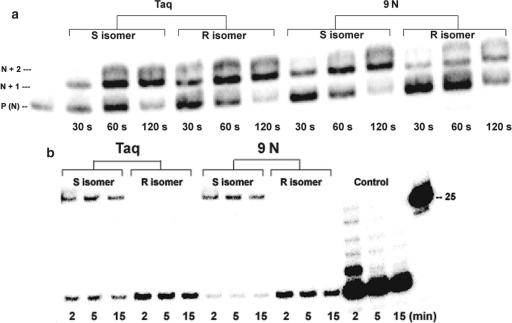
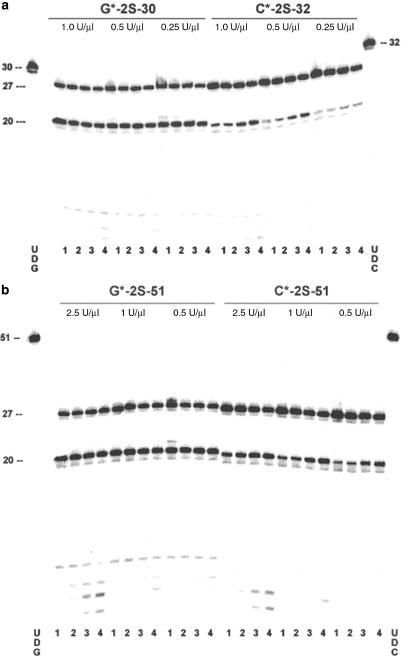
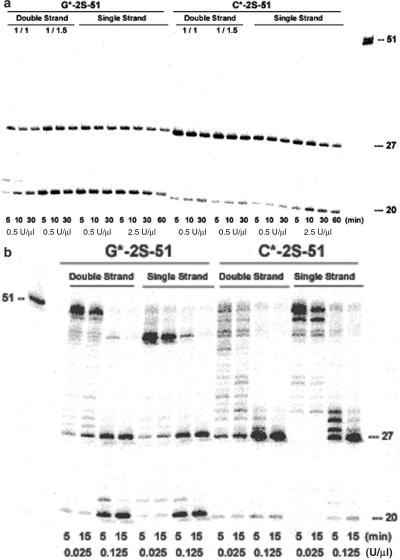
The use of DNA polymerases to incorporate phosphorothioate linkages into DNA, and the use of exonuclease III to determine where those linkages have been incorporated, are re-examined in this work. The results presented here show that exonuclease III degrades single-stranded DNA as a substrate and digests through phosphorothioate linkages having one absolute stereochemistry, assigned (assuming inversion in the polymerase reaction) as S, but not the other absolute stereochemistry. This contrasts with a general view in the literature that exonuclease III favors double-stranded nucleic acid as a substrate and stops completely at phosphorothioate linkages. Furthermore, not all DNA polymerases appear to accept exclusively the (R) stereoisomer of nucleoside alpha-thiotriphosphates [and not the (S) diastereomer], a conclusion inferred two decades ago by examination of five Family-A polymerases and a reverse transcriptase. This suggests that caution is appropriate when extrapolating the detailed behavior of one polymerase from the behaviors of other polymerases. Furthermore, these results provide constraints on how exonuclease III-thiotriphosphate-polymerase combinations can be used to analyze the behavior of the components of a synthetic biology.
本研究重新审视了使用DNA聚合酶将硫代磷酸酯键掺入DNA以及使用核酸外切酶III来确定这些键掺入位置的方法。此处呈现的结果表明,核酸外切酶III将单链DNA作为底物进行降解,并能通过具有一种绝对立体化学构型(假定在聚合酶反应中发生构型翻转)且被指定为S的硫代磷酸酯键进行消化,但不能通过另一种绝对立体化学构型的硫代磷酸酯键。这与文献中的普遍观点形成对比,即核酸外切酶III倾向于将双链核酸作为底物,并在硫代磷酸酯键处完全停止。此外,并非所有DNA聚合酶似乎都只接受核苷α-硫代三磷酸的(R)立体异构体[而不接受(S)非对映异构体],这一结论是二十年前通过对五种A家族聚合酶和一种逆转录酶的研究推断得出的。这表明在从其他聚合酶的行为推断一种聚合酶的详细行为时需谨慎。此外,这些结果对核酸外切酶III - 硫代三磷酸 - 聚合酶组合如何用于分析合成生物学组件的行为提供了限制。