Ehlers Michael D, Heine Martin, Groc Laurent, Lee Ming-Chia, Choquet Daniel
Department of Neurobiology, Howard Hughes Medical Institute, Duke University Medical Center, Durham, NC 27710, USA.
Neuron. 2007 May 3;54(3):447-60. doi: 10.1016/j.neuron.2007.04.010.
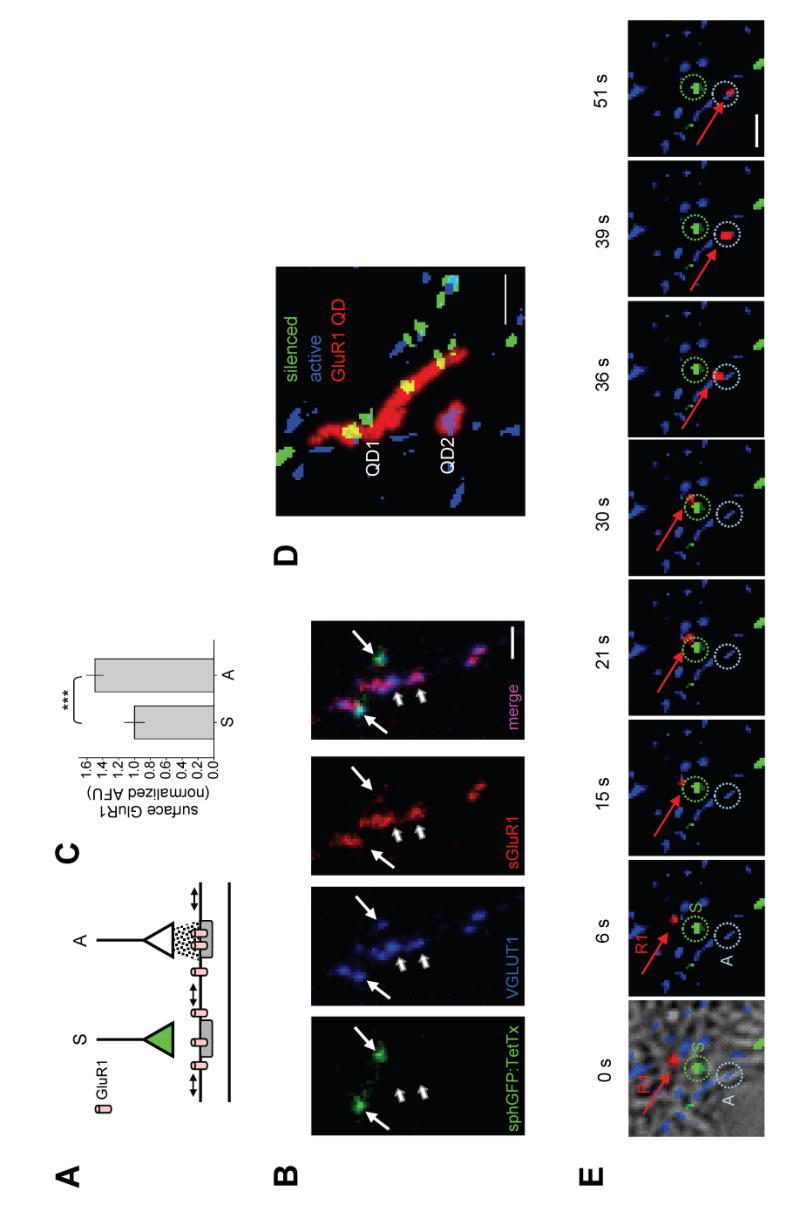
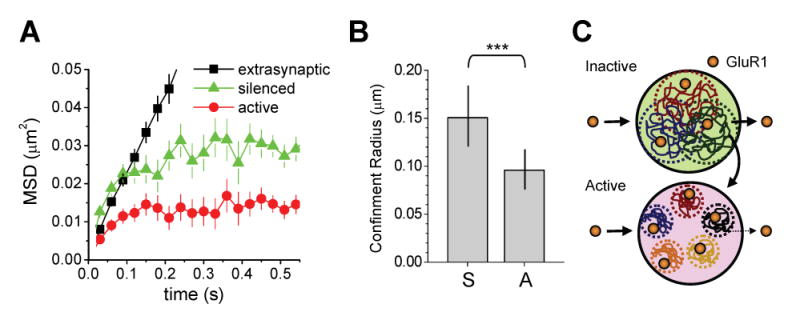
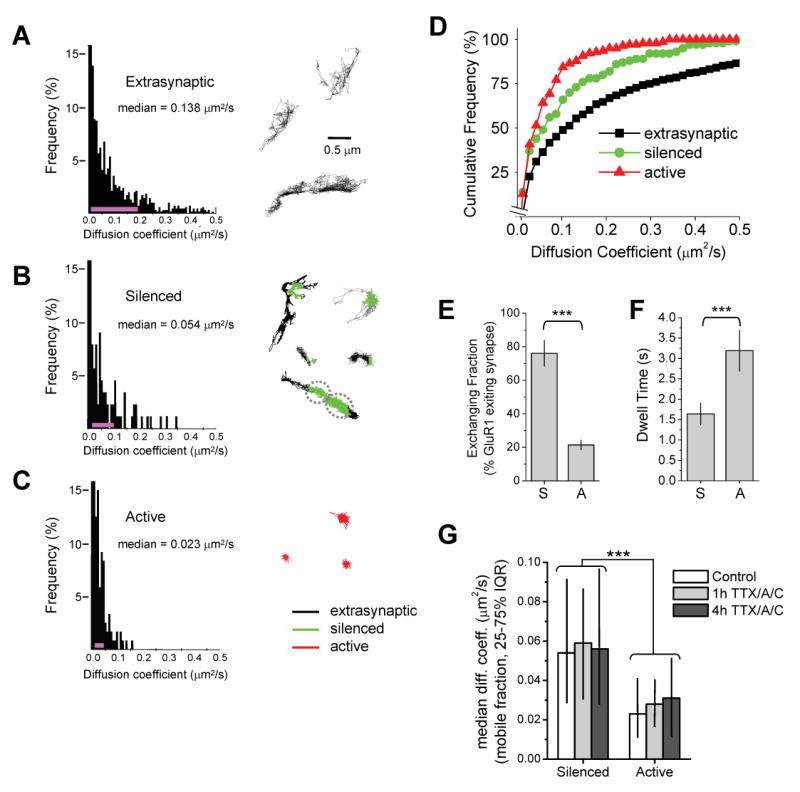
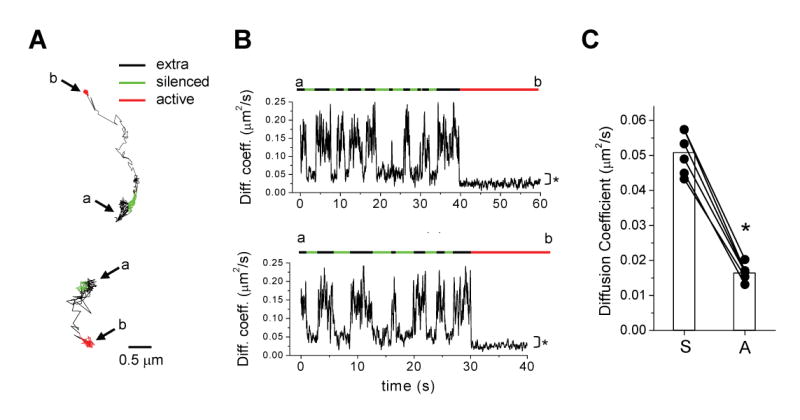
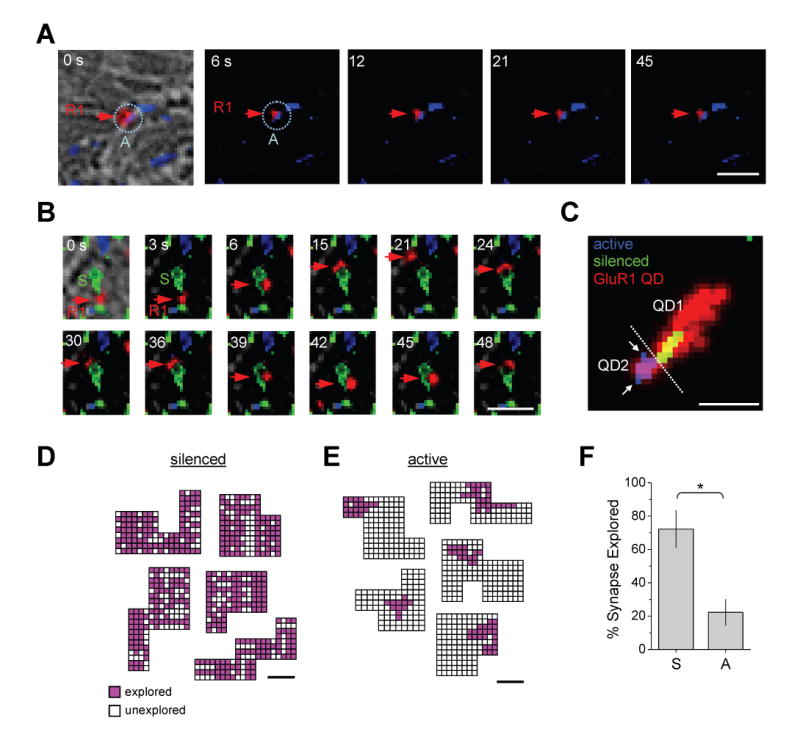
Synaptic activity regulates the postsynaptic accumulation of AMPA receptors over timescales ranging from minutes to days. Indeed, the regulated trafficking and mobility of GluR1 AMPA receptors underlies many forms of synaptic potentiation at glutamatergic synapses throughout the brain. However, the basis for synapse-specific accumulation of GluR1 is unknown. Here we report that synaptic activity locally immobilizes GluR1 AMPA receptors at individual synapses. Using single-molecule tracking together with the silencing of individual presynaptic boutons, we demonstrate that local synaptic activity reduces diffusional exchange of GluR1 between synaptic and extraynaptic domains, resulting in postsynaptic accumulation of GluR1. At neighboring inactive synapses, GluR1 is highly mobile with individual receptors frequently escaping the synapse. Within the synapse, spontaneous activity confines the diffusional movement of GluR1 to restricted subregions of the postsynaptic membrane. Thus, local activity restricts GluR1 mobility on a submicron scale, defining an input-specific mechanism for regulating AMPA receptor composition and abundance.
突触活动在从几分钟到几天的时间尺度上调节AMPA受体在突触后的积累。实际上,GluR1 AMPA受体的调控运输和移动性是大脑中谷氨酸能突触多种形式突触增强的基础。然而,GluR1在突触特异性积累的基础尚不清楚。在此我们报告,突触活动在单个突触处局部固定GluR1 AMPA受体。通过单分子追踪以及单个突触前终扣的沉默,我们证明局部突触活动减少了GluR1在突触和突触外区域之间的扩散交换,导致GluR1在突触后积累。在相邻的非活动突触处,GluR1具有高度移动性,单个受体经常逃离突触。在突触内,自发活动将GluR1的扩散运动限制在突触后膜的受限亚区域。因此,局部活动在亚微米尺度上限制了GluR1的移动性,定义了一种调节AMPA受体组成和丰度的输入特异性机制。