Bruno John F, Selig Elizabeth R, Casey Kenneth S, Page Cathie A, Willis Bette L, Harvell C Drew, Sweatman Hugh, Melendy Amy M
Department of Marine Sciences, The University of North Carolina at Chapel Hill, Chapel Hill, North Carolina, United States of America.
PLoS Biol. 2007 Jun;5(6):e124. doi: 10.1371/journal.pbio.0050124.
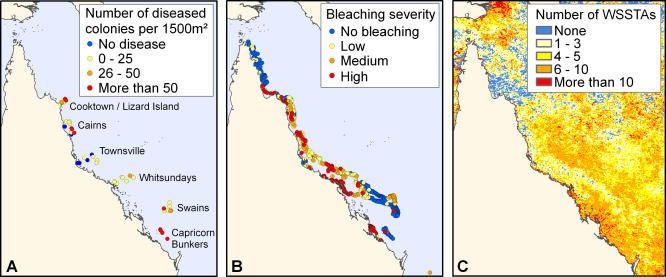
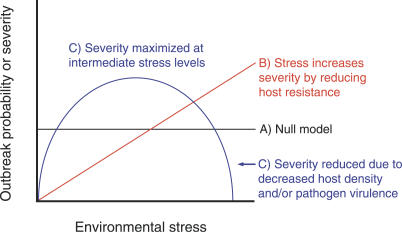
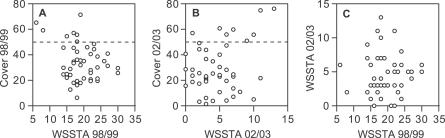
Very little is known about how environmental changes such as increasing temperature affect disease dynamics in the ocean, especially at large spatial scales. We asked whether the frequency of warm temperature anomalies is positively related to the frequency of coral disease across 1,500 km of Australia's Great Barrier Reef. We used a new high-resolution satellite dataset of ocean temperature and 6 y of coral disease and coral cover data from annual surveys of 48 reefs to answer this question. We found a highly significant relationship between the frequencies of warm temperature anomalies and of white syndrome, an emergent disease, or potentially, a group of diseases, of Pacific reef-building corals. The effect of temperature was highly dependent on coral cover because white syndrome outbreaks followed warm years, but only on high (>50%) cover reefs, suggesting an important role of host density as a threshold for outbreaks. Our results indicate that the frequency of temperature anomalies, which is predicted to increase in most tropical oceans, can increase the susceptibility of corals to disease, leading to outbreaks where corals are abundant.
关于诸如气温上升等环境变化如何影响海洋疾病动态,尤其是在大空间尺度上,我们所知甚少。我们研究了在澳大利亚大堡礁1500公里的区域内,暖温异常的频率是否与珊瑚疾病的频率呈正相关。我们使用了一个新的高分辨率海洋温度卫星数据集以及来自48个珊瑚礁年度调查的6年珊瑚疾病和珊瑚覆盖数据来回答这个问题。我们发现暖温异常频率与白综合征(一种太平洋造礁珊瑚出现的疾病,或者可能是一组疾病)的频率之间存在高度显著的关系。温度的影响高度依赖于珊瑚覆盖度,因为白综合征爆发发生在温暖年份之后,但仅发生在高(>50%)覆盖度的珊瑚礁上,这表明宿主密度作为爆发阈值具有重要作用。我们的结果表明,预计在大多数热带海洋中会增加的温度异常频率,会增加珊瑚对疾病的易感性,导致在珊瑚丰富的地方爆发疾病。