Slagter Heleen A, Lutz Antoine, Greischar Lawrence L, Francis Andrew D, Nieuwenhuis Sander, Davis James M, Davidson Richard J
Waisman Laboratory for Brain Imaging and Behavior and Department of Psychology, University of Wisconsin, Madison, Wisconsin, United States of America.
PLoS Biol. 2007 Jun;5(6):e138. doi: 10.1371/journal.pbio.0050138.
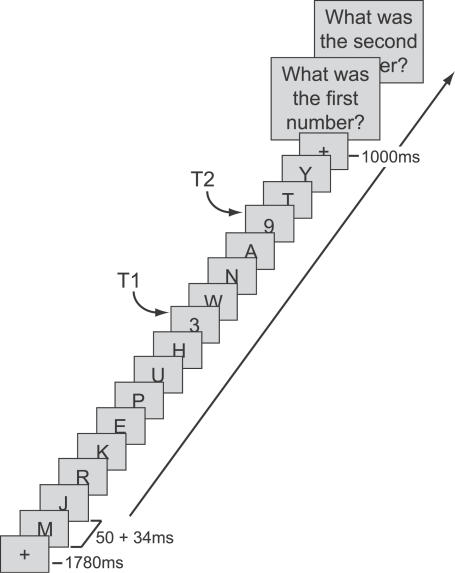
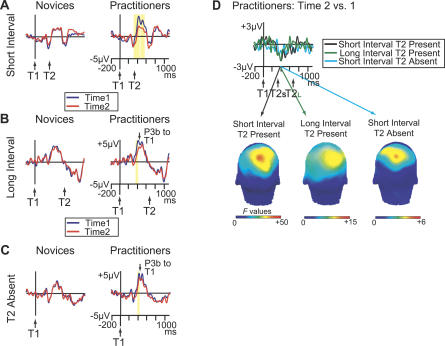
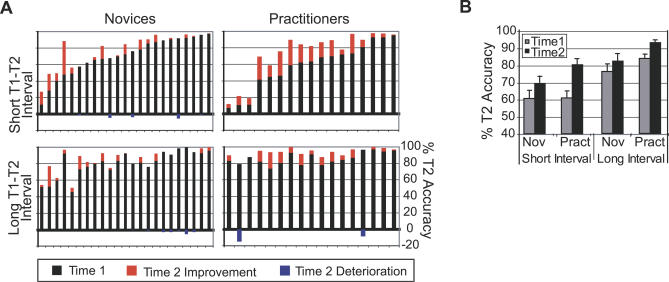
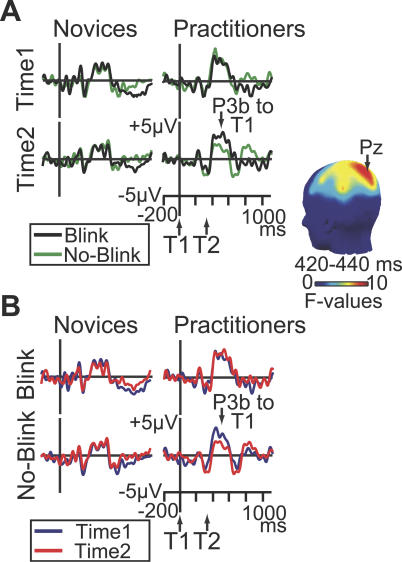
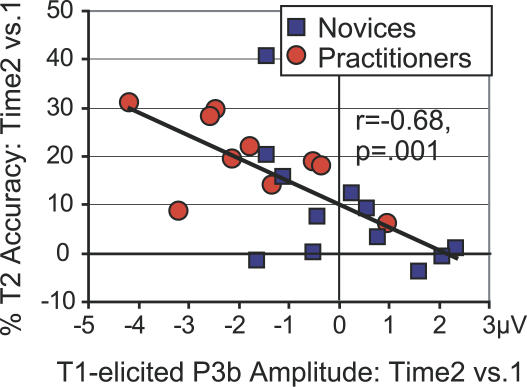
The information processing capacity of the human mind is limited, as is evidenced by the so-called "attentional-blink" deficit: When two targets (T1 and T2) embedded in a rapid stream of events are presented in close temporal proximity, the second target is often not seen. This deficit is believed to result from competition between the two targets for limited attentional resources. Here we show, using performance in an attentional-blink task and scalp-recorded brain potentials, that meditation, or mental training, affects the distribution of limited brain resources. Three months of intensive mental training resulted in a smaller attentional blink and reduced brain-resource allocation to the first target, as reflected by a smaller T1-elicited P3b, a brain-potential index of resource allocation. Furthermore, those individuals that showed the largest decrease in brain-resource allocation to T1 generally showed the greatest reduction in attentional-blink size. These observations provide novel support for the view that the ability to accurately identify T2 depends upon the efficient deployment of resources to T1. The results also demonstrate that mental training can result in increased control over the distribution of limited brain resources. Our study supports the idea that plasticity in brain and mental function exists throughout life and illustrates the usefulness of systematic mental training in the study of the human mind.
人类思维的信息处理能力是有限的,这一点在所谓的“注意瞬脱”缺陷中得到了证明:当嵌入快速事件流中的两个目标(T1和T2)在时间上紧密相邻呈现时,第二个目标往往会被忽视。这种缺陷被认为是由于两个目标争夺有限的注意力资源所致。在这里,我们通过注意瞬脱任务中的表现和头皮记录的脑电活动表明,冥想或心理训练会影响有限脑资源的分配。三个月的强化心理训练导致注意瞬脱变小,并且对第一个目标的脑资源分配减少,这通过较小的T1诱发的P3b反映出来,P3b是资源分配的脑电指标。此外,那些对T1的脑资源分配减少最多的个体,其注意瞬脱大小的减少通常也最大。这些观察结果为以下观点提供了新的支持,即准确识别T2的能力取决于对T1的资源有效分配。结果还表明,心理训练可以增强对有限脑资源分配的控制。我们的研究支持了这样一种观点,即大脑和心理功能的可塑性在一生中都存在,并说明了系统心理训练在人类思维研究中的有用性。