Goel S, Gupta A K, Singh A, Lenka S R
Department of Community Medicine, Post Graduate Institute of Medical Education and Research, Chandigarh, India.
J Hosp Infect. 2007 Jun;66(2):142-7. doi: 10.1016/j.jhin.2007.02.015. Epub 2007 May 18.
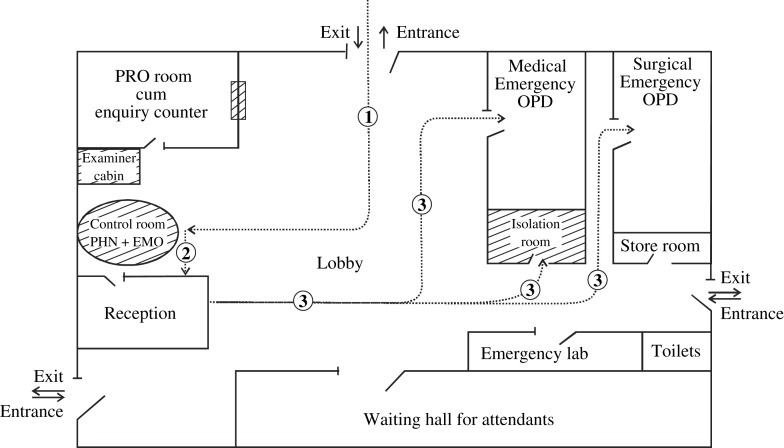
This short-term observational study of infection control practice was performed in the medical emergency outpatient department (EMOPD) of a tertiary-care hospital in India when threatened by an outbreak of severe acute respiratory syndrome (SARS). An investigator attended the lobby daily to screen patients with symptoms for SARS. Patient/attendant load, patient flow, medical staff working practices and position in the EMOPD were observed. Infection control measures such as fumigation and cleaning were noted, as was the EMOPD laboratory function, use of personnel protection and display of information on infectious diseases. A total of 162 (7.4%) of the 2165 patients surveyed had respiratory symptoms but no cases of SARS were found. The flow of patients and their attendants was not systematic. No laboratory tests for SARS were available, and no educational material on SARS was displayed. The EMOPDs in key hospitals need be able to screen for infectious diseases, especially in view of the threats from SARS and Avian influenza.
这项关于感染控制措施的短期观察性研究,是在印度一家三级医院的医疗急诊门诊部(EMOPD)面临严重急性呼吸综合征(SARS)爆发威胁时开展的。一名调查员每天在大厅筛查有SARS症状的患者。观察了患者/陪护人员数量、患者流量、医务人员的工作习惯以及他们在医疗急诊门诊部的位置。记录了熏蒸和清洁等感染控制措施,以及医疗急诊门诊部实验室的功能、个人防护用品的使用情况和传染病信息的展示情况。在接受调查的2165名患者中,共有162名(7.4%)有呼吸道症状,但未发现SARS病例。患者及其陪护人员的流动缺乏系统性。没有可用的SARS实验室检测方法,也未展示有关SARS的教育资料。重点医院的医疗急诊门诊部需要具备筛查传染病的能力,尤其是考虑到SARS和禽流感带来的威胁。