Zinn Andrew R, Roeltgen David, Stefanatos Gerry, Ramos Purita, Elder Frederick F, Kushner Harvey, Kowal Karen, Ross Judith L
Eugene McDermott Center for Human Growth and Development and Department of Internal Medicine, The University of Texas Southwestern Medical School, Dallas TX, USA.
Behav Brain Funct. 2007 May 21;3:24. doi: 10.1186/1744-9081-3-24.
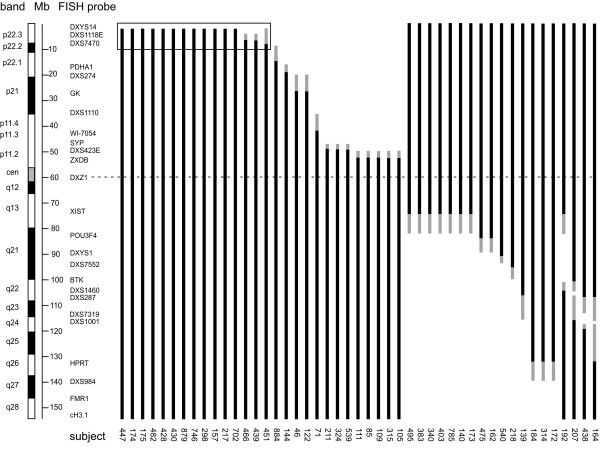
Turner syndrome (TS) is associated with a neurocognitive phenotype that includes selective nonverbal deficits, e.g., impaired visual-spatial abilities. We previously reported evidence that this phenotype results from haploinsufficiency of one or more genes on distal Xp. This inference was based on genotype/phenotype comparisons of individual girls and women with partial Xp deletions, with the neurocognitive phenotype considered a dichotomous trait. We sought to confirm our findings in a large cohort (n = 47) of adult women with partial deletions of Xp or Xq, enriched for subjects with distal Xp deletions.
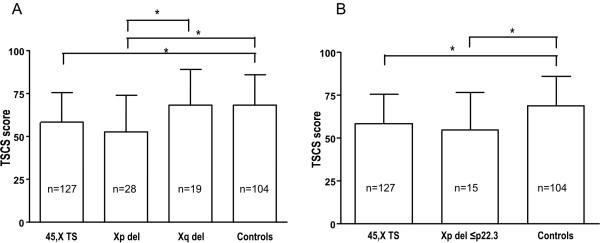
Subjects were recruited from North American genetics and endocrinology clinics. Phenotype assessment included measures of stature, ovarian function, and detailed neurocognitive testing. The neurocognitive phenotype was measured as a quantitative trait, the Turner Syndrome Cognitive Summary (TSCS) score, derived from discriminant function analysis. Genetic analysis included karyotyping, X inactivation studies, fluorescent in situ hybridization, microsatellite marker genotyping, and array comparative genomic hybridization.
We report statistical evidence that deletion of Xp22.3, an interval containing 31 annotated genes, is sufficient to cause the neurocognitive phenotype described by the TSCS score. Two other cardinal TS features, ovarian failure and short stature, as well as X chromosome inactivation pattern and subject's age, were unrelated to the TSCS score.
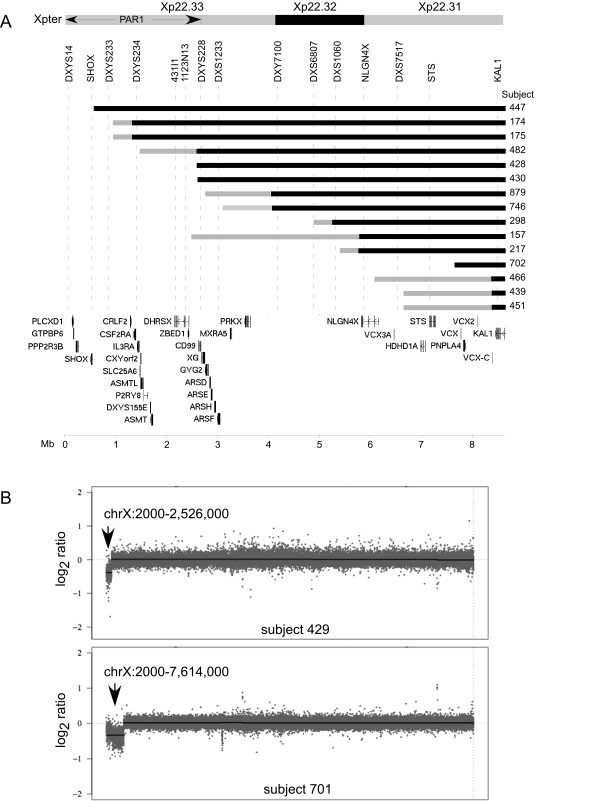
Detailed mapping suggests that haploinsufficiency of one or more genes in Xp22.3, the distal 8.3 megabases (Mb) of the X chromosome, is responsible for a TS neurocognitive phenotype. This interval includes the 2.6 Mb Xp-Yp pseudoautosomal region (PAR1). Haploinsufficiency of the short stature gene SHOX in PAR1 probably does not cause this TS neurocognitive phenotype. Two genes proximal to PAR1 within the 8.3 Mb critical region, STS and NLGN4X, are attractive candidates for this neurocognitive phenotype.
特纳综合征(TS)与一种神经认知表型相关,该表型包括选择性非语言缺陷,例如视觉空间能力受损。我们之前报告有证据表明,这种表型是由Xp远端一个或多个基因的单倍剂量不足导致的。这一推断是基于对部分Xp缺失的个体女孩和女性进行的基因型/表型比较,其中神经认知表型被视为一种二分性状。我们试图在一个大型队列(n = 47)的成年女性中证实我们的发现,这些女性存在部分Xp或Xq缺失,且以远端Xp缺失的受试者为主。
受试者从北美遗传学和内分泌诊所招募。表型评估包括身高、卵巢功能测量以及详细的神经认知测试。神经认知表型通过特纳综合征认知总结(TSCS)评分作为定量性状进行测量,该评分源自判别函数分析。基因分析包括核型分析、X染色体失活研究、荧光原位杂交、微卫星标记基因分型以及阵列比较基因组杂交。
我们报告了统计学证据,表明Xp22.区域(包含31个注释基因的一个区间)的缺失足以导致TSCS评分所描述的神经认知表型。特纳综合征的另外两个主要特征,卵巢功能衰竭和身材矮小,以及X染色体失活模式和受试者年龄,均与TSCS评分无关。
详细定位表明,X染色体远端8.3兆碱基(Mb)的Xp22.3中一个或多个基因的单倍剂量不足是导致特纳综合征神经认知表型的原因。这个区间包括2.6 Mb的Xp - Yp假常染色体区域(PAR1)。PAR1中身材矮小基因SHOX的单倍剂量不足可能不会导致这种特纳综合征神经认知表型。在8.3 Mb关键区域内PAR1近端的两个基因,STS和NLGN4X,是这种神经认知表型的有吸引力的候选基因。