García Rodríguez Luis Alberto, Egan Karine, FitzGerald Garret A
Centro Español de Investigación Farmacoepidemiológica, Madrid, Spain.
PLoS Med. 2007 May;4(5):e157. doi: 10.1371/journal.pmed.0040157.
Suppression of prostacyclin (PGI2) is implicated in the cardiovascular hazard from inhibitors of cyclooxygenase (COX)-2. Furthermore, estrogen confers atheroprotection via COX-2-dependent PGI2 in mice, raising the possibility that COX inhibitors may undermine the cardioprotection, suggested by observational studies, of endogenous or exogenous estrogens.
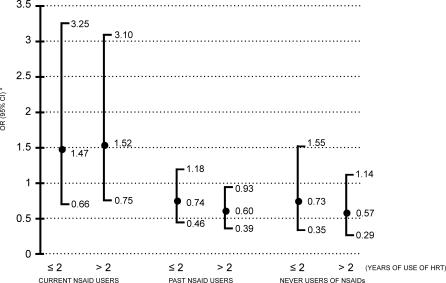
To identify an interaction between hormone therapy (HT) and COX inhibition, we measured a priori the association between concomitant nonsteroidal anti-inflammatory drugs (NSAIDs), excluding aspirin, in peri- and postmenopausal women on HT and the incidence of myocardial infarction (MI) in a population-based epidemiological study. The odds ratio (OR) of MI in 1,673 individuals and 7,005 controls was increased from 0.66 (95% confidence interval [CI] 0.50-0.88) when taking HT in the absence of traditional (t)NSAIDs to 1.50 (95% CI 0.85-2.64) when taking the combination of HT and tNSAIDs, resulting in a significant (p < 0.002) interaction. The OR when taking aspirin at doses of 150 mg/d or more was 1.41 (95% CI 0.47-4.22). However, a similar interaction was not observed with other commonly used drugs, including lower doses of aspirin, which target preferentially COX-1.
Whether estrogens confer cardioprotection remains controversial. Such a benefit was observed only in perimenopausal women in the only large randomized trial designed to address this issue. Should such a benefit exist, these results raise the possibility that COX inhibitors may undermine the cardioprotective effects of HT.
前列环素(PGI2)的抑制与环氧化酶(COX)-2抑制剂引发的心血管风险有关。此外,雌激素通过COX-2依赖的PGI2在小鼠中发挥抗动脉粥样硬化保护作用,这增加了一种可能性,即COX抑制剂可能会破坏观察性研究中所提示的内源性或外源性雌激素的心脏保护作用。
为了确定激素治疗(HT)与COX抑制之间的相互作用,我们在一项基于人群的流行病学研究中,预先测量了接受HT的围绝经期和绝经后女性同时使用非甾体抗炎药(NSAIDs,不包括阿司匹林)与心肌梗死(MI)发生率之间的关联。1673例个体和7005例对照中,在不使用传统(t)NSAIDs而接受HT时,MI的比值比(OR)为0.66(95%置信区间[CI] 0.50 - 0.88),而在接受HT与tNSAIDs联合使用时,OR增加至1.50(95% CI 0.85 - 2.64),导致显著的(p < 0.002)相互作用。当服用剂量为150 mg/d或更高的阿司匹林时,OR为1.41(95% CI 0.47 - 4.22)。然而,在其他常用药物中未观察到类似的相互作用,包括较低剂量的阿司匹林,其优先作用于COX-1。
雌激素是否具有心脏保护作用仍存在争议。在唯一一项旨在解决此问题的大型随机试验中,仅在围绝经期女性中观察到了这种益处。如果确实存在这种益处,这些结果增加了COX抑制剂可能破坏HT心脏保护作用的可能性。