Parikh Neha, Koshy Caroline, Dhayabaran Vaigundan, Perumalsamy Lakshmi R, Sowdhamini R, Sarin Apurva
National Centre for Biological Sciences, Bangalore, Karnataka, India.
BMC Cell Biol. 2007 May 23;8:16. doi: 10.1186/1471-2121-8-16.
Bcl-2 family proteins are key regulators of mitochondrial integrity and comprise both pro- and anti-apoptotic proteins. Bax a pro-apoptotic member localizes as monomers in the cytosol of healthy cells and accumulates as oligomers in mitochondria of apoptotic cells. The Bcl-2 homology-3 (BH3) domain regulates interactions within the family, but regions other than BH3 are also critical for Bax function. Thus, the N-terminus has been variously implicated in targeting to mitochondria, interactions with BH3-only proteins as well as conformational changes linked to Bax activation. The transmembrane (TM) domains (alpha5-alpha6 helices in the core and alpha9 helix in the C-terminus) in Bax are implicated in localization to mitochondria and triggering cytotoxicity. Here we have investigated N-terminus modulation of TM function in the context of regulation by the anti-apoptotic protein Bcl-xL.
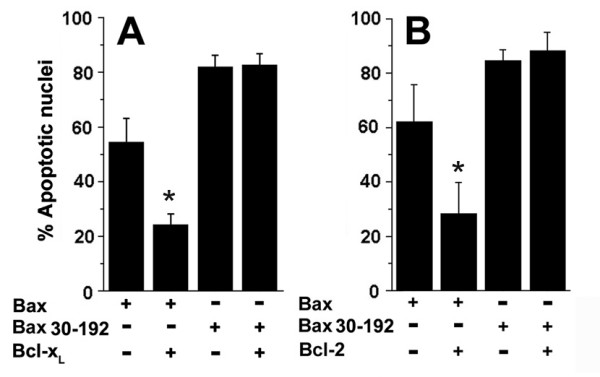
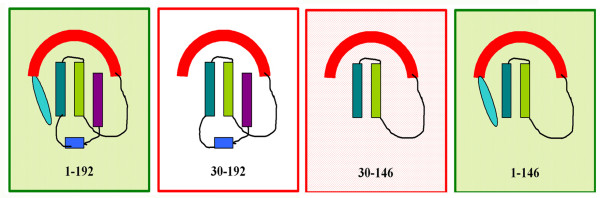
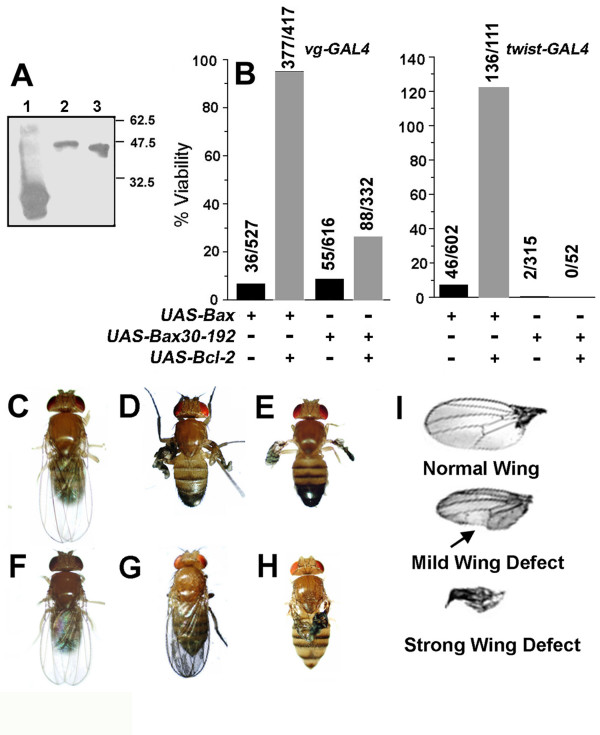
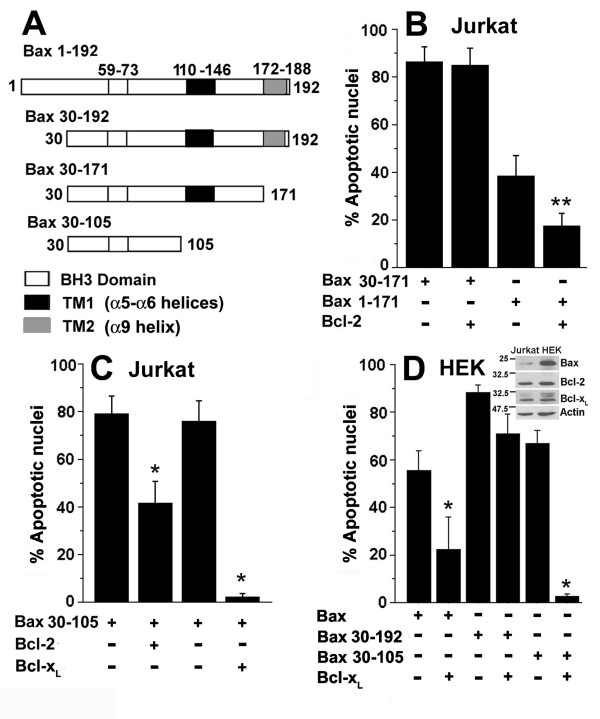
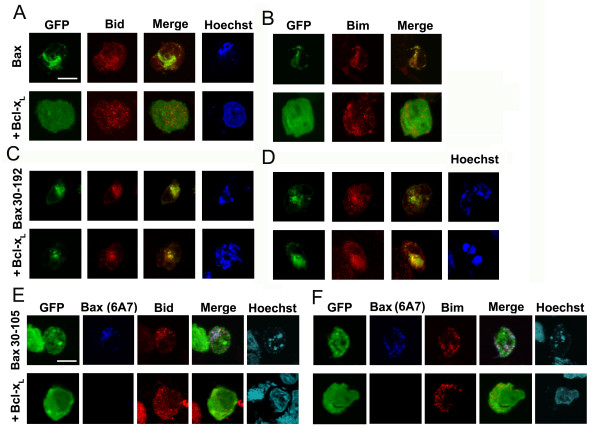
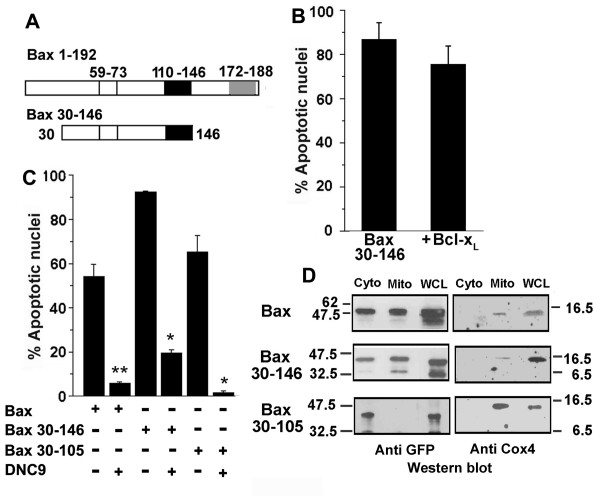
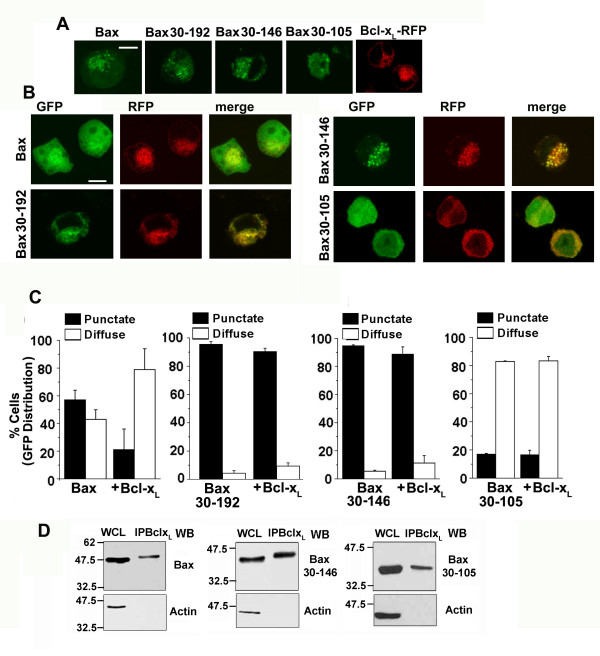
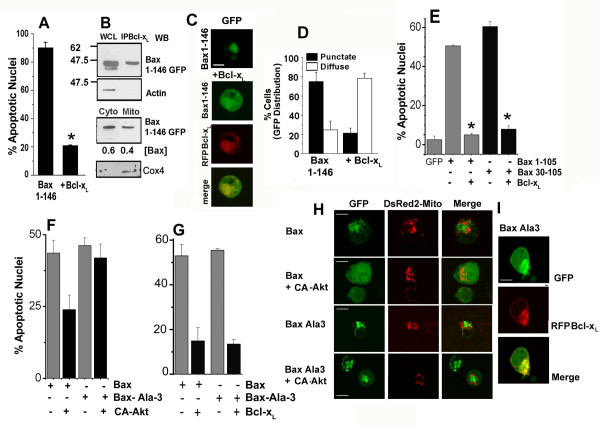
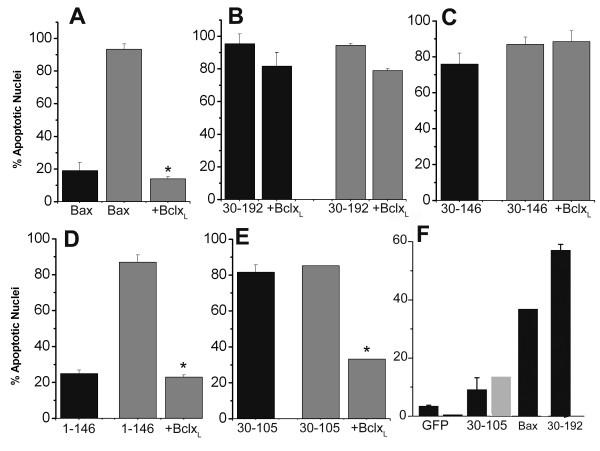
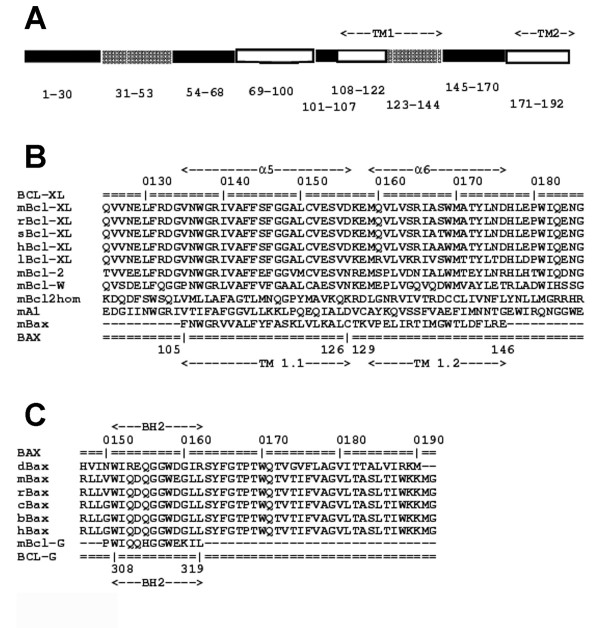
Deletion of 29 amino acids in the Bax N-terminus (Bax 30-192) caused constitutive accumulation at mitochondria and triggered high levels of cytotoxicity, not inhibited by Bcl-xL. Removal of the TM domains (Bax 30-105) abrogated mitochondrial localization but resulted in Bcl-xL regulated activation of endogenous Bax and Bax-Bak dependent apoptosis. Inclusion of the alpha5-alpha6 helices/TMI domain (Bax 30-146) phenocopied Bax 30-192 as it restored mitochondrial localization, Bcl-xL independent cytotoxicity and was not dependent on endogenous Bax-Bak. Inhibition of function and localization by Bcl-xL was restored in Bax 1-146, which included the TM1 domain. Regardless of regulation by Bcl-xL, all N-terminal deleted constructs immunoprecipitated Bcl-xLand converged on caspase-9 dependent apoptosis consistent with mitochondrial involvement in the apoptotic cascade. Sub-optimal sequence alignments of Bax and Bcl-xL indicated a sequence similarity between the alpha5-alpha6 helices of Bax and Bcl-xL. Alanine substitutions of three residues (T14A-S15A-S16A) in the N-terminus (Bax-Ala3) attenuated regulation by the serine-threonine kinase Akt/PKB but not by Bcl-xL indicative of distinct regulatory mechanisms.
Collectively, the analysis of Bax deletion constructs indicates that the N-terminus drives conformational changes facilitating inhibition of cytotoxicity by Bcl-xL. We speculate that the TM1 helices may serve as 'structural antagonists' for BH3-Bcl-xL interactions, with this function being regulated by the N-terminus in the intact protein.
Bcl-2家族蛋白是线粒体完整性的关键调节因子,包括促凋亡蛋白和抗凋亡蛋白。促凋亡成员Bax在健康细胞的胞质溶胶中以单体形式定位,在凋亡细胞的线粒体中以寡聚体形式积累。Bcl-2同源3(BH3)结构域调节家族内的相互作用,但BH3以外的区域对Bax功能也至关重要。因此,N端在靶向线粒体、与仅含BH3的蛋白相互作用以及与Bax激活相关的构象变化中具有多种作用。Bax中的跨膜(TM)结构域(核心中的α5-α6螺旋和C端的α9螺旋)与线粒体定位和触发细胞毒性有关。在这里,我们研究了在抗凋亡蛋白Bcl-xL调节的背景下,N端对TM功能的调节作用。
Bax N端缺失29个氨基酸(Bax 30-192)导致其在线粒体中组成性积累并引发高水平的细胞毒性,且不受Bcl-xL抑制。去除TM结构域(Bax 30-105)消除了线粒体定位,但导致Bcl-xL调节内源性Bax的激活以及Bax-Bak依赖性凋亡。包含α5-α6螺旋/TM1结构域(Bax 30-146)模拟了Bax 30-192的情况,因为它恢复了线粒体定位、不依赖Bcl-xL的细胞毒性,且不依赖内源性Bax-Bak。在包含TM1结构域的Bax 1-146中,Bcl-xL对功能和定位的抑制作用得以恢复。无论是否受Bcl-xL调节,所有N端缺失的构建体都能免疫沉淀Bcl-xL,并汇聚于caspase-9依赖性凋亡,这与线粒体参与凋亡级联反应一致。Bax和Bcl-xL的次优序列比对表明,Bax的α5-α6螺旋与Bcl-xL之间存在序列相似性。N端三个残基(T14A-S15A-S16A)的丙氨酸取代(Bax-Ala3)减弱了丝氨酸-苏氨酸激酶Akt/PKB的调节作用,但不影响Bcl-xL的调节作用,这表明存在不同的调节机制。
总体而言,对Bax缺失构建体的分析表明,N端驱动构象变化,促进Bcl-xL对细胞毒性的抑制。我们推测,TM1螺旋可能作为BH3-Bcl-xL相互作用的“结构拮抗剂”,而这种功能在完整蛋白中受N端调节。