Levy Jonathan I, Wilson Andrew M, Zwack Leonard M
Department of Environmental Health, Exposure Epidemiology and Risk Program, and Harvard Center for Risk Analysis, Harvard School of Public Health, Boston, Massachusetts 02215, USA.
Environ Health Perspect. 2007 May;115(5):743-50. doi: 10.1289/ehp.9712. Epub 2007 Jan 22.
In deciding among competing approaches for emissions control, debates often hinge on the potential tradeoffs between efficiency and equity. However, previous health benefits analyses have not formally addressed both dimensions.
We modeled the public health benefits and the change in the spatial inequality of health risk for a number of hypothetical control scenarios for power plants in the United States to determine optimal control strategies.
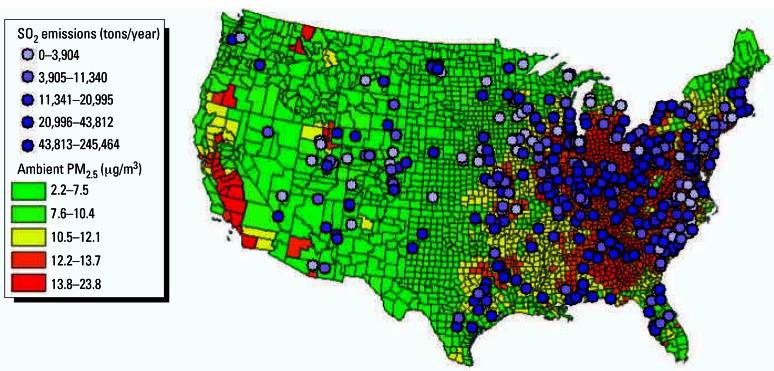
We simulated various ways by which emission reductions of sulfur dioxide (SO(2)), nitrogen oxides, and fine particulate matter (particulate matter < 2.5 microm in diameter; PM(2.5)) could be distributed to reach national emissions caps. We applied a source-receptor matrix to determine the PM(2.5) concentration changes associated with each control scenario and estimated the mortality reductions. We estimated changes in the spatial inequality of health risk using the Atkinson index and other indicators, following previously derived axioms for measuring health risk inequality.
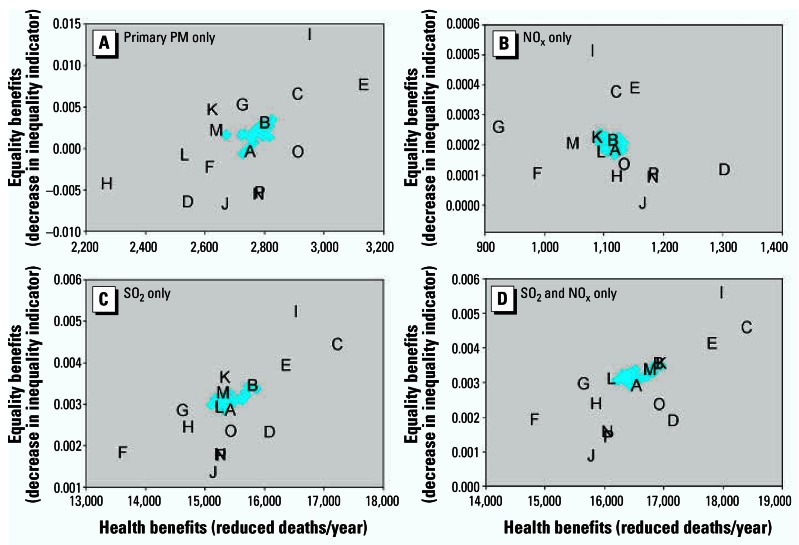
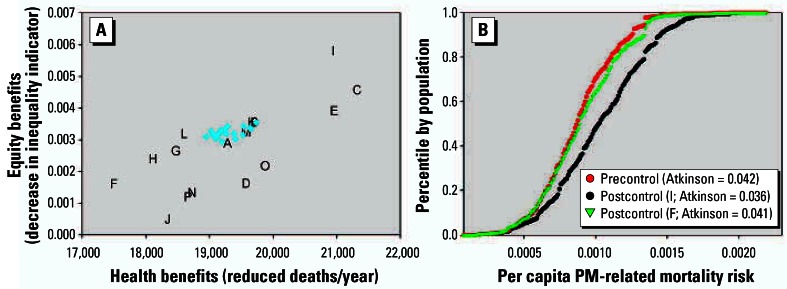
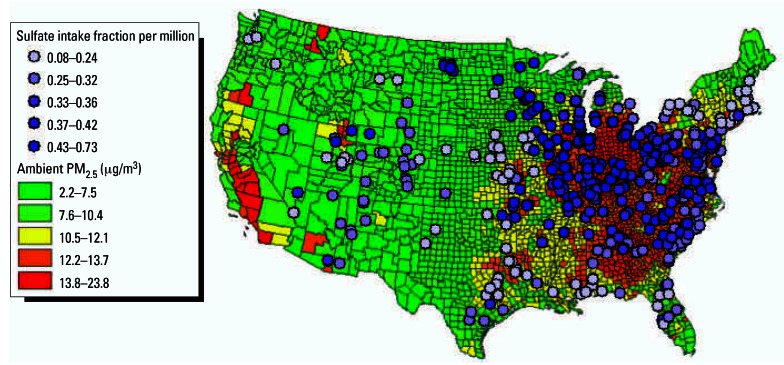
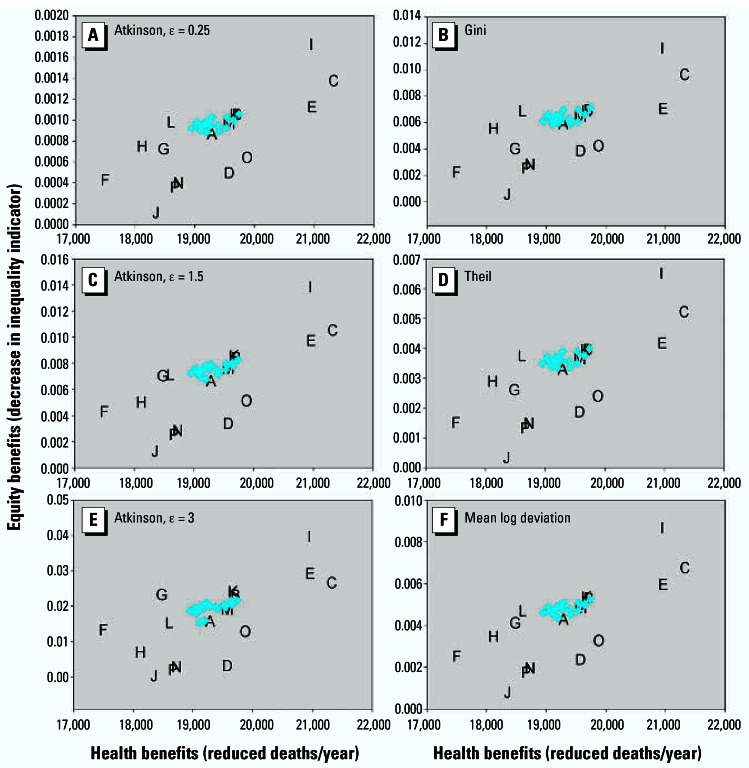
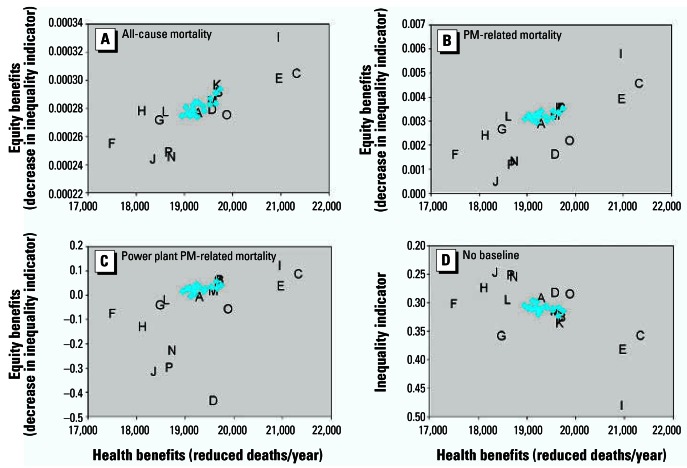
In our baseline model, benefits ranged from 17,000-21,000 fewer premature deaths per year across control scenarios. Scenarios with greater health benefits also tended to have greater reductions in the spatial inequality of health risk, as many sources with high health benefits per unit emissions of SO(2) were in areas with high background PM(2.5) concentrations. Sensitivity analyses indicated that conclusions were generally robust to the choice of indicator and other model specifications.
Our analysis demonstrates an approach for formally quantifying both the magnitude and spatial distribution of health benefits of pollution control strategies, allowing for joint consideration of efficiency and equity.
在决定采用何种排放控制方法时,争论往往集中在效率与公平之间可能的权衡上。然而,以往的健康效益分析并未正式涉及这两个方面。
我们针对美国发电厂的一些假设控制情景,模拟了公共健康效益以及健康风险空间不平等性的变化,以确定最优控制策略。
我们模拟了多种将二氧化硫(SO₂)、氮氧化物和细颗粒物(直径小于2.5微米的颗粒物;PM₂.₅)减排量分配以达到国家排放上限的方式。我们应用源 - 受体矩阵来确定与每个控制情景相关的PM₂.₅浓度变化,并估算死亡率的降低情况。我们按照先前推导的衡量健康风险不平等性的公理,使用阿特金森指数和其他指标估算健康风险空间不平等性的变化。
在我们的基线模型中,各控制情景下每年减少的过早死亡人数在17,000 - 21,000人之间。健康效益更大的情景往往在健康风险空间不平等性方面的降低幅度也更大,因为许多单位SO₂排放量健康效益高的源位于背景PM₂.₅浓度高的地区。敏感性分析表明,结论通常对指标选择和其他模型设定具有稳健性。
我们的分析展示了一种正式量化污染控制策略健康效益的规模和空间分布的方法,从而能够同时考虑效率与公平。