Barraj Leila M, Tsuji Joyce S, Scrafford Carolyn G
Center for Chemical Regulation and Food Safety, Exponent, Inc., Washington, DC 20036, USA.
Environ Health Perspect. 2007 May;115(5):781-6. doi: 10.1289/ehp.9741. Epub 2007 Feb 21.
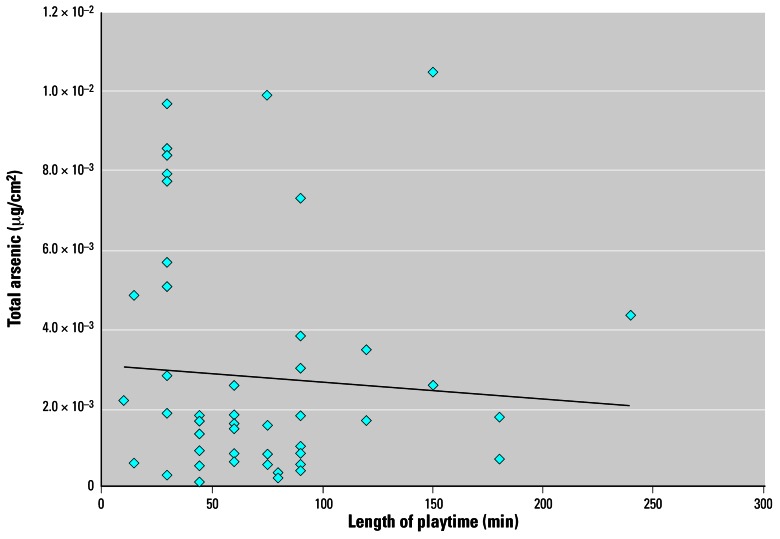
Lumber treated with chromated copper arsenate (CCA) compounds has been used in residential outdoor wood structures and public playgrounds. The U.S. Environmental Protection Agency (EPA) has conducted a probabilistic assessment of children's exposure to arsenic using the Stochastic Human Exposure and Dose Simulation model for the wood preservative scenario (SHEDS-Wood). The assessment relied on data derived from an experimental study conducted using adult volunteers and designed to result in maximum hand and wipe loadings to estimate the residue-skin transfer efficiency. Recent analyses of arsenic hand-loading data generated by studies of children actively involved in playing on CCA-treated structures indicate that the transfer efficiency coefficient and hand-loading estimates derived from the experimental study significantly overestimate the amount that occurs during actual play.
Our goal was to assess the feasibility of using child hand-loading data in the SHEDS-Wood model and their impact on exposure estimates.
We used data generated by the larger of the studies of children in SHEDS-Wood, instead of the distributions used by U.S. EPA. We compared our estimates of the lifetime average daily dose (LADD) and average daily dose (ADD) with those derived by the U.S. EPA.
Our analysis indicates that data from observational studies of children can be used in SHEDS-Wood. Our estimates of the mean (and 95th percentile) LADD and ADD were 27% (10%) and 29% (15%) of the estimates derived by U.S. EPA.
We recommend that the SHEDS-Woods model use data from studies of children actively playing on playsets to more accurately estimate children's actual exposures to CCA.
经铬酸铜砷酸盐(CCA)化合物处理的木材已用于住宅户外木结构和公共游乐场。美国环境保护局(EPA)使用木材防腐剂情景下的随机人类暴露和剂量模拟模型(SHEDS-Wood)对儿童接触砷的情况进行了概率评估。该评估依赖于一项使用成年志愿者进行的实验研究得出的数据,该研究旨在产生最大的手部和擦拭负荷,以估计残留物向皮肤的转移效率。最近对积极参与在经CCA处理的结构上玩耍的儿童的研究产生的砷手部负荷数据的分析表明,从实验研究得出的转移效率系数和手部负荷估计值显著高估了实际玩耍期间发生的量。
我们的目标是评估在SHEDS-Wood模型中使用儿童手部负荷数据的可行性及其对暴露估计的影响。
我们使用了SHEDS-Wood中较大的儿童研究产生的数据,而不是美国环境保护局使用的分布数据。我们将我们对终身平均每日剂量(LADD)和平均每日剂量(ADD)的估计与美国环境保护局得出的估计值进行了比较。
我们的分析表明,来自儿童观察性研究的数据可用于SHEDS-Wood。我们对平均(和第95百分位数)LADD和ADD的估计分别为美国环境保护局得出的估计值的27%(10%)和29%(15%)。
我们建议SHEDS-Woods模型使用来自积极在游乐设施上玩耍的儿童研究的数据,以更准确地估计儿童实际接触CCA的情况。