Mertens zur Borg Ingrid R A M, Di Biase Manuela, Verbrugge Serge, Ijzermans Jan N M, Gommers Diederik
Department of Anesthesiology, Erasmus University Medical Center, Rotterdam, The Netherlands.
Surg Endosc. 2008 Jan;22(1):146-50. doi: 10.1007/s00464-007-9391-9. Epub 2007 May 24.
Pneumoperitoneum (PP), as used for laparoscopic procedures, impairs stroke volume, renal blood flow, glomerular filtration rate and urine output. This study investigated whether perioperative fluid management can abolish these negative effects of PP on hemodynamics.
Twenty-one patients undergoing laparoscopic donor nephrectomy (LDN) were randomized into three groups: group 1 received overnight infusion and received a bolus of colloid before induction of anesthesia, followed by a bolus just before PP; group 2 received overnight infusion and a colloid bolus before anesthesia; group 3 served as controls and received only infusion during operation. All three groups received the same total amount of crystalloids and colloids until nephrectomy. Data analysis of the donor included; mean arterial pressure (MAP), stroke volume (SV), left ventricular ejection time (LVETc), perioperative urine output and renal function measured as the creatinine clearance (CrCl) until one-year post-operative.
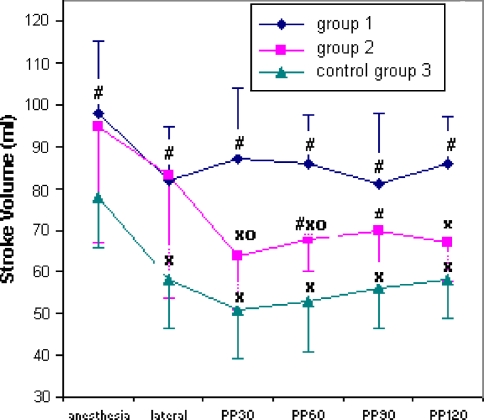
SV was significantly higher in group 1 compared to controls for all measurements. In the control group SV significantly decreased after changing from the supine to lateral position whereas there was no change in SV in both pre-hydrated groups. In all groups, MAP decreased after induction of anesthesia, and restored to pre-anesthetic values during PP. CrCl decreased in the control group during PP, but not in the other groups. From two days postoperative, CrCl was comparable between the three study groups.
Overnight infusion and a bolus of colloid just before PP attenuate hemodynamic compromise from PP.
用于腹腔镜手术的气腹(PP)会损害心输出量、肾血流量、肾小球滤过率和尿量。本研究调查围手术期液体管理是否能消除PP对血流动力学的这些负面影响。
21例行腹腔镜供肾切除术(LDN)的患者被随机分为三组:第1组接受过夜输液,并在麻醉诱导前给予一次胶体推注,然后在气腹前再给予一次推注;第2组接受过夜输液并在麻醉前给予一次胶体推注;第3组作为对照组,仅在手术期间接受输液。三组在肾切除术前接受相同总量的晶体液和胶体液。对供体的数据分析包括:平均动脉压(MAP)、心输出量(SV)、左心室射血时间(LVETc)、围手术期尿量以及以肌酐清除率(CrCl)衡量的肾功能,直至术后一年。
在所有测量中,第1组的SV显著高于对照组。在对照组中,从仰卧位变为侧卧位后SV显著下降,而在两组预先补液的组中SV没有变化。在所有组中,麻醉诱导后MAP下降,并在气腹期间恢复到麻醉前值。气腹期间对照组的CrCl下降,但其他组没有。术后两天开始,三个研究组之间的CrCl相当。
过夜输液并在气腹前给予一次胶体推注可减轻气腹引起的血流动力学损害。