Peterson Leigh, Taylor Doug, Roddy Ronald, Belai Ghiorghis, Phillips Pamela, Nanda Kavita, Grant Robert, Clarke Edith Essie Kekawo, Doh Anderson Sama, Ridzon Renee, Jaffe Howard S, Cates Willard
Family Health International, Durham, North Carolina, United States of America.
PLoS Clin Trials. 2007 May 25;2(5):e27. doi: 10.1371/journal.pctr.0020027.
The objective of this trial was to investigate the safety and preliminary effectiveness of a daily dose of 300 mg of tenofovir disoproxil fumarate (TDF) versus placebo in preventing HIV infection in women.
This was a phase 2, randomized, double-blind, placebo-controlled trial.
The study was conducted between June 2004 and March 2006 in Tema, Ghana; Douala, Cameroon; and Ibadan, Nigeria.
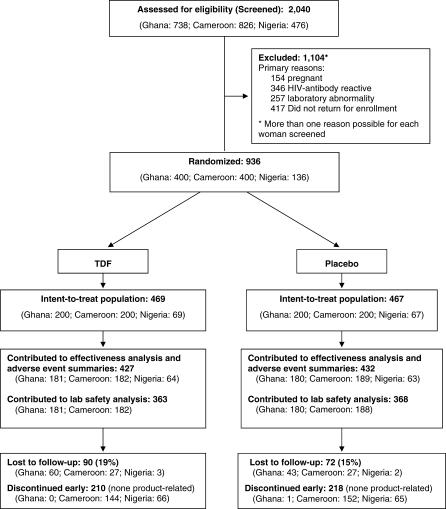
We enrolled 936 HIV-negative women at high risk of HIV infection into this study.
Participants were randomized 1:1 to once daily use of 300 mg of TDF or placebo.
The primary safety endpoints were grade 2 or higher serum creatinine elevations (>2.0 mg/dl) for renal function, grade 3 or 4 aspartate aminotransferase or alanine aminotransferase elevations (>170 U/l) for hepatic function, and grade 3 or 4 phosphorus abnormalities (<1.5 mg/dl). The effectiveness endpoint was infection with HIV-1 or HIV-2.
Study participants contributed 428 person-years of laboratory testing to the primary safety analysis. No significant differences emerged between treatment groups in clinical or laboratory safety outcomes. Study participants contributed 476 person-years of HIV testing to the primary effectiveness analysis, during which time eight seroconversions occurred. Two were diagnosed in participants randomized to TDF (0.86 per 100 person-years) and six in participants receiving placebo (2.48 per 100 person-years), yielding a rate ratio of 0.35 (95% confidence interval = 0.03-1.93), which did not achieve statistical significance. Owing to premature closures of the Cameroon and Nigeria study sites, the planned person-years of follow-up and study power could not be achieved.
Daily oral use of TDF in HIV-uninfected women was not associated with increased clinical or laboratory adverse events. Effectiveness could not be conclusively evaluated because of the small number of HIV infections observed during the study.
本试验的目的是研究每日服用300毫克富马酸替诺福韦二吡呋酯(TDF)与安慰剂相比,在预防女性感染艾滋病毒方面的安全性和初步有效性。
这是一项2期随机双盲安慰剂对照试验。
该研究于2004年6月至2006年3月在加纳的特马、喀麦隆的杜阿拉和尼日利亚的伊巴丹进行。
我们招募了936名有感染艾滋病毒高风险的艾滋病毒阴性女性参与本研究。
参与者按1:1随机分配,每日服用一次300毫克TDF或安慰剂。
主要安全性终点为肾功能方面血清肌酐升高2级或更高(>2.0毫克/分升)、肝功能方面天冬氨酸转氨酶或丙氨酸转氨酶升高3级或4级(>170 U/升)以及3级或4级磷异常(<1.5毫克/分升)。有效性终点为感染HIV-1或HIV-2。
研究参与者为主要安全性分析贡献了428人年的实验室检测数据。治疗组在临床或实验室安全结果方面未出现显著差异。研究参与者为主要有效性分析贡献了476人年的艾滋病毒检测数据,在此期间发生了8例血清转化。2例在随机分配接受TDF的参与者中被诊断出(每100人年0.86例),6例在接受安慰剂的参与者中被诊断出(每100人年2.48例),率比为0.35(95%置信区间 = 0.03 - 1.93),未达到统计学显著性。由于喀麦隆和尼日利亚研究地点提前关闭,未能实现计划的随访人年数和研究效能。
在未感染艾滋病毒的女性中每日口服TDF与临床或实验室不良事件增加无关。由于研究期间观察到的艾滋病毒感染病例数较少,无法对有效性进行确定性评估。