Linka René M, Porter Andrew C G, Volkov Arsen, Mielke Christian, Boege Fritz, Christensen Morten O
Institute of Clinical Chemistry and Laboratory Diagnostics, Heinrich-Heine-University, Medical School, Moorenstrasse 5, D-40225 Düsseldorf, Germany.
Nucleic Acids Res. 2007;35(11):3810-22. doi: 10.1093/nar/gkm102. Epub 2007 May 25.
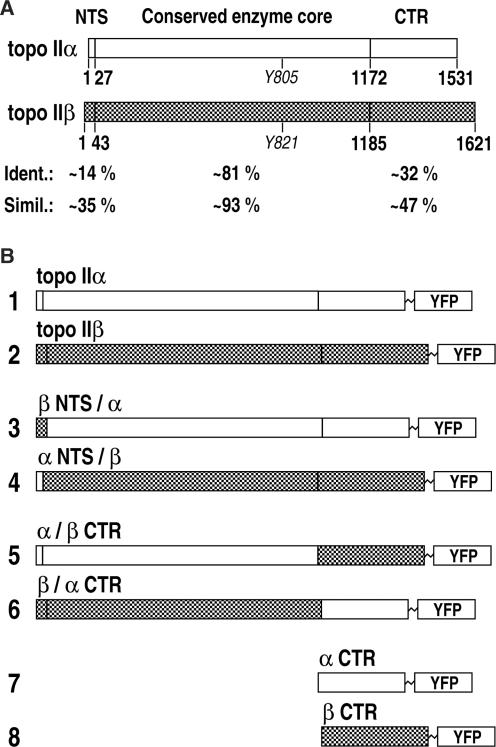
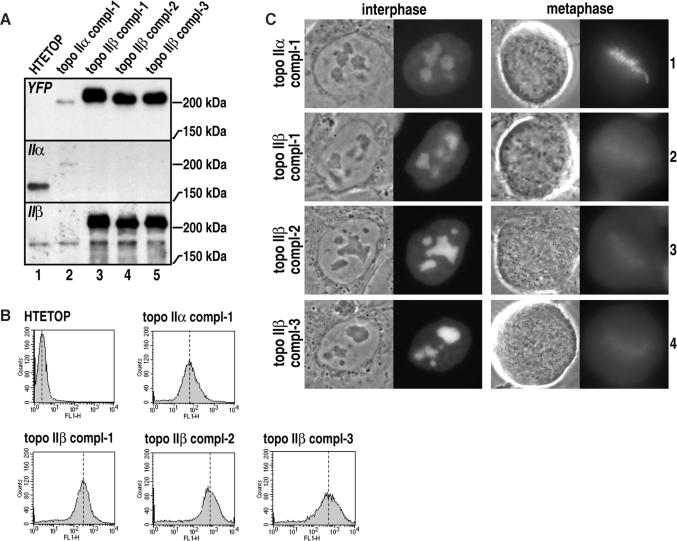
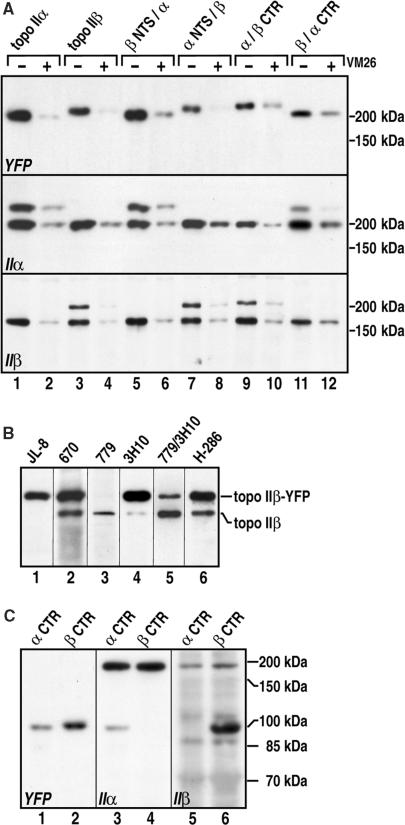
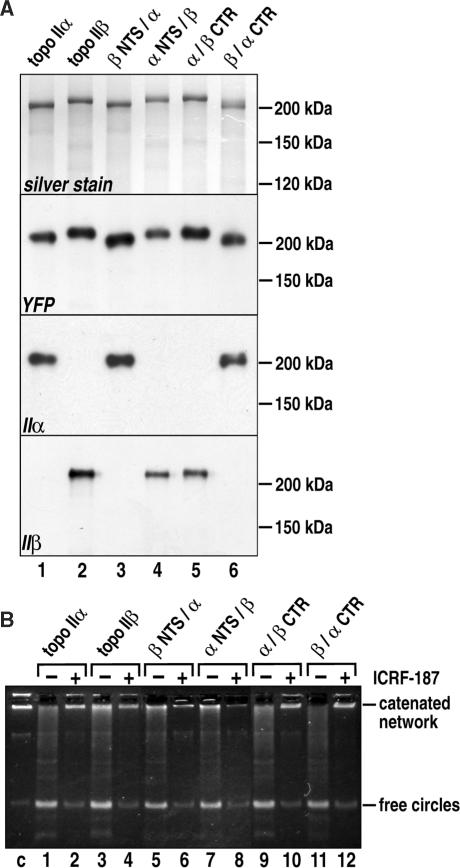
Topoisomerase II removes supercoils and catenanes generated during DNA metabolic processes such as transcription and replication. Vertebrate cells express two genetically distinct isoforms (alpha and beta) with similar structures and biochemical activities but different biological roles. Topoisomerase IIalpha is essential for cell proliferation, whereas topoisomerase IIbeta is required only for aspects of nerve growth and brain development. To identify the structural features responsible for these differences, we exchanged the divergent C-terminal regions (CTRs) of the two human isoforms (alpha 1173-1531 and beta 1186-1621) and tested the resulting hybrids for complementation of a conditional topoisomerase IIalpha knockout in human cells. Proliferation was fully supported by all enzymes bearing the alpha CTR. The alpha CTR also promoted chromosome binding of both enzyme cores, and was by itself chromosome-bound, suggesting a role in enzyme targeting during mitosis. In contrast, enzymes bearing the beta CTR supported proliferation only rarely and when expressed at unusually high levels. A similar analysis of the divergent N-terminal regions (alpha 1-27 and beta 1-43) revealed no role in isoform-specific functions. Our results show that it is the CTRs of human topoisomerase II that determine their isoform-specific functions in proliferating cells. They also indicate persistence of some functional redundancy between the two isoforms.
拓扑异构酶II可消除DNA代谢过程(如转录和复制)中产生的超螺旋和连环体。脊椎动物细胞表达两种基因上不同的同工型(α和β),它们具有相似的结构和生化活性,但生物学作用不同。拓扑异构酶IIα对细胞增殖至关重要,而拓扑异构酶IIβ仅在神经生长和大脑发育方面是必需的。为了确定造成这些差异的结构特征,我们交换了两种人类同工型(α 1173 - 1531和β 1186 - 1621)的不同C末端区域(CTR),并测试了所得杂种对人类细胞中条件性拓扑异构酶IIα敲除的互补作用。所有带有α CTR的酶都能完全支持细胞增殖。α CTR还促进了两种酶核心与染色体的结合,并且其自身与染色体结合,这表明在有丝分裂期间它在酶靶向中发挥作用。相比之下,带有β CTR的酶很少支持细胞增殖,并且只有在异常高水平表达时才支持。对不同的N末端区域(α 1 - 27和β 1 - 43)进行的类似分析表明,它们在同工型特异性功能中没有作用。我们的结果表明,正是人类拓扑异构酶II的CTR决定了它们在增殖细胞中的同工型特异性功能。它们还表明两种同工型之间存在一些功能冗余。