Pennington Jeanine M, Rosenberg Susan M
Interdepartmental Program in Cell and Molecular Biology and Department of Molecular and Human Genetics, Houston, Texas 77030-3411, USA.
Nat Genet. 2007 Jun;39(6):797-802. doi: 10.1038/ng2051. Epub 2007 May 27.
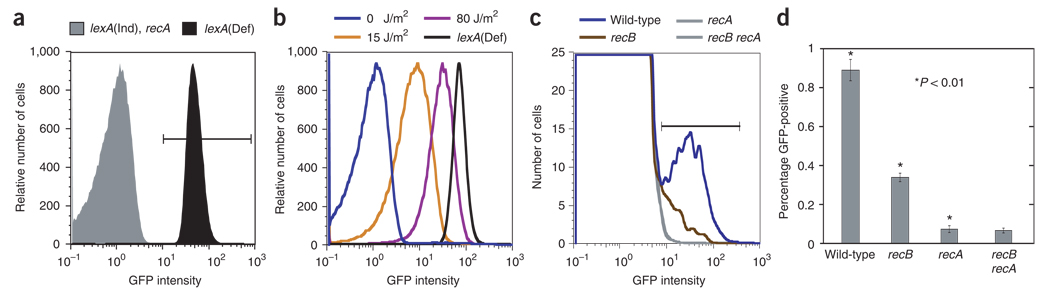
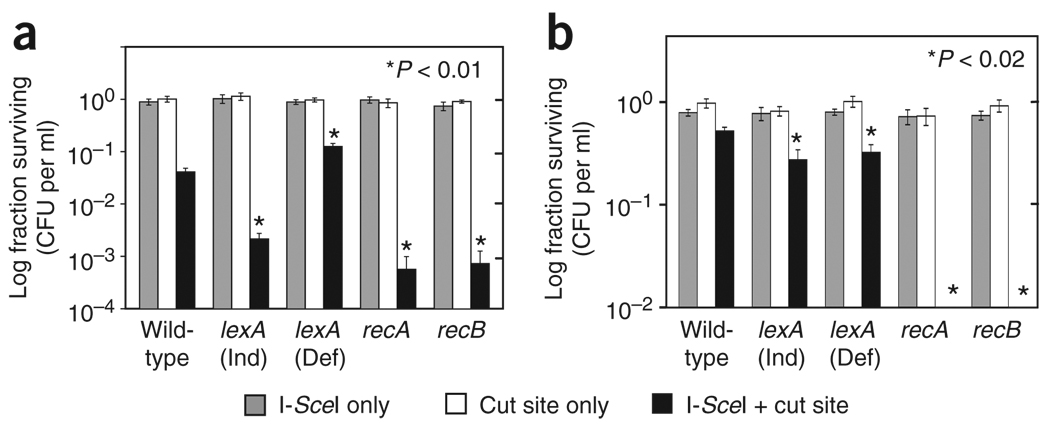
Spontaneous DNA breakage is predicted to be a frequent, inevitable consequence of DNA replication and is thought to underlie much of the genomic change that fuels cancer and evolution. Despite its importance, there has been little direct measurement of the amounts, types, sources and fates of spontaneous DNA lesions in living cells. We present a direct, sensitive flow cytometric assay in single living Escherichia coli cells for DNA lesions capable of inducing the SOS DNA damage response, and we report its use in quantification of spontaneous DNA double-strand breaks (DSBs). We report efficient detection of single chromosomal DSBs and rates of spontaneous breakage approximately 20- to 100-fold lower than predicted. In addition, we implicate DNA replication in the origin of spontaneous DSBs with the finding of fewer spontaneous DSBs in a mutant with altered DNA polymerase III. The data imply that spontaneous DSBs induce genomic changes and instability 20-100 times more potently than previously appreciated. Finally, FACS demonstrated two main cell fates after spontaneous DNA damage: viability with or without resumption of proliferation.
自发DNA断裂预计是DNA复制频繁且不可避免的结果,并且被认为是推动癌症和进化的许多基因组变化的基础。尽管其很重要,但对于活细胞中自发DNA损伤的数量、类型、来源和归宿,几乎没有直接测量。我们提出了一种针对能够诱导SOS DNA损伤反应的DNA损伤的直接、灵敏的流式细胞术检测方法,用于单个活大肠杆菌细胞,并报告了其在定量自发DNA双链断裂(DSB)中的应用。我们报告了对单个染色体DSB的有效检测以及自发断裂率比预测值低约20至100倍。此外,我们发现DNA聚合酶III改变的突变体中自发DSB较少,这表明DNA复制与自发DSB的起源有关。数据表明,自发DSB诱导基因组变化和不稳定性的能力比之前认为的要强20至100倍。最后,流式细胞术显示自发DNA损伤后细胞有两种主要命运:恢复增殖或未恢复增殖的存活。