Kassas Bassel, Mourtada Firas, Horton John L, Lane Richard G, Buchholz Thomas A, Strom Eric A
Radiation Oncology Department, Greater Baltimore Medical Center, Baltimore, Maryland 21204, USA.
J Appl Clin Med Phys. 2006 Aug 24;7(3):28-34. doi: 10.1120/jacmp.v7i3.2293.
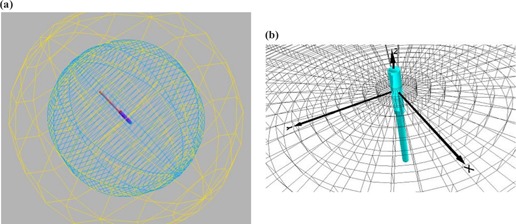
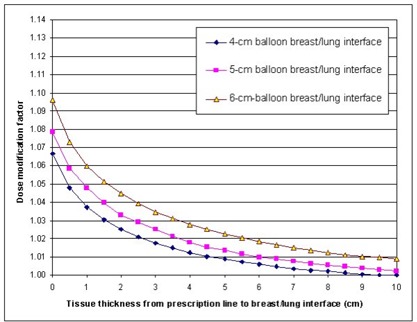
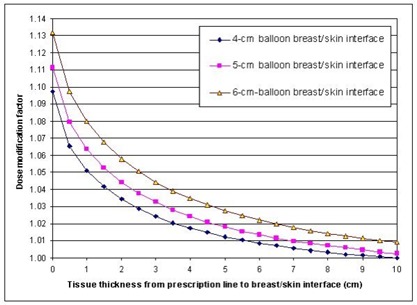
A recently introduced brachytherapy system for partial breast irradiation, MammoSite, consists of a balloon applicator filled with contrast solution and a catheter for insertion of an 192Ir high-dose-rate (HDR) source. In using this system, the treatment dose is typically prescribed to be delivered 1 cm from the balloon's surface. Most treatment-planning systems currently in use for brachytherapy procedures use water-based dosimetry with no correction for heterogeneity. Therefore, these systems assume that full scatter exists regardless of the amount of tissue beyond the prescription line. This assumption might not be a reasonable one, especially when the tissue beyond the prescription line is thin. In such a case, the resulting limited scatter could cause an underdose to be delivered along the prescription line. We used Monte Carlo simulations to investigate how the thickness of the tissue between the surface of the balloon and the skin or lung affected the treatment dose delivery. Calculations were based on a spherical water phantom with a diameter of 30 cm and balloons with diameters of 4 cm, 5 cm, and 6 cm. The dose modification factor is defined as the ratio of the dose rate at the typical prescription distance of 1 cm from the balloon's surface with full scatter obtained using the water phantom to the dose rate with a finite tissue thickness (from 0 cm to 10 cm) beyond the prescription line. The dose modification factor was found to be dependent on the balloon diameter and was 1.098 for the 4-cm balloon and 1.132 for the 6-cm balloon with no tissue beyond the prescription distance at the breast-skin interface. The dose modification factor at the breast-lung interface was 1.067 for the 4-cm balloon and 1.096 for the 6-cm balloon. Even 5 cm of tissue beyond the prescription distance could not result in full scatter. Thus, we found that considering the effect of diminished scatter is important to accurate dosimetry. Not accounting for the dose modification factor may result in delivering a lower dose than is prescribed.
一种最近推出的用于部分乳腺照射的近距离放射治疗系统——MammoSite,由一个充满造影剂的球囊施源器和一根用于插入铱-192高剂量率(HDR)源的导管组成。在使用该系统时,治疗剂量通常规定在距球囊表面1厘米处给予。目前大多数用于近距离放射治疗程序的治疗计划系统采用基于水的剂量测定法,且不对不均匀性进行校正。因此,这些系统假定无论处方线以外的组织量多少,都存在完全散射。这种假设可能不合理,尤其是当处方线以外的组织很薄时。在这种情况下,产生的有限散射可能导致沿处方线给予的剂量不足。我们使用蒙特卡罗模拟来研究球囊表面与皮肤或肺之间的组织厚度如何影响治疗剂量的给予。计算基于直径为30厘米的球形水体模以及直径为4厘米、5厘米和6厘米的球囊。剂量修正因子定义为使用水体模在距球囊表面1厘米的典型处方距离处获得的有完全散射时的剂量率与处方线以外有有限组织厚度(从0厘米到10厘米)时的剂量率之比。发现剂量修正因子取决于球囊直径,在乳腺-皮肤界面处方距离以外无组织时,4厘米球囊的剂量修正因子为1.098,6厘米球囊的为1.132。在乳腺-肺界面,4厘米球囊的剂量修正因子为1.067,6厘米球囊的为1.096。即使处方距离以外有5厘米的组织也不能导致完全散射。因此,我们发现考虑散射减少的影响对于准确的剂量测定很重要。不考虑剂量修正因子可能导致给予的剂量低于规定剂量。