Rajhans Rajib, Nair Sujit, Holden Alan H, Kumar Rakesh, Tekmal Rajeshwar Rao, Vadlamudi Ratna K
Department of Obstetrics and Gynecology and San Antonio Cancer Institute, University of Texas Health Science Center at San Antonio, San Antonio, Texas 78229-3900, USA.
Cancer Res. 2007 Jun 1;67(11):5505-12. doi: 10.1158/0008-5472.CAN-06-3647.
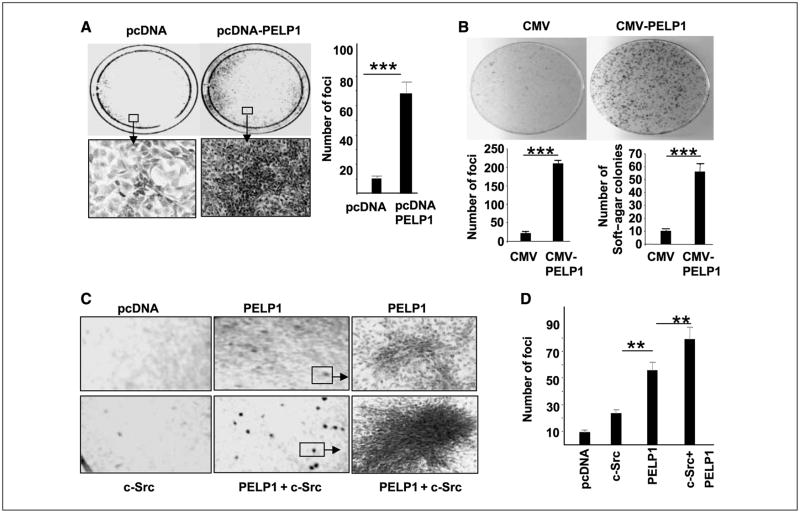
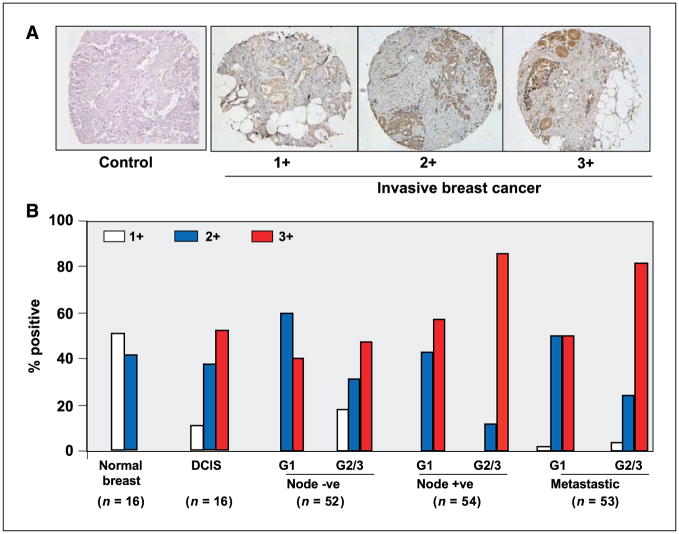
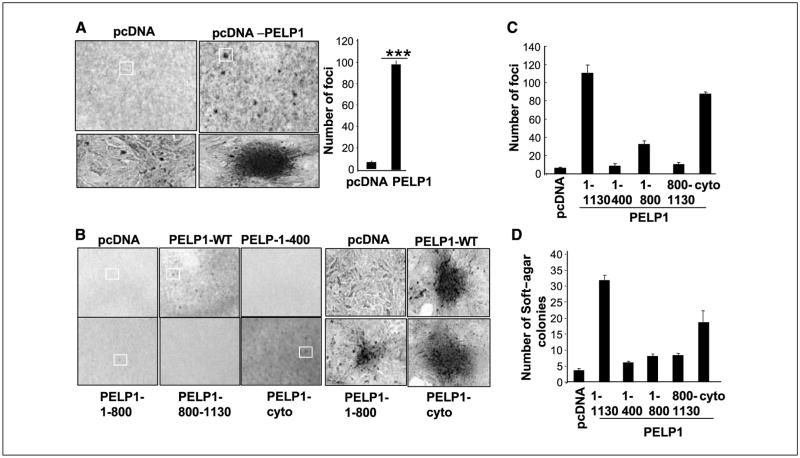
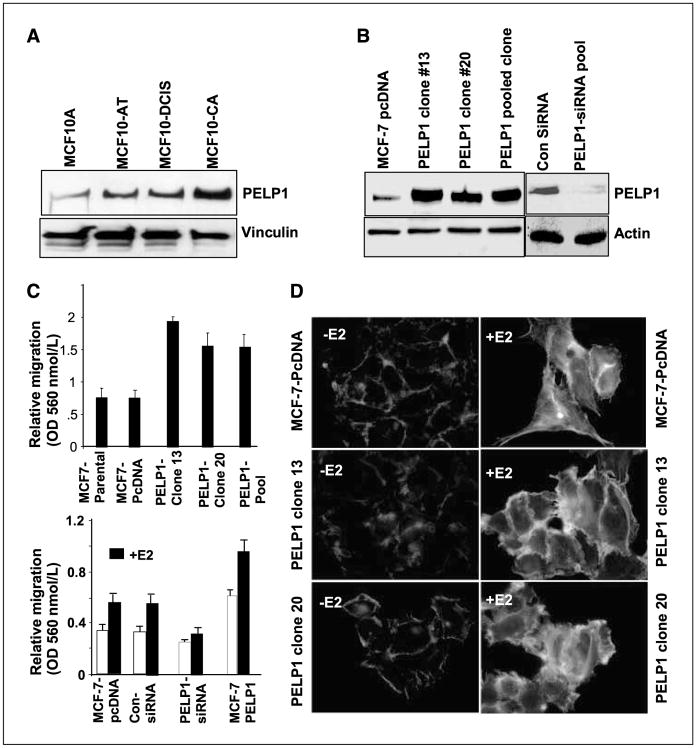
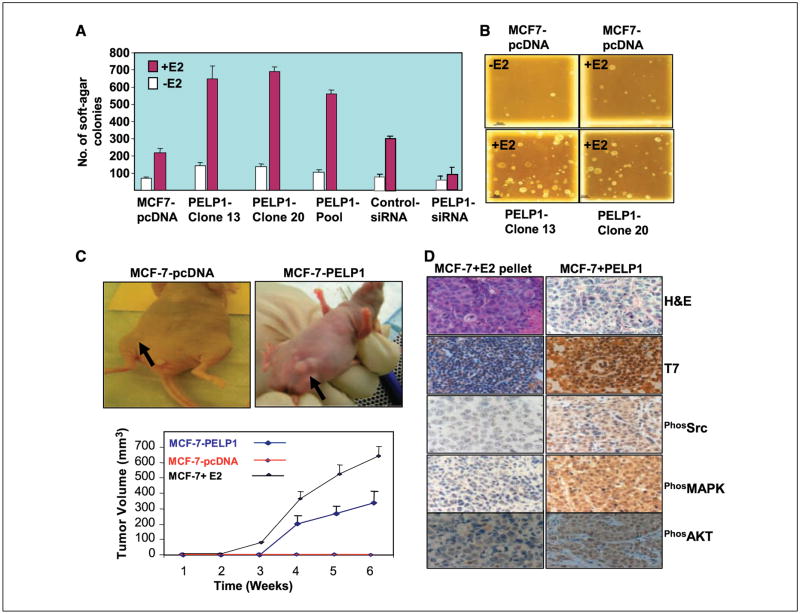
Proline-, glutamic acid-, leucine-rich protein 1 (PELP1), a novel nuclear receptor coactivator, and its expression is deregulated in hormone-dependent cancers, including those of the breast, endometrium, and ovary. PELP1 interacts with estrogen receptor and modulates its genomic and nongenomic functions. In this study, we examined whether PELP1 functions as an oncogene. The overexpression of PELP1 in fibroblasts and epithelial model cells resulted in cellular transformation. PELP1 also enhanced the transformation potential of c-Src kinase in focus formation assays, and PELP1 overexpression potentiated estradiol-mediated cell migratory potential and anchorage-independent growth. Using PELP1-small interfering RNA, we provided evidence that endogenous PELP1 plays an essential role in E2-mediated anchorage-independent growth, cell migration, and cytoskeletal changes. When compared with control vector transfectants, breast cancer cells stably overexpressing PELP1 showed a rapid tumor growth in xenograft studies. Immunohistochemical analysis of PELP1 expression using a tumor progression array of 252 breast carcinomas and normal breast tissue specimens revealed that PELP1 expression is deregulated to a greater degree in higher grade node-positive invasive tumors than in normal breast tissue or ductal carcinoma in situ. Our data suggest that PELP1 is a potential oncogene, that its expression is deregulated during cancer progression, and that PELP1 may play a role in oncogenesis.
富含脯氨酸、谷氨酸和亮氨酸的蛋白1(PELP1)是一种新型核受体共激活因子,其表达在包括乳腺癌、子宫内膜癌和卵巢癌在内的激素依赖性癌症中失调。PELP1与雌激素受体相互作用并调节其基因组和非基因组功能。在本研究中,我们检测了PELP1是否作为一种癌基因发挥作用。PELP1在成纤维细胞和上皮模型细胞中的过表达导致细胞转化。在焦点形成试验中,PELP1还增强了c-Src激酶的转化潜能,并且PELP1过表达增强了雌二醇介导的细胞迁移潜能和非锚定依赖性生长。使用PELP1小干扰RNA,我们提供了证据表明内源性PELP1在E2介导的非锚定依赖性生长、细胞迁移和细胞骨架变化中起重要作用。与对照载体转染细胞相比,稳定过表达PELP1的乳腺癌细胞在异种移植研究中显示出快速的肿瘤生长。使用252例乳腺癌和正常乳腺组织标本的肿瘤进展阵列对PELP1表达进行免疫组织化学分析,结果显示,与正常乳腺组织或原位导管癌相比,PELP1表达在高分级淋巴结阳性浸润性肿瘤中失调程度更大。我们的数据表明,PELP1是一种潜在的癌基因,其表达在癌症进展过程中失调,并且PELP1可能在肿瘤发生中起作用。