Perria Carla, Mandolini Donatella, Guerrera Carmelina, Jefferson Tom, Billi Paolo, Calzini Virgilio, Fiorillo Alfonso, Grasso Giuseppe, Leotta Sergio, Marrocco Walter, Suraci Concetta, Pasquarella Amina
Community Health Unit, Lazio Region Public Health Agency, Rome, Italy.
BMC Health Serv Res. 2007 Jun 4;7:79. doi: 10.1186/1472-6963-7-79.
In Italy many diabetics still lack adequate care in general practice. We assessed the effectiveness of different strategies for the implementation of an evidence-based guideline for the management of non-complicated type 2 diabetes among General Practitioners (GPs) of Lazio region.
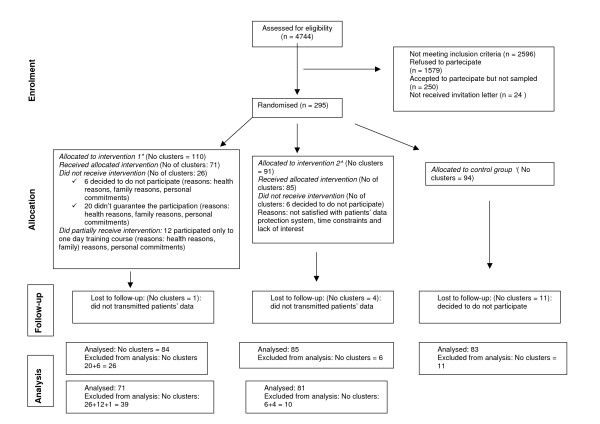
Three-arm cluster-randomised controlled trial with GPs as units of randomisation (clusters). 252 GPs were randomised either to an active strategy (training module with administration of the guideline), or to a passive dissemination (administration of the guideline only), or to usual care (control). Data on prescriptions of tests and drugs were collected by existing information systems, whereas patients' data came from GPs' databases. Process outcomes were measured at the cluster level one year after the intervention. Primary outcomes concerned the measurement of glycosilated haemoglobin and the commissioning of micro- and macrovascular complications assessment tests. In order to assess the physicians' drug prescribing behaviour secondary outcomes were also calculated.
GPs identified 6395 uncomplicated type 2 patients with a high prevalence of cardiovascular risk factors. Data on GPs baseline performance show low proportions of glycosilated haemoglobin assessments. Results of the C-RCT analysis indicate that the active implementation strategy was ineffective relating to all primary outcomes (respectively, OR 1.06 [95% IC: 0.76-1.46]; OR 1.07 [95% IC: 0.80-1.43]; OR 1.4 [95% IC:0.91-2.16]. Similarly, passive dissemination of the guideline showed no effect.
In our region compliance of GPs with guidelines was not enhanced by a structured learning programme. Implementation through organizational measures appears to be essential to induce behavioural changes.
ISRCTN80116232.
在意大利,许多糖尿病患者在全科医疗中仍未得到充分治疗。我们评估了不同策略在拉齐奥地区全科医生(GP)中实施非复杂性2型糖尿病循证管理指南的有效性。
以GP为随机分组单位(群组)的三臂整群随机对照试验。252名GP被随机分配至积极策略组(接受指南培训模块)、被动传播组(仅接受指南)或常规治疗组(对照组)。通过现有信息系统收集检查和药物处方数据,而患者数据来自GP数据库。干预一年后在群组层面测量过程结局。主要结局涉及糖化血红蛋白的测量以及微血管和大血管并发症评估检查的开展。为评估医生的药物处方行为,还计算了次要结局。
GP识别出6395例非复杂性2型患者,心血管危险因素患病率较高。GP基线表现数据显示糖化血红蛋白评估比例较低。整群随机对照试验分析结果表明,积极实施策略在所有主要结局方面均无效(分别为:比值比1.06 [95%置信区间:0.76 - 1.46];比值比1.07 [95%置信区间:0.80 - 1.43];比值比1.4 [95%置信区间:0.91 - 2.16])。同样,指南的被动传播也未显示出效果。
在我们地区,结构化学习计划并未提高GP对指南的依从性。通过组织措施实施似乎对于促使行为改变至关重要。
ISRCTN80116232