Tchanturia Kate, Davies Helen, Campbell Iain C
Section of Eating Disorders, Institute of Psychiatry, King's College London, London, SE5 8AF, UK.
Ann Gen Psychiatry. 2007 Jun 5;6:14. doi: 10.1186/1744-859X-6-14.
Anorexia nervosa (AN) is a severe mental illness. Drug treatments are not effective and there is no established first choice psychological treatment for adults with AN. Neuropsychological studies have shown that patients with AN have difficulties in cognitive flexibility: these laboratory based findings have been used to develop a clinical intervention based on Cognitive Remediation Therapy (CRT) which aims to use cognitive exercises to strengthen thinking skills.
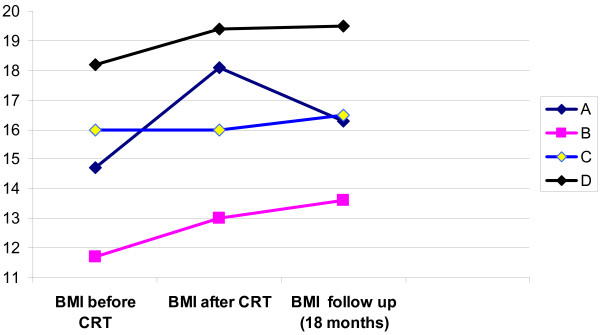
Intervention was comprised of ten 45 minute sessions of CRT. Four patients with AN were assessed before and after the ten sessions using five set shifting tests and clinical assessments. At the end, each patient wrote a letter providing feedback on the intervention.
Post intervention, three of the five set shifting assessments showed a moderate to large effect size in performance and two showed a large effect size in performance, both indicative of improved flexibility. Patients were aware of an improvement in their cognitive flexibility qualitative feedback was generally positive towards CRT.
This preliminary study suggests that CRT changed performance on flexibility tasks and may be beneficial for acute, treatment resistant patients with AN. Feedback gathered from this small case series has enabled modification of the intervention for a future larger study, for example, by linking exercises with real life behavioural tasks and including exercises that encourage global thinking.
This exploratory study has produced encouraging data supporting the use of CRT in patients with AN: it has also provided insight into how the module should be tailored to maximise its effectiveness for people with acute AN.
神经性厌食症(AN)是一种严重的精神疾病。药物治疗无效,且对于成年神经性厌食症患者尚无既定的首选心理治疗方法。神经心理学研究表明,神经性厌食症患者在认知灵活性方面存在困难:这些基于实验室的研究结果已被用于开发一种基于认知康复疗法(CRT)的临床干预措施,该措施旨在通过认知练习来增强思维能力。
1)对神经性厌食症患者进行认知康复疗法的初步调查;2)探讨认知训练是否能提高任务转换能力;3)探讨认知康复疗法练习对神经性厌食症患者是否合适且可接受;4)利用这些数据改进针对神经性厌食症患者的认知康复疗法模块。
干预包括十次每次45分钟的认知康复疗法课程。四名神经性厌食症患者在十次课程前后使用五项任务转换测试和临床评估进行评估。最后,每位患者写一封信,提供对干预措施的反馈。
干预后,五项任务转换评估中的三项显示出表现上中等至较大的效应量,两项显示出表现上较大的效应量,均表明灵活性有所提高。患者意识到自己的认知灵活性有所改善,定性反馈总体上对认知康复疗法持积极态度。
这项初步研究表明,认知康复疗法改变了灵活性任务的表现,可能对急性、难治性神经性厌食症患者有益。从这个小病例系列收集的反馈使得能够为未来更大规模的研究修改干预措施,例如,通过将练习与现实生活行为任务联系起来,并纳入鼓励整体思维的练习。
这项探索性研究产生了令人鼓舞的数据,支持在神经性厌食症患者中使用认知康复疗法:它还提供了关于如何调整该模块以使其对急性神经性厌食症患者的有效性最大化的见解。