Marciniak R A, Sharp P A
Center for Cancer Research, Massachusetts Institute of Technology, Cambridge 02139.
EMBO J. 1991 Dec;10(13):4189-96. doi: 10.1002/j.1460-2075.1991.tb04997.x.
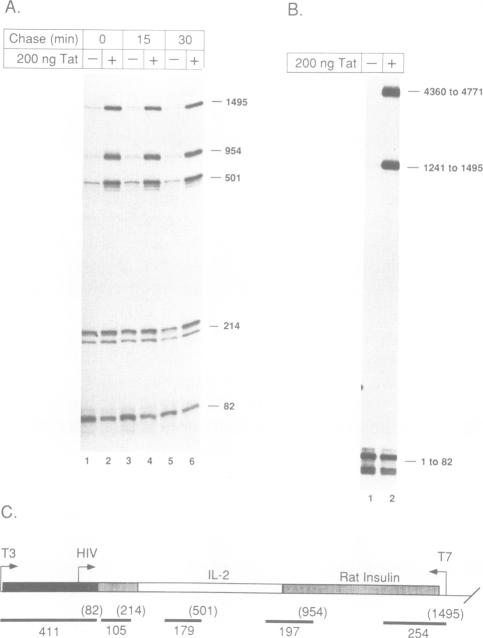
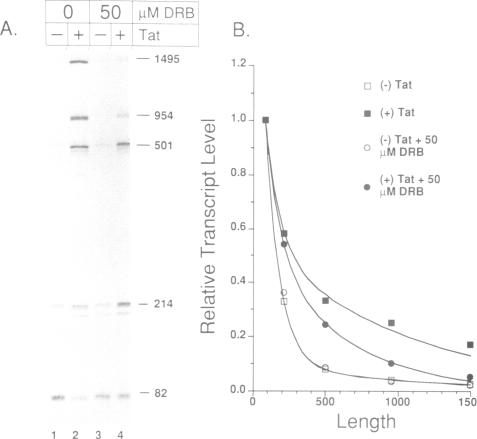
The Tat protein of HIV-1 trans-activates transcription in vitro in a cell-free extract of HeLa nuclei. Quantitative analysis of the efficiency of elongation revealed that a majority of the elongation complexes generated by the HIV-1 promoter were not highly processive and terminated within the first 500 nucleotides. Tat trans-activation of transcription from the HIV-1 promoter resulted from an increase in processive character of the elongation complexes. More specifically, the analysis suggests that there exist two classes of elongation complexes initiating from the HIV promoter: a less-processive form and a more-processive form. Addition of purified Tat protein was found to increase the abundance of the more-processive class of elongation complex. The purine nucleoside analog, 5,6-dichloro-1-beta-D-ribofuranosylbenzimidazole (DRB) inhibits transcription in this reaction by decreasing the efficiency of elongation. Surprisingly, stimulation of transcription elongation by Tat was preferentially inhibited by the addition of DRB.
HIV-1的Tat蛋白在体外能在HeLa细胞核的无细胞提取物中反式激活转录。对延伸效率的定量分析表明,由HIV-1启动子产生的大多数延伸复合物并非高度持续延伸,而是在最初的500个核苷酸内终止。HIV-1启动子转录的Tat反式激活是由于延伸复合物持续延伸特性的增加。更具体地说,分析表明存在两类从HIV启动子起始的延伸复合物:一种是持续延伸性较差的形式,另一种是持续延伸性较强的形式。发现添加纯化的Tat蛋白会增加持续延伸性较强的延伸复合物的丰度。嘌呤核苷类似物5,6-二氯-1-β-D-呋喃核糖基苯并咪唑(DRB)通过降低延伸效率来抑制该反应中的转录。令人惊讶的是,添加DRB会优先抑制Tat对转录延伸的刺激作用。