Whittle Carrie-Ann, Malik Meghna R, Krochko Joan E
Plant Biotechnology Institute, National Research Council of Canada, Saskatoon, SK, Canada.
BMC Genomics. 2007 Jun 13;8:169. doi: 10.1186/1471-2164-8-169.
Currently, there is little data available regarding the role of gender-specific gene expression on synonymous codon usage (translational selection) in most organisms, and particularly plants. Using gender-specific EST libraries (with > 4000 ESTs) from Zea mays and Triticum aestivum, we assessed whether gender-specific gene expression per se and gender-specific gene expression level are associated with selection on codon usage.
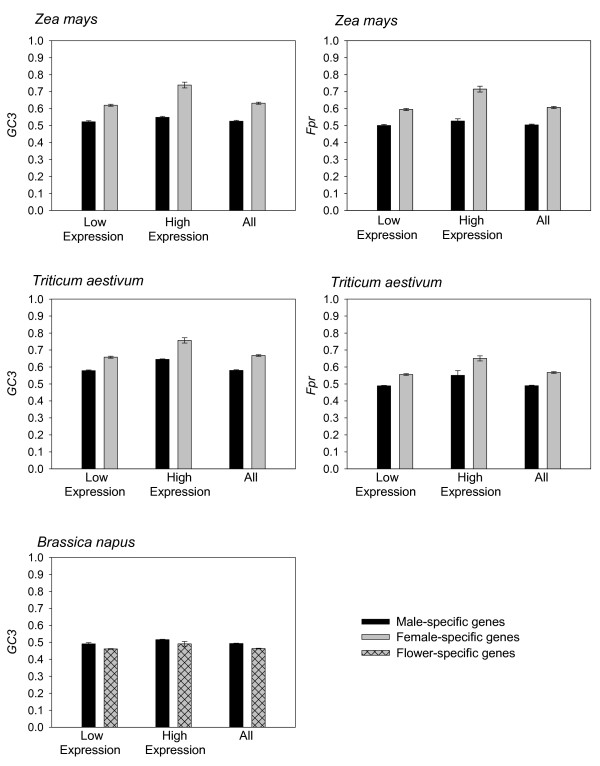
We found clear evidence of a greater bias in codon usage for genes expressed in female than in male organs and gametes, based on the variation in GC content at third codon positions and the frequency of species-preferred codons. This finding holds true for both highly and for lowly expressed genes. In addition, we found that highly expressed genes have greater codon bias than lowly expressed genes for both female- and male-specific genes. Moreover, in both species, genes with female-specific expression show a greater usage of species-specific preferred codons for each of the 18 amino acids having synonymous codons. A supplemental analysis of Brassica napus suggests that bias in codon usage could also be higher in genes expressed in male gametophytic tissues than in heterogeneous (flower) tissues.
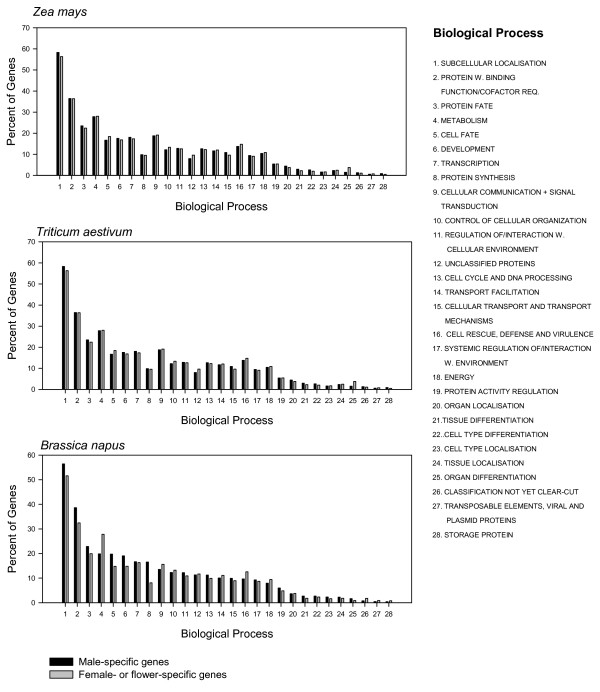
This study reports gender-specific bias in codon usage in plants. The findings reported here, based on the analysis of 1,497,876 codons, are not caused either by differences in the biological functions of the genes or by differences in protein lengths, nor are they likely attributable to mutational bias. The data are best explained by gender-specific translational selection. Plausible explanations for these findings and the relevance to these and other organisms are discussed.
目前,关于大多数生物,特别是植物中性别特异性基因表达在同义密码子使用(翻译选择)方面的作用,可用数据很少。我们利用来自玉米和普通小麦的性别特异性EST文库(包含超过4000条EST),评估了性别特异性基因表达本身以及性别特异性基因表达水平是否与密码子使用选择相关。
基于第三密码子位置的GC含量变化和物种偏好密码子的频率,我们发现了明确的证据,表明在雌性器官和配子中表达的基因比在雄性器官和配子中表达的基因在密码子使用上存在更大的偏差。这一发现对于高表达基因和低表达基因均成立。此外,我们发现对于雌性和雄性特异性基因,高表达基因比低表达基因具有更大的密码子偏好性。而且,在这两个物种中,具有雌性特异性表达的基因对于具有同义密码子的18种氨基酸中的每一种,都更多地使用物种特异性偏好密码子。对甘蓝型油菜的补充分析表明,在雄配子体组织中表达的基因比在异质(花)组织中表达的基因在密码子使用上的偏差可能也更高。
本研究报道了植物中密码子使用的性别特异性偏差。基于对1,497,876个密码子的分析,此处报道的结果既不是由基因生物学功能的差异引起的,也不是由蛋白质长度的差异引起的,也不太可能归因于突变偏差。这些数据最好用性别特异性翻译选择来解释。我们讨论了这些发现的合理原因以及它们与这些生物和其他生物的相关性。