Gillespie Suzanne M, Friedman Susan M
Division of Geriatrics/Aging, University of Rochester School of Medicine and Dentistry, Monroe Community Hospital, Rochester, NY, USA.
J Am Med Dir Assoc. 2007 Jun;8(5):307-13. doi: 10.1016/j.jamda.2007.04.006.
To measure the prevalence of fear of falling in older adults at the time of long- term care (LTC) enrollment and identify potentially treatable risk factors for low fall related self-efficacy.
Prospective cohort study.
Three LTC programs in Upstate New York.
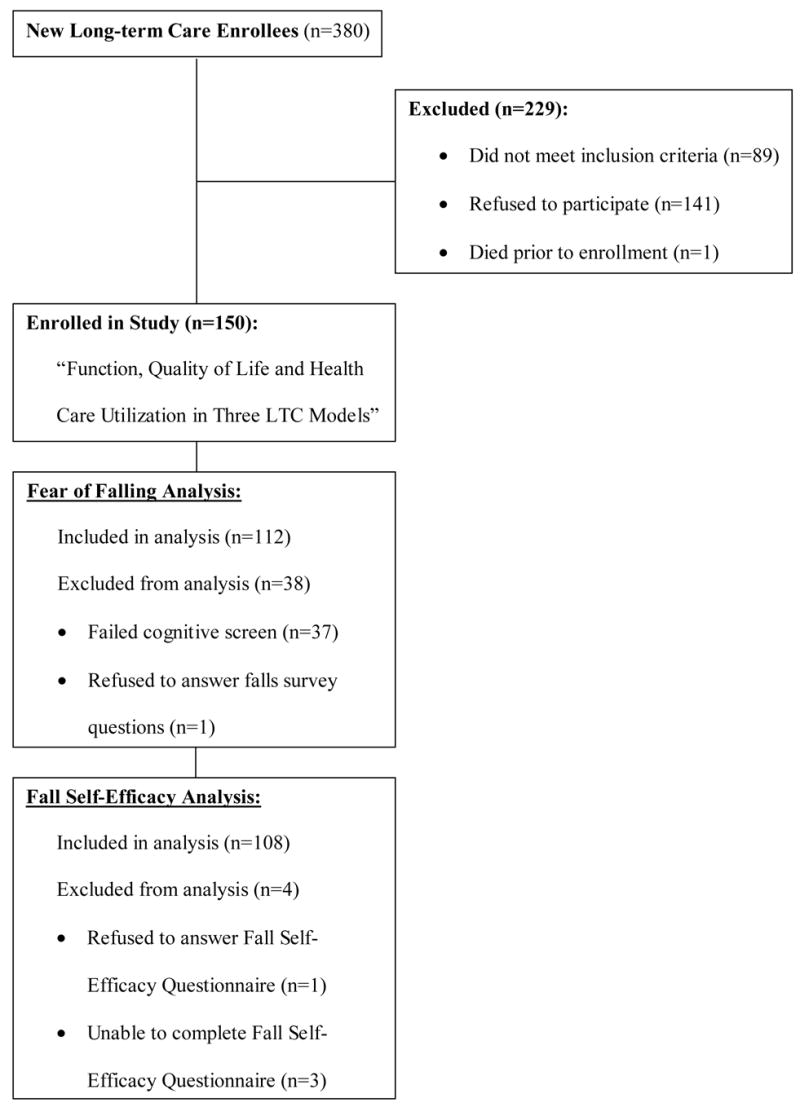
112 new enrollees in LTC, aged 55 or older, who passed a cognitive screen.
Self-reported falls, the falls efficacy scale (FES), medical conditions, the short geriatric depression scale, and physical performance measures (Berg balance scale, hip flexor, knee extensor and grip strength, gait speed and a six-minute walk).
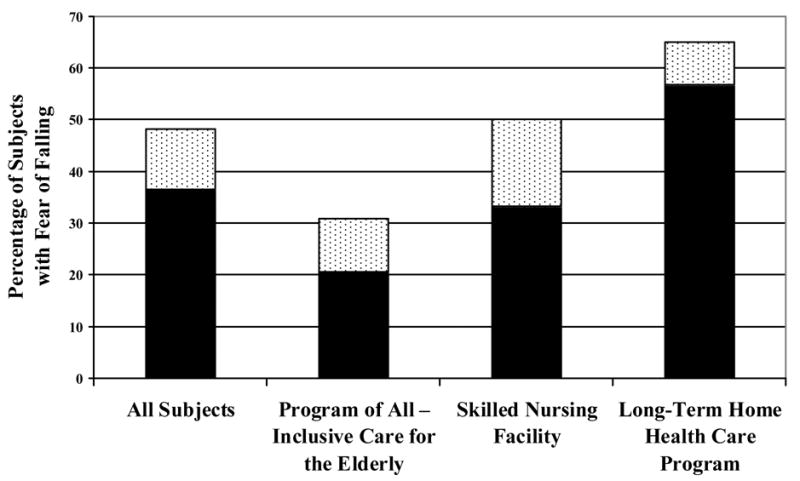
Of the 54 subjects (48.2%) who reported fear of falling, 41 (75.9%) reported activity modification secondary to fear. Fearful subjects were more likely to be female (P = .003), report low back pain (P = .030) and lower extremity arthritis (P = .037). Fearful subjects were weaker at the hip (P < .001) and knee (P = .001), and had shorter six-minute walk distances. Subjects with better FES scores had better Berg scores (P < .001), had greater hip and knee strength, had faster gait speeds and walked further in six minutes (P < .001, P = .006, P = .001 and P = .001 respectively). Subjects with low FES scores and fearful subjects were more likely to have depressive symptoms (P = .003, P = .044, respectively).
Falls and fear of falling are more common in new LTC enrollees than in previously described community dwelling and SNF cohorts. Attention to associated characteristics like depression, arthritis, low back pain and lower extremity weakness may identify opportunities to reduce fear and improve patient safety during this transitional period.
测量长期护理(LTC)登记时老年人跌倒恐惧的患病率,并确定与跌倒相关的自我效能低下的潜在可治疗风险因素。
前瞻性队列研究。
纽约州北部的三个LTC项目。
112名年龄在55岁及以上、通过认知筛查的LTC新登记者。
自我报告的跌倒情况、跌倒效能量表(FES)、医疗状况、简短老年抑郁量表以及身体性能指标(伯格平衡量表、髋屈肌、膝伸肌和握力、步态速度和六分钟步行距离)。
在报告有跌倒恐惧的54名受试者(48.2%)中,41名(75.9%)报告因恐惧而改变了活动。有恐惧心理的受试者更可能为女性(P = 0.003),报告有腰痛(P = 0.030)和下肢关节炎(P = 0.037)。有恐惧心理的受试者髋部(P < 0.001)和膝部(P = 0.001)力量较弱,六分钟步行距离较短。FES得分较高的受试者伯格得分较好(P < 0.001),髋部和膝部力量更大,步态速度更快,六分钟内步行距离更远(分别为P < 0.001、P = 0.006、P = 0.001和P = 0.001)。FES得分较低的受试者和有恐惧心理的受试者更可能有抑郁症状(分别为P = 0.003、P = 0.044)。
与之前描述的社区居住者和熟练护理机构队列相比,跌倒和跌倒恐惧在LTC新登记者中更为常见。关注抑郁、关节炎、腰痛和下肢无力等相关特征,可能有助于发现减少恐惧并改善这一过渡时期患者安全的机会。