Koehler Melissa, Rabinowitz Terry, Hirdes John, Stones Michael, Carpenter G Iain, Fries Brant E, Morris John N, Jones Richard N
New Hanover Regional Medical Center, 2131 S 17th Street, Wilmington, NC 28401, USA.
BMC Geriatr. 2005 Jan 1;5:1. doi: 10.1186/1471-2318-5-1.
The objective of this study was to examine the Minimum Data Set (MDS) and Geriatric Depression Scale (GDS) as measures of depression among nursing home residents.
The data for this study were baseline, pre-intervention assessment data from a research study involving nine nursing homes and 704 residents in Massachusetts. Trained research nurses assessed residents using the MDS and the GDS 15-item version. Demographic, psychiatric, and cognitive data were obtained using the MDS. Level of depression was operationalized as: (1) a sum of the MDS Depression items; (2) the MDS Depression Rating Scale; (3) the 15-item GDS; and (4) the five-item GDS. We compared missing data, floor effects, means, internal consistency reliability, scale score correlation, and ability to identify residents with conspicuous depression (chart diagnosis or use of antidepressant) across cognitive impairment strata.
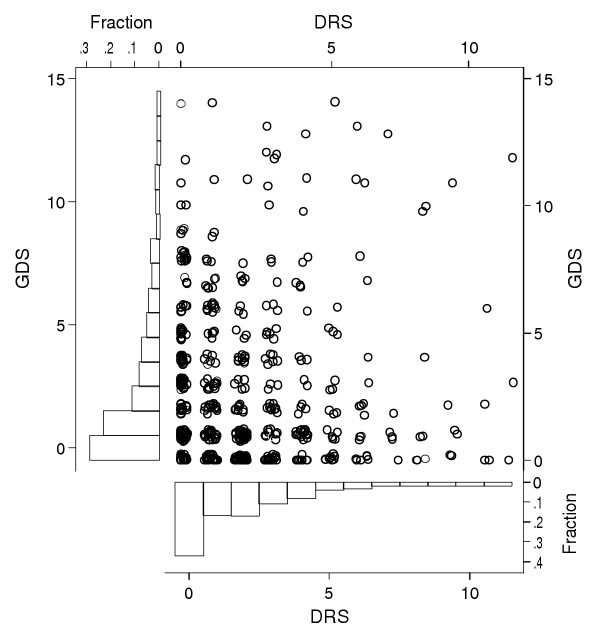
The GDS and MDS Depression scales were uncorrelated. Nevertheless, both MDS and GDS measures demonstrated adequate internal consistency reliability. The MDS suggested greater depression among those with cognitive impairment, whereas the GDS suggested a more severe depression among those with better cognitive functioning. The GDS was limited by missing data; the DRS by a larger floor effect. The DRS was more strongly correlated with conspicuous depression, but only among those with cognitive impairment.
The MDS Depression items and GDS identify different elements of depression. This may be due to differences in the manifest symptom content and/or the self-report nature of the GDS versus the observer-rated MDS. Our findings suggest that the GDS and the MDS are not interchangeable measures of depression.
本研究的目的是检验最小数据集(MDS)和老年抑郁量表(GDS)作为疗养院居民抑郁测量工具的情况。
本研究的数据来自一项涉及马萨诸塞州九家疗养院和704名居民的研究的基线、干预前评估数据。经过培训的研究护士使用MDS和15项版本的GDS对居民进行评估。使用MDS获取人口统计学、精神病学和认知数据。抑郁水平的操作定义为:(1)MDS抑郁项目的总和;(2)MDS抑郁评定量表;(3)15项GDS;以及(4)5项GDS。我们比较了认知障碍各层之间的缺失数据、地板效应、均值、内部一致性信度、量表分数相关性以及识别明显抑郁居民(病历诊断或使用抗抑郁药)的能力。
GDS和MDS抑郁量表不相关。然而,MDS和GDS测量均显示出足够的内部一致性信度。MDS表明认知障碍者中抑郁程度更高,而GDS表明认知功能较好者中抑郁更严重。GDS受缺失数据的限制;抑郁评定量表受更大的地板效应影响。抑郁评定量表与明显抑郁的相关性更强,但仅在认知障碍者中如此。
MDS抑郁项目和GDS识别出抑郁的不同要素。这可能是由于明显症状内容的差异和/或GDS的自我报告性质与观察者评定的MDS之间的差异。我们的研究结果表明,GDS和MDS不是可互换的抑郁测量工具。