DeFrank Jessica T, Bowling J Michael, Rimer Barbara K, Gierisch Jennifer M, Skinner Celette Sugg
Lineberger Comprehensive Cancer Center, The University of North Carolina at Chapel Hill, Campus Box #7295, Chapel Hill, NC 27599-7295, USA.
Prev Chronic Dis. 2007 Jul;4(3):A60. Epub 2007 Jun 15.
In 1994, the U.S. Department of Health and Human Services mandated sufficient inclusion of racial and ethnic minorities in all federally funded research. This mandate requires researchers to monitor study samples for research participation and differential survey nonresponse. This study illustrates methods to assess differential survey nonresponse when population race data are incomplete, which is often the case when studies are conducted among members of health plans.
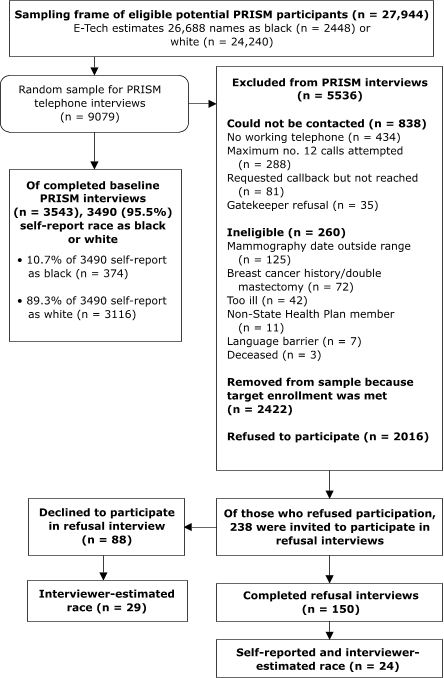
We collected data as part of the PRISM (Personally Relevant Information about Screening Mammography) study, a trial funded by the National Institutes of Health to increase rates of annual mammography adherence. We used two methods to estimate racial distribution of the PRISM study population. The first method, called E-Tech, estimated race of the sample frame by using individuals' names and zip codes. In the second method, we conducted interviews with a subsample of PRISM study refusals. We validated both estimation methods through comparisons with self-reported race. We used race information generated by E-Tech, interviewer estimates, and self-report to assess differential nonresponse in the PRISM study.
The E-Tech method had moderate sensitivity (48%) in estimating race of black participants but higher specificity (97%) and positive predictive value (71%). The interviewer-estimation method had high sensitivity (100%), high specificity (95%), and moderate positive predictive value (80%). Black women were less likely than white women to be reached for study participation.
There was slight differential nonresponse by race in the PRISM study. Techniques described here may be useful for assessing differential nonresponse in samples with incomplete data on race.
1994年,美国卫生与公众服务部规定,所有由联邦政府资助的研究都必须充分纳入种族和少数族裔群体。这项规定要求研究人员监测研究样本的参与情况以及不同的调查无应答情况。本研究阐述了在人口种族数据不完整时评估不同调查无应答情况的方法,在健康计划成员中开展研究时,这种情况经常出现。
我们收集了作为PRISM(关于乳腺钼靶筛查的个人相关信息)研究一部分的数据,该研究由美国国立卫生研究院资助,旨在提高年度乳腺钼靶检查的依从率。我们使用两种方法来估计PRISM研究人群的种族分布。第一种方法称为E-Tech,通过使用个人姓名和邮政编码来估计样本框架的种族。第二种方法是,我们对PRISM研究拒绝者的一个子样本进行访谈。我们通过与自我报告的种族进行比较来验证这两种估计方法。我们使用E-Tech生成的种族信息、访谈者估计值和自我报告来评估PRISM研究中的不同无应答情况。
E-Tech方法在估计黑人参与者的种族方面具有中等敏感性(48%),但特异性较高(97%)和阳性预测值较高(71%)。访谈者估计方法具有高敏感性(100%)、高特异性(95%)和中等阳性预测值(80%)。黑人女性比白人女性被联系参与研究的可能性更小。
PRISM研究中存在轻微的种族差异无应答情况。这里描述的技术可能有助于评估种族数据不完整的样本中的差异无应答情况。